Free AI Visibility Audit
Find out exactly which competitors are cited instead of you across ChatGPT, Claude, Perplexity, and Gemini, at no cost.
Get your free auditLLMReach publishes original GEO and AEO guides, AI citation research, and operational playbooks. Topics include Generative Engine Optimization, Answer Engine Optimization, AI citation signals, platform-specific strategies for ChatGPT, Claude, Perplexity, and Gemini, schema markup implementation, llms.txt configuration, and GEO case studies. Every article is built on live prompt-testing data from client engagements across 20 industries and the AI platforms LLMReach optimizes for.
GEO AND AEO RESOURCES
The LLMReach resource hub publishes original GEO and AEO guides, AI citation research, and operational playbooks for brands that want to appear in ChatGPT, Claude, Perplexity, and Gemini responses. Every article is built on prompt-testing data, not speculation.
Last updated: June 30, 2026
ALL ARTICLES
The journalists PR teams pitch and the journalists AI engines cite overlap by 2%. What that means for choosing an agency, and how to read the three different earned media statistics you will be quoted.
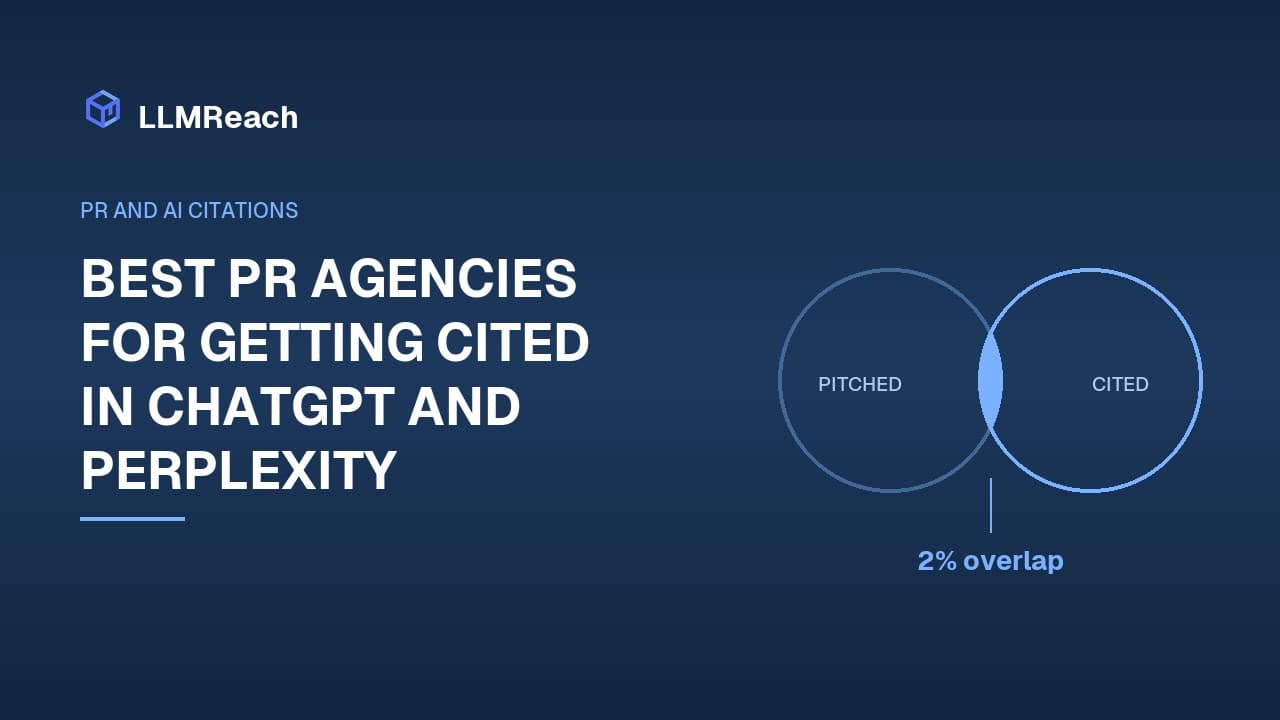
Most agencies added GEO to a service page without changing what they do. The questions that separate the ones measuring citations from the ones measuring rankings.
Engines do not cite the best-ranked page, they cite the most extractable and corroborated one. What the published research actually establishes about selection and absorption, and which widely repeated numbers do not trace to a source.
Shoppers ask AI engines about ingredients, sweeteners and dietary fit before they ever reach a product page. What it takes for a food and beverage DTC brand to be the answer, and why most agencies are not set up to deliver it.
AI crawler traffic is up sharply and most sites have never taken a position on it. What a crawlability and citation-readiness audit actually checks, which widely quoted numbers do not survive a look at the source, and where the two layers differ.
ChatGPT cites about four sources per answer and roughly half of what it retrieves. The signals that decide which pages make it, what the research actually supports, and where the widely repeated numbers fall apart.
Independent benchmarks put most B2B brands outside the AI conversations that build vendor shortlists. Here is the five-step audit that tells you where you actually stand, and what the numbers can and cannot prove.
The acronyms are confusing and a lot of what gets sold under them does not work. But the scepticism is aimed at the wrong target: the problem is the tactic being sold, not the category.
Engines are not optimising for the best answer, they are optimising for the answer least likely to be wrong. Why your own website is the weakest signal in the stack, and which two of the five signals sit entirely off your domain.
FULL INDEX
TOPIC GUIDES
Each topic cluster below covers one area of GEO or AEO in depth, from the foundational concepts to the specific technical implementations. Use these as your operational reference library.
The complete strategy for getting your brand cited in AI-generated responses, from prompt mapping and content architecture to entity standardization and weekly Share of Voice tracking.
The content engineering discipline at the core of GEO, answer-first paragraph structure, FAQ schema, HowTo schema, and the 40-60 word answer block format that AI engines are built to extract.
The specific content, technical, and authority signals that determine whether ChatGPT, Claude, Perplexity, and Gemini cite your brand, and the ones that are most commonly missing from brand websites.
The technical layer of GEO, llms.txt configuration, robots.txt for AI crawlers, schema markup types (FAQPage, HowTo, Organization, SoftwareApplication), and GA4 AI channel group setup.
Each AI platform uses different citation logic. ChatGPT weights entity authority and Wikipedia presence. Perplexity performs real-time web search. Claude prioritizes factual accuracy and source quality. Gemini rewards traditional search performance. Platform-specific strategy matters, citation volumes differ by up to 615× between platforms.
Real-world GEO and AEO results from LLMReach client engagements, including the NexumAutomations case study and vertical-specific citation growth campaigns.
WHY GEO WORKS
WHAT TO EXPECT
FREQUENTLY ASKED QUESTIONS
GEO, Generative Engine Optimization, is the full strategic discipline of making your brand cited across AI platforms, encompassing content engineering, technical infrastructure, entity authority, and earned media. AEO, Answer Engine Optimization, is the content-layer component of GEO: the specific practice of formatting pages with answer-first paragraphs, FAQ schema, and structured answer blocks so AI engines can extract and cite your content directly. AEO is how you engineer individual pages. GEO is the full program that makes your brand visible across the entire AI search ecosystem.
SEO optimizes for ranking in Google's list of blue links, position, click-through rate, and organic traffic. GEO optimizes for citation in AI-generated answers, appearing as the named source inside a ChatGPT, Claude, Perplexity, or Gemini response. Ranking number one on Google does not guarantee a single AI citation, because AI engines use different citation logic: they prioritize extractable answers, entity clarity, and third-party authority signals over keyword density and backlink volume. GEO does not replace SEO, it extends your visibility strategy to the platforms where your buyers are now searching first. Brands cited in AI Overviews earn 35% more organic clicks than non-cited competitors on the same queries, so GEO investment compounds into traditional SEO performance as well.
AI Share of Voice is your brand's citation rate relative to named competitors, measured as the percentage of AI responses that cite your brand across a defined set of buyer-intent prompts. LLMReach measures it by running 100+ industry-specific prompts across ChatGPT, Claude, Perplexity, and Gemini weekly, recording which brands are cited in each response, and calculating each brand's share of total citations across the full prompt set. It is the GEO equivalent of Google's organic market share, the single metric that shows whether your brand is winning or losing the AI search channel against specific named competitors.
Search-enabled AI platforms may reflect newly available web content differently from systems that blend training data with web search, which tend to update on longer cycles. LLMReach measures the baseline first, then runs the five inputs of the Citation Stack against it, so the effect of the work is visible against your own starting point.
llms.txt is a plain-text file placed at the root of your domain (yourdomain.com/llms.txt) that tells AI crawlers, GPTBot, ClaudeBot, PerplexityBot, which pages on your site are most important, what your organization does, and how your content is structured. It is the GEO equivalent of a sitemap for AI engines: it does not guarantee citation, but it removes friction from the crawl and indexing process. As of 2026, only 10% of websites have deployed an llms.txt file, meaning 90% of brands are not giving AI engines the structured context they need to understand and cite their content accurately.
The schema types with the highest impact on AI citation are FAQPage, HowTo, Organization, and Article, in that order for most brand websites. FAQPage schema makes your Q&A content directly extractable by AI engines as structured answer pairs. HowTo schema signals step-by-step authority for process-based queries. Organization schema establishes your entity identity, name, URL, logo, founding date, contact information, which AI engines use to verify that citations are accurate and current. Article schema with author, datePublished, and dateModified signals recency and credibility. Industry-specific schema types, SoftwareApplication for B2B SaaS, MedicalOrganization for healthcare, InsuranceAgency for insurance, add vertical-specific citation signals on top of the universal baseline.
Yes, the LLMReach blog publishes original GEO and AEO research, case studies, and operational guides weekly. Articles are built on live prompt-testing data from client engagements and cross-platform citation analysis, not recycled SEO advice. Subscribe to the monthly GEO Playbook newsletter to receive the operational blueprints, case study breakdowns, and platform-specific updates we are actively deploying for client engagements, delivered directly to your inbox.
SOURCES AND RESEARCH
EXPLORE LLMREACH
| Service | What's included | Best for |
|---|---|---|
| Free AI Audit | Priority buyer prompts tracked across relevant AI platforms, reviewed with you in a guided meeting | Brands measuring baseline AI visibility |
| AI Visibility Strategy | Prompt mapping, content architecture, weekly SoV tracking | Brands ready to build a GEO program |
| Technical AEO Infrastructure | llms.txt, robots.txt, schema markup, GA4 AI channel group | Brands with technical citation blockers |
| AI Mention Tracking | Ongoing cross-engine monitoring with weekly reports | Brands tracking competitive share of voice |
Find out exactly which competitors are cited instead of you across ChatGPT, Claude, Perplexity, and Gemini, at no cost.
Get your free auditThe four-part GEO system LLMReach deploys for every client: Technical AEO Infrastructure, AI Visibility Strategy and Content Engineering, Reddit Optimization for SEO and AI Citations, and AI Mention Tracking and Optimization.
See the servicesIndustry-specific GEO programs for 20 verticals, from B2B SaaS and cybersecurity to healthcare, insurance, nonprofits, and local business.
Browse all industriesThe Nexum Automations case study shows how LLMReach turns AI search uncertainty into a measurable visibility system.
Read the case studyChatGPT usage, LLM market share, SEO and GEO statistics, each figure sourced, with LLMReach's own measurement of 750 AI answers.
See the statisticsThe complete technical checklist for AI citation readiness: llms.txt, robots.txt, schema markup, GA4 AI channel group, and entity standardization.
See the checklistA practical guide to the systems, sources, and signals that shape AI search answers.
Read the guideREADY TO GET CITED
Every article on this blog describes a strategy LLMReach is actively deploying for clients. The fastest way to apply it to your brand is the free AI audit, 100+ buyer-intent prompts run across ChatGPT, Claude, Perplexity, and Gemini, with a full citation gap report. No sales call required to receive the report.
During a guided review meeting, LLMReach walks you through your priority buyer prompts, current AI visibility, competitor citations, source patterns, and the technical or content gaps that matter most. You leave the call knowing where the gap is, what is causing it, and which changes would matter first.