Best PR Agencies for Getting Cited in ChatGPT and Perplexity
By Karim MezitiSeptember 23, 2026Updated June 2026
Most PR agencies report success in clip counts, reach and impressions. Those numbers measure whether a journalist published the story. They do not measure whether ChatGPT or Perplexity cited it.
That gap is now a commercial problem. When a buyer asks an AI engine which vendor to consider or which agency to hire, the answer is assembled from a pool of sources that traditional PR metrics were never designed to influence. A brand with 200 clips can be absent from AI answers. A brand with twenty well-structured, corroborated placements can be in most of them.
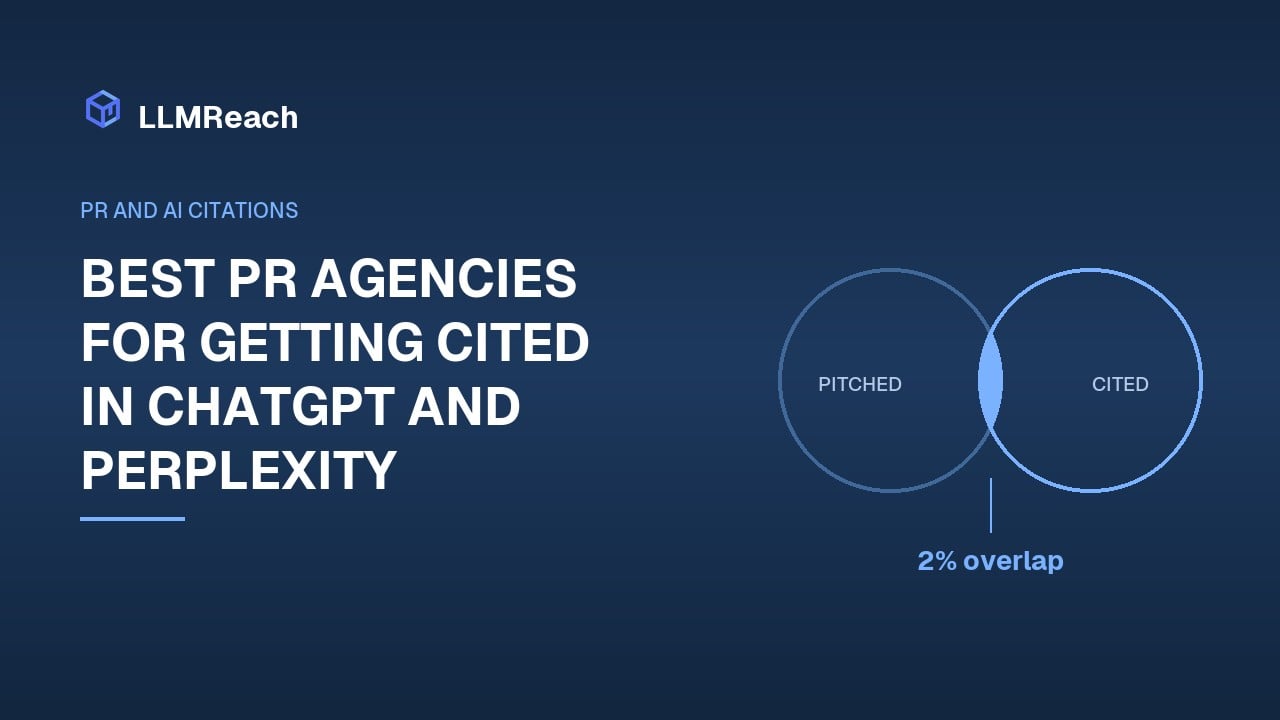
One finding should reset how you brief an agency. Muck Rack, analysing more than a million links cited across ChatGPT, Claude, Gemini and Perplexity, reported that the journalists most frequently pitched by PR professionals and those most frequently cited by AI engines share an average overlap of just 2%.
Read that again. The pitch list and the citation list are almost disjoint. Most PR agencies are working hard on an audience that AI engines are largely not reading.
The number everyone quotes, and what it actually says
You will hear that earned media drives somewhere between 25% and 94% of AI citations, often from the same agency in the same meeting. The range is not sloppiness. It is three different questions with three different answers.
| Figure | What it counts |
|---|---|
| 94% | Non-paid sources of every kind, including Reddit, Wikipedia, review platforms and forums |
| 84% | Earned media under a broad definition that keeps those community and reference sources inside it |
| 25% | Journalism and press coverage specifically, which is the part a PR agency actually pitches |
All three come from the same body of Muck Rack research. The 94% and the 25% appear in the same release: non-paid sources account for roughly 94% of AI-cited links, while journalistic and earned media sources account for nearly 25% of all citations.
Machine Relations went further and reconciled four separate studies, concluding that the effective share of AI citations that PR teams influence is not 84%, not 25%, but closer to 14 to 17% once you subtract citations lost in summarisation.
The question to ask
When an agency quotes one of these numbers, ask which of the three it is. An agency that says "earned media drives 84% of AI citations, so hire us for press" is quoting the broad definition to sell the narrow service. The honest version is that press is one input among several, and the others need owners too.
Why traditional PR does not automatically produce citations
Traditional PR optimises for journalist relationships, editorial calendars and audience reach. Those inputs produce coverage. Citation needs coverage that an engine can reach, parse, trust and lift a passage from.
What survives extraction looks different
Muck Rack compared cited press releases against uncited ones and found the cited ones contain roughly twice as many statistics, 30% more action verbs, 2.5 times as many bullet points, and a 30% higher rate of objective sentences. That comparison is specifically about press releases, so treat it as a signal about format rather than a law about all coverage, but the direction is consistent with everything else in the category: concrete, structured, checkable writing gets extracted, and atmospheric writing does not.
An agency briefing for citation gives journalists named metrics, dates, amounts and answer-shaped quotes, because a quote that only makes sense after two paragraphs of setup cannot be lifted into an answer.
Coverage decays, so a single annual push does not hold
Recency carries real weight. Muck Rack's December 2025 edition found half of all citations coming from articles published within the previous eleven months, and later editions restate the window at around twelve. Visibility built in one campaign erodes unless something keeps replacing it.
One placement is worth less than several
Stacker, working with Scrunch across 87 stories for 30 clients and 2,600 or more prompts on eight AI platforms, reported that distributing a story through earned media produced a 239% median lift in AI citations, with coverage breadth rising from 5.4% to 17.9% at the median. An earlier and much smaller pilot of eight articles had put the lift at 325%, moving citation rate from 8% to 34%.
Worth saying plainly: Stacker sells the distribution service its research measures, and the larger study produced the lower number. Both facts belong next to the figure. The mechanism, corroboration across independent sources, is well supported elsewhere, and the size of the effect is a vendor's own estimate.
Reddit, and how to read the statistic you will be shown
Almost every agency pitching AI citation work will show you the same number: Reddit accounts for 46.7% of Perplexity's citations. It comes from Discovered Labs, and it is worth understanding precisely, because how an agency handles it tells you how it handles evidence generally.
| What is usually said | What the figure is |
|---|---|
| "Reddit is 46.7% of Perplexity citations" | 46.7% is Reddit's share of Perplexity's top ten sources, not of all citations |
| Implied to be most of Perplexity's answers | Reddit's share of total Perplexity citations has been reported near 6.6% |
| Presented as neutral research | Discovered Labs sells Reddit marketing services |
| Presented as current | Reddit sued Perplexity over scraping in October 2025, and Reddit citation volume reportedly shifted afterwards |
None of that makes Reddit unimportant. Community discussion is genuinely one of the strongest corroboration signals available, particularly on recommendation and comparison questions, and it is measurable in your own category rather than in a vendor's slide. What it means is that an agency quoting 46.7% without the qualifier either has not read the source or is counting on you not to.
The work also has to be done honestly to be worth anything. LLMReach does not use fake accounts, automated comments, vote manipulation, undisclosed promotion, or content designed to imitate genuine community discussion. Removed threads cannot be cited, so authenticity is an operational requirement here rather than a value statement.
Five questions that separate citation work from rebranded PR
- Show me citation frequency for a current client, by engine. Live, on the call, against a named prompt. An agency that has built tracking can do this in a minute. A clip report is not the same artefact.
- Which of the three earned media numbers are you quoting? The 94%, the 84% or the 25% from the section above. If they cannot say which, or do not know the three differ, they are repeating a headline.
- What does your prompt set look like? How many prompts, chosen how, across which engines, at what cadence, and agreed with the client before the work starts or after.
- How do you handle run-to-run variance? Engines return different sources on different days for the same question. A credible answer describes repeated runs and a rate, not a screenshot.
- What is measured, and against what baseline? The answer should name a metric, a window and a starting point recorded before the work began. If it names impressions or reach, the agency is measuring publication, not citation.
| What they say | What to check |
|---|---|
| "We track AI mentions" | Whether that is a monitoring alert or a fixed prompt set run on a cadence |
| "We optimise for AI search" | Whether anything in the delivery changed, or only the service page |
| "We have AI-era PR experience" | What they did differently on the last campaign because of it |
| "We measure citation share" | Ask to see the data before accepting the claim |
| "We guarantee AI visibility" | Which metric, which engines, which baseline, and what happens if it is missed |
You cannot improve what you have not measured
Before evaluating any agency, you need to know where you stand: which prompts are live in your category, whether you appear, which competitors are cited instead, and which sources are feeding those answers.
During a guided review meeting, LLMReach walks you through your priority buyer prompts, current AI visibility, competitor citations, source patterns, and the technical or content gaps that matter most. You leave the call knowing where the gap is, what is causing it, and which changes would matter first.
Your audit is reviewed live on the call. It is not emailed as a PDF.
Get your free AI visibility audit before you compare agencies, not after.
LLMReach is built for citation, not adapted to it
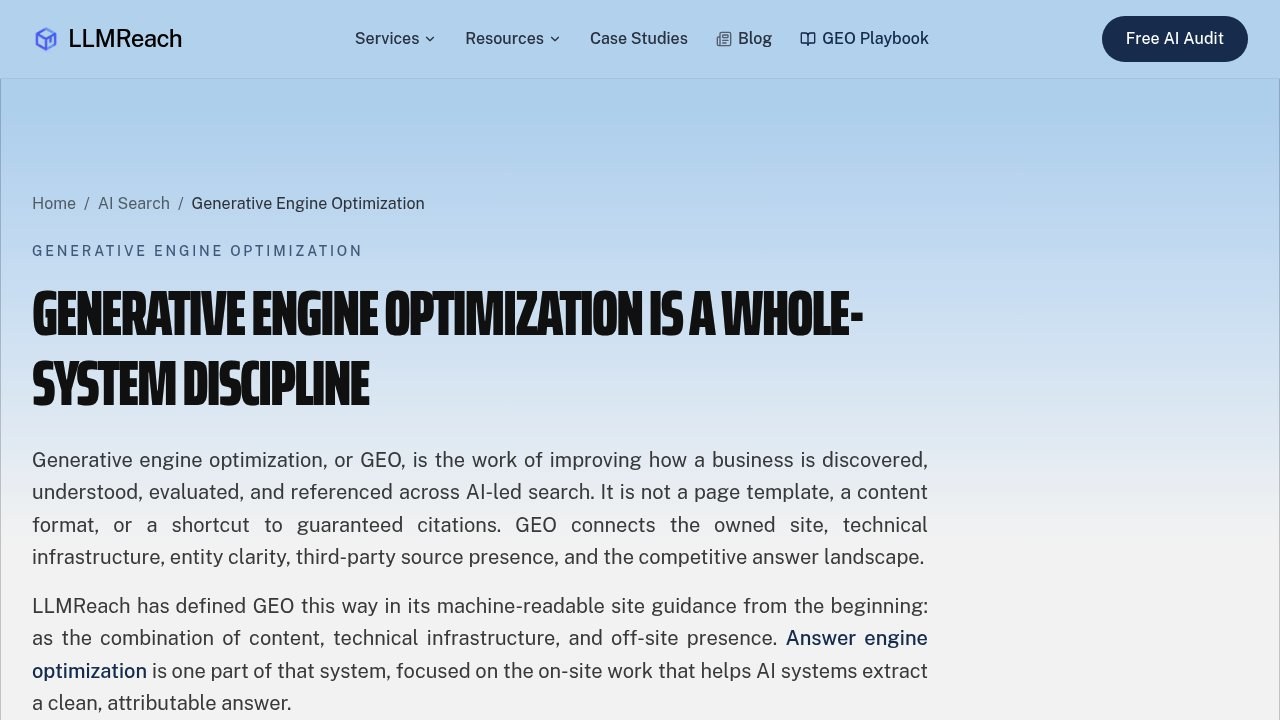
Most agencies now offering AI citation work started as SEO shops, content agencies or PR firms and added the language to a service page. LLMReach does not sell traditional PR, SEO or paid media. It runs one system and measures one output: citations, tracked against the client's own baseline.
| Discipline | What it does |
|---|---|
| Prompt research | The fifty prompts your buyers use before they decide, agreed with you before work begins |
| Technical optimisation | Crawler access at robots.txt and at the edge, rendering, schema, entity consistency |
| Citation-grade content | Answer-first and specific, structured so a section survives being quoted alone |
| Community | Corroboration where buyers actually discuss the category, under the conduct rules above |
| Citation tracking | The prompt set run across all four engines, reported against baseline in a shared dashboard |
The commitment
The Citation Stack is guaranteed as a whole: a 30% increase in total citations across your site, measured against your own baseline, within 90 days. If that is not reached, you choose between continued work at no charge and a full refund.
A baseline is recorded before work begins, and it is the benchmark everything afterwards is read against. You receive weekly updates and a fortnightly review.
Why a PR retainer usually cannot carry that commitment
Not because PR agencies are worse at their work. Because a commitment needs control of the inputs. An agency that owns one layer of five, and reports on publication rather than citation, has no lever on the number and no baseline to read it against. LLMReach runs all five, which is what makes the total citation count something to commit to.
The agency that gets you cited is the one that measures citations
The distinguishing question stays simple: can they show you citation frequency for a client, by engine, against a defined prompt set, before and after. If not, they are selling coverage. Coverage is valuable, and coverage that never enters the citation pool does not help a buyer find you inside an AI answer.
Citation authority also compounds, which is the argument for starting sooner rather than at the point where competitors are already established. Run the free AI visibility audit and see which engines are naming someone else.
Frequently asked questions
What makes a PR agency good at getting cited in ChatGPT and Perplexity?
It starts from the prompts buyers actually run rather than from story angles, briefs coverage so a passage can be lifted out of it, treats community discussion and reference sources as part of the job rather than as someone else's problem, and reports citation frequency by engine instead of clip counts and impressions. The test is whether they can show you that citation data for a current client, live.
Why does press coverage alone often fail to produce AI citations?
Because press is a minority of the citation pool. Muck Rack's research puts journalism and press coverage at nearly 25% of all AI citations, and Machine Relations, reconciling four studies, puts the share PR teams effectively influence closer to 14 to 17%. The rest sits in community discussion, reference sites, review platforms and directories. Coverage also has to be structured and reachable: an engine cites what it can parse and extract.
Does earned media account for 84% of AI citations, or 25%?
Both figures are real and they count different things. Around 94% of AI-cited links come from non-paid sources of every kind, including Reddit, Wikipedia and review platforms. The broad definition of earned media that keeps those inside it produces roughly 84%. Journalism and press coverage specifically account for nearly 25%. An agency quoting the broad number to sell the narrow service is worth questioning.
How important is Reddit for getting cited in Perplexity?
It matters, and the usual statistic is misread. Discovered Labs' 46.7% is Reddit's share of Perplexity's top ten sources, not of all its citations, which has been reported nearer 6.6%. Discovered Labs also sells Reddit marketing, and Reddit's litigation against Perplexity in October 2025 was followed by reported shifts in citation volume. Community corroboration is genuinely valuable, and it is worth measuring in your own category rather than taking from a vendor slide.
Does distributing the same story across several publications increase citations?
The evidence points that way, with a caveat about who produced it. Stacker, with Scrunch, across 87 stories for 30 clients and more than 2,600 prompts on eight AI platforms, reported a 239% median lift and coverage breadth rising from 5.4% to 17.9%. An earlier eight-article pilot reported 325%. Stacker sells the distribution service being measured, and the larger study returned the smaller number, so treat the mechanism as well supported and the magnitude as a vendor estimate.
What does LLMReach commit to, and how is it measured?
The Citation Stack is guaranteed as a whole: a 30% increase in total citations across your site, measured against your own baseline, within 90 days. If that is not reached, you choose between continued work at no charge and a full refund. A baseline is recorded before work begins, and it is the benchmark everything afterwards is read against.
What is the first step to getting cited in ChatGPT and Perplexity?
A baseline. You need to know which prompts are live in your category, whether you appear in the answers, which competitors are cited instead, and which sources are feeding those answers. Without it there is no starting point to measure against, and no way to tell whether an agency's work moved anything.
During a guided review meeting, LLMReach walks you through your priority buyer prompts, current AI visibility, competitor citations, source patterns, and the technical or content gaps that matter most. You leave the call knowing where the gap is, what is causing it, and which changes would matter first.