SEO and GEO agency
Be the brand recommended
by Google, ChatGPT, Claude, Perplexity and Gemini.


SEO and GEO, done for you: we run the whole system that gets you found in Google and cited by ChatGPT, Claude, Perplexity and Gemini.
Your audit is reviewed live on the call. It is not emailed as a PDF.
The difference
Same question. Different answer.
Without LLMReach


 Perplexity
With LLMReach
PerplexityThis is the gap we close.
Our own results
This is how it looks on our own website.
Real answers and our own tracking, for the questions our buyers ask. Click any card to see it full size, with its prompt, engine and date.
AI answers vary by platform and moment, so these show the method working on those days, not a promise of identical answers.
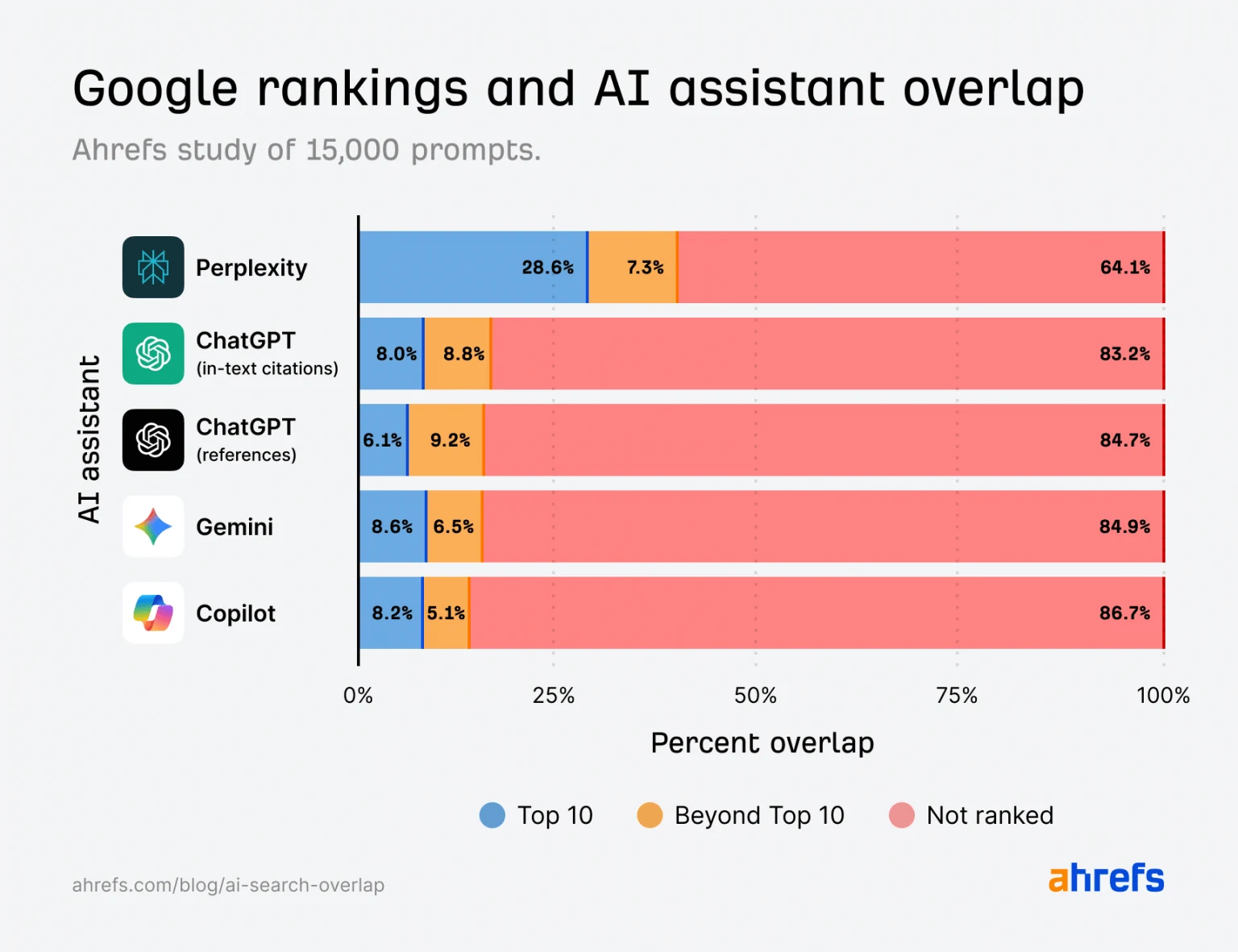
Why SEO alone isn't enough
Ranking in Google doesn't mean AI will cite you.
Google rankings still matter, and we work on them. But ranking alone does not make you a source.
of the URLs AI assistants cite also rank in Google's top 10 for the same query
of those citations do not rank anywhere in Google for the original query
Source: Ahrefs, August 2025
So we work on both: where you rank in Google, and the sources AI cites.
Here's what you get
One complete system. Done for you.
SEO and GEO in one 90-day engagement that installs the entire Citation Stack inside your business.
- Full prompt and keyword research, with a Google, AI visibility and competitor positioning audit
- Technical fixes so Google and AI crawlers can reach, index and read your site
- Schema, internal links and page signals that help you rank and get retrieved when a model answers
- Pages written for the agreed searches and prompts, built to rank and be cited
- Answers and supporting material that give AI systems something worth citing
- Genuine presence in the Reddit communities your buyers trust, nothing automated
- A baseline of your Google rankings and AI citations, taken before work begins
- Weekly updates on your Google and AI visibility
Your options
Why not just hire an SEO agency?
 LLMReachDone for you LLMReachDone for you | SEO agencyRetainer | Measurement tool + your teamSubscription | In-houseYour team | |
|---|---|---|---|---|
| Technical and on-page SEO for Google | ||||
| Buyer searches and prompts identified and agreed | Keywords, not prompts | Measures only | ||
| Pages built to rank and be retrieved by a model | Built for rankings | |||
| Content written for those searches and prompts | For keywords | |||
| Authority where models look for sources | Rarely | |||
| AI visibility tracking | Rarely | |||
| Time from you, per week | ~1 hr review | ~12-15 hrs | ~15-20 hrs |
How it works
The Citation Stack. Five parts, one system, done for you.





We identify the fifty prompts your buyers ask AI assistants and the Google searches behind them, agreed with you before work begins. They are what the system is built around and what results are measured against.
We fix the structural reasons Google and AI systems pass over your site. Crawling and indexing, speed and Core Web Vitals, schema, internal links, and the conditions that make a page rank and be retrieved at the moment a model answers.
We write the pages, answers, and supporting material that rank for the searches agreed in step one and give AI systems something worth citing.
We build genuine presence in the communities your buyers trust, where the threads often rank in Google and feed AI answers. This is not spam, automation, or manufactured discussion. It is the kind of source activity that makes a brand a reference point rather than an unknown.
Your Google rankings and your AI citations per day, across the agreed searches and prompts, in a shared dashboard. A baseline is established before work begins. You receive weekly updates and a review every two weeks.
Most agencies run one of these. The chain only works when all five hold. You approve, we execute: about an hour a week from you.
Who this is for
This is not for everybody.
The Citation Stack works when all five parts run together, so we only take on companies where it can.
Not for you
If any of these sound like you.
- You expect results in a few days
- You want the cheapest option
- You only want one isolated part of the system
- You only want a report or an audit
For you
If this sounds like you.
- You want the work done for you, not another report
- You want the final say on everything we publish
- You want to rank in Google and be named by the AI engines your buyers use
- You're ready to commit to a 90-day window
FAQ
Questions about hiring an SEO and GEO agency, answered.
What do you actually need from me?
About an hour a week. You approve what gets published and read a weekly update, and you give us access to the CMS and repository so the work can happen. That is all of it.
How does the Reddit work actually work? I do not want us posting spam.
Neither do we. It is the fastest way to lose an account and take the brand with it. We join conversations that already exist, and nothing is automated.
What exactly are you measuring?
Two things, both against a baseline taken before work starts: your Google rankings for the agreed searches, and your AI citations, meaning links to pages on your site inside tracked AI responses. The guarantee counts the citations across your whole site, and you see the same measurement we do.
What does the free AI visibility audit include?
It is a GEO audit of the questions your buyers ask. Before the call we run them through ChatGPT, Claude, Perplexity and Gemini; on the call we show you where competitors are cited and you are not, and what is causing it. It is reviewed live, not emailed as a PDF.
Do you offer a guarantee or a refund?
Yes. A minimum 30% increase in your total citations across the AI models within 90 days, measured against your own baseline. If we do not hit it, we keep working at no charge until we do. At 25% the guarantee has not been met, and we will not tell you otherwise after the fact.
We already have an SEO agency. Why would we need this too?
SEO decides whether you are eligible. GEO decides whether you get used as a source when an assistant answers. Different jobs, and they stack. We do both, as an SEO and GEO agency, so you can hand us the whole job, or we work alongside the agency you already have.
Is there a minimum commitment?
90 days, because that is the window the guarantee is measured over. After that it runs month to month, without commitment.
What happens when AI models change?
You own what gets built: a site models can retrieve and content that answers what buyers ask. A model rebuilt on new data still needs sources that are structured, credible and present, and we watch for updates so you don't find out from a drop in your numbers.
Final step
Pick a time. Let's talk.
You leave knowing where the gap is, what is causing it, and which changes would matter first, whether we work together or not.
What to expect
Audit
Before the call, we run your buyers' questions through ChatGPT, Claude, Perplexity and Gemini.
Map
On the call, we show you where competitors are cited and you are not, and what's causing it.
Decide
An honest read on whether the Citation Stack fits. If it doesn't, you'll hear it on the call.
Don't see a time that works? Email Karim directly: contact@llmreach.ai