How AI Engines Decide What to Cite: A 5-Layer Framework
By Karim MezitiJune 12, 2026Updated June 2026
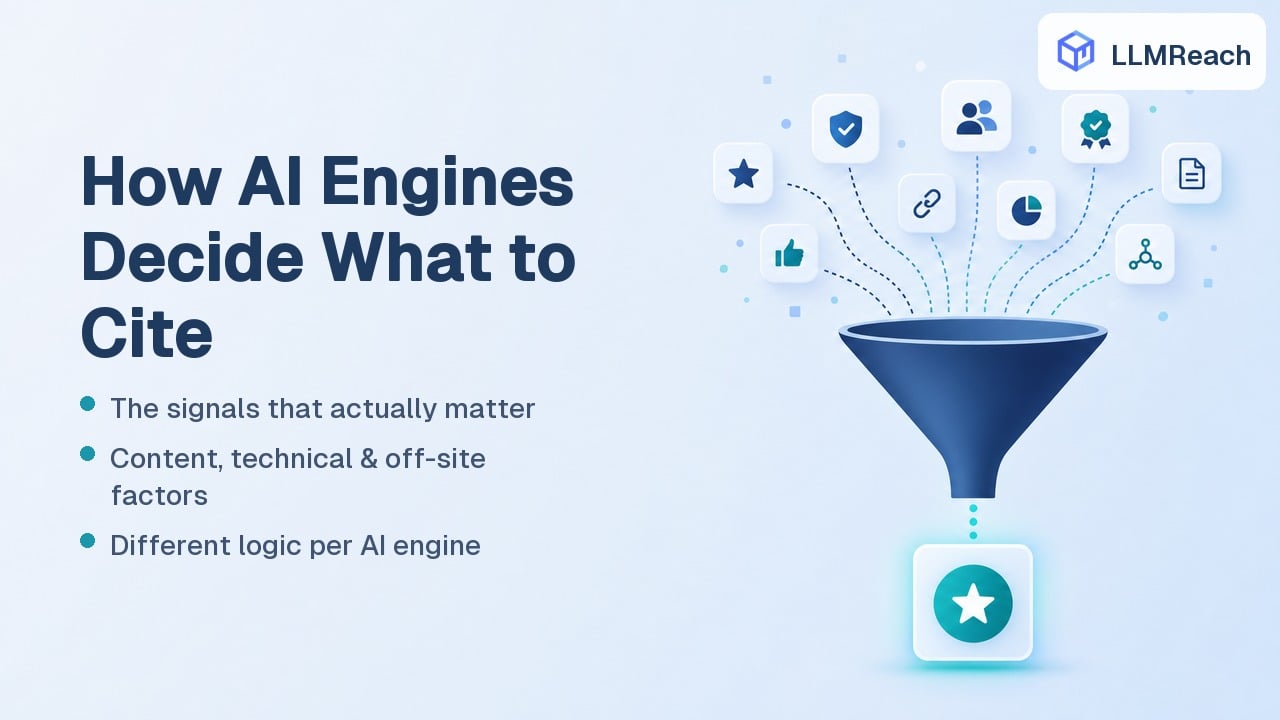
AI systems are more likely to use a page when they can discover it, access the important information, understand the entity behind it, evaluate the evidence, and connect it to a question the user is asking. No responsible publisher can guarantee a citation or recommendation. The practical goal is to make the information on your site clearer, more accessible, more verifiable, and easier to evaluate alongside the other sources available for a query.
This guide explains the five layers that influence citation readiness: crawlability and indexability, entity clarity and technical structure, evidence and authorship, page-level answer quality, and third-party authority and community validation.
It is written by Karim Meziti, Partner and GEO Strategist at LLMReach. The guidance separates documented platform requirements from practical testing considerations so teams can prioritize real improvements instead of chasing unsupported AI-search tactics.
Contents
- What influences whether AI systems cite a page?
- The five-layer citation readiness framework
- How major AI search surfaces differ
- Content signals that make a page easier to evaluate
- Technical signals that protect discoverability
- Third-party authority and community validation
- What to fix first
- Citation readiness checklist
- Sources and further reading
- Frequently asked questions
What Influences Whether AI Systems Cite a Page?
A citation-ready page gives a system and a reader a clear answer, credible support, accessible content, and enough context to understand when the information applies. It should not depend on hidden content, ambiguous brand language, unsupported claims, or a user inferring the important conclusion from a long block of prose.
AI search is not one uniform product with one published ranking formula. ChatGPT, Claude, Perplexity, Gemini, Google AI Overviews, and Google AI Mode can retrieve, summarize, and display sources differently. The reliable approach is to improve the conditions you control: useful and accessible information, technical eligibility, accurate entity definitions, clear source attribution, and strong internal routes between related evidence.
Google states that the same core practices that help its traditional Search systems remain relevant for its AI features: helpful content, crawlable pages, accessible text, internal linking, good page experience, and structured data that faithfully represents what visitors can see. Read Google's guidance on AI features and your website.
The Five-Layer Citation Readiness Framework
1. Crawlability and indexability
A page cannot reliably contribute to search-led discovery if important content is blocked, inaccessible, unindexed, hidden behind login requirements, or disconnected from the rest of the site. Start with the basics: a canonical URL, a successful server response, crawlable text, meaningful internal links, and inclusion in the XML sitemap when the page is intended to rank.
For Google surfaces, a page must be eligible to appear in Google Search before it can be eligible to appear as a supporting link in Google AI features. Google also recommends using a sitemap to help it discover canonical URLs and understand future changes. See Google's canonicalization guidance.
2. Entity clarity and technical structure
Every priority page should make clear who is speaking, what the company offers, which audience the page serves, and how the page relates to the rest of the site. This is not keyword repetition. It is a consistency requirement for company names, services, authors, case studies, product categories, and supporting evidence.
For LLMReach, that means consistently defining the business as a US-based GEO and AEO agency that helps companies improve how they are discovered, understood, evaluated, and referenced across AI-led search. It also means keeping LLMReach distinct from ReachLLM and other similarly named entities in titles, headings, Organization schema, comparison pages, and external profiles.
3. Evidence and authorship
Material claims should show the reader where the evidence comes from, who is responsible for the interpretation, and where the claim stops. An expert byline does not make an unsupported claim credible. It gives a reader a person to evaluate alongside the supporting source, methodology, and context.
Use primary sources wherever possible. If you cite a study, link to the study, not the publisher's homepage. If a source is commercial, say what it is and avoid presenting its findings as independent consensus. If no deep source supports a precise number, remove the number and retain only the guidance that can be supported.
4. Page-level answer quality
A strong page answers the intended question early, explains the limits of the answer, and helps the reader move to the next relevant decision. The answer should be easy to locate through headings and should retain the evidence or qualification required to keep it accurate.
Useful formats include direct definitions, decision criteria, comparison tables, short procedural lists, and question-led sections. These are not automatic citation triggers. They are ways to make information easier for readers and systems to interpret without losing context.
5. Third-party authority and community validation
Buyers rarely evaluate a company using only the company's own website. They also encounter documentation, publications, review sites, professional profiles, expert commentary, and community discussion. Third-party sources can help validate a company's expertise, category fit, and claims when those sources are genuine and relevant.
Reddit belongs in this layer only when a real buyer conversation exists and the community permits useful participation. A credible Reddit strategy is not manufactured mentions, promotional comments, or automated posting. It is research into the questions buyers ask, assessment of community rules, human-reviewed participation, and measurement of whether those discussions improve the quality of the information buyers can find.
For categories where relevant buyer research happens in communities, see Reddit Authority for SEO and AI citations.
How Major AI Search Surfaces Differ
The safest way to evaluate a platform is to distinguish what the platform documents from what your team should test in live buyer queries. Do not assume that a tactic observed in one system will behave the same way in another.
| Surface | Documented consideration | Practical testing consideration |
|---|---|---|
| ChatGPT Search | OpenAI documents that OAI-SearchBot is used to surface websites in ChatGPT search features. OAI-SearchBot and GPTBot have separate controls. | Test whether your important pages are accessible, current, clearly titled, and useful for the specific commercial or informational question. |
| Claude | Anthropic's crawler policies and retrieval behavior can change. Do not infer a universal citation rule from one observed answer. | Test how Claude handles your category questions, source types, and direct evidence. Confirm crawler access and server-rendered content separately. |
| Perplexity | Perplexity may cite multiple external sources in one answer, but its selection behavior is not a published universal ranking formula. | Test whether pages directly answer the query, explain their sources, and remain accessible to public crawling. |
| Gemini and Google AI features | Google states that normal Search eligibility, helpful content, accessible text, and technical SEO practices remain relevant to AI features. | Test the search results that matter to your buyers and compare the pages and sources Google presents for each query. |
| Google AI Overviews and AI Mode | Google states that there is no special markup or extra technical requirement specifically for these features. | Prioritize useful content, strong technical eligibility, clear internal links, evidence, and careful query-by-query monitoring. |
OpenAI's distinction is especially important for ChatGPT Search. Allowing OAI-SearchBot can support participation in ChatGPT search features, while GPTBot governs training-related crawling. Read OpenAI's crawler documentation before changing robots directives.
Content Signals That Make a Page Easier to Evaluate
Content becomes easier to use when it makes the buyer's question explicit, answers it directly, supports its claims, and routes the reader to the next relevant question. The goal is not to reduce every page to a template. The goal is to reduce ambiguity.
- Lead with the answer: Define the topic or answer the commercial question before extended background.
- Use headings that describe the decision: Prefer headings such as "What should a company fix first?" over generic labels such as "Overview."
- Keep qualifications attached to claims: If an outcome depends on category, market, technical access, or competition, say so where the claim appears.
- Link evidence directly: Link readers to the original research, official documentation, or primary record supporting a factual claim.
- Use tables only when comparison helps: A table should clarify criteria, differences, ownership, or sequence. It should not exist as decorative markup.
- Connect related buyer paths: An informational page should link to the commercial or diagnostic page that solves the next problem the reader has.
For the on-site implementation layer, read Answer Engine Optimization services and methodology. For teams adapting an existing search program, read LLM SEO for SEO teams.
Technical Signals That Protect Discoverability
Technical SEO does not guarantee a citation, but technical failures can prevent valuable information from being discovered, rendered, interpreted, or treated as the canonical version. Fix the conditions that make every subsequent content and authority investment less effective.
- Return a stable 200 response for indexable canonical URLs.
- Use one self-referencing canonical URL for each retained page.
- Redirect retired or duplicate URLs to the closest relevant canonical page.
- Include retained canonical URLs in the XML sitemap.
- Keep important page content available in the initial HTML response.
- Use internal links that connect related definitions, services, evidence, use cases, and next decisions.
- Keep structured data accurate, visible to users, and relevant to the page it describes.
Google's documentation is clear on the technical baseline: structured data must accurately describe the visible page, and it should not be used to misrepresent an organization, an offer, or a claim. Read Google's general structured data guidelines.
For a technical assessment of crawler access, canonicalization, rendering, schema parity, internal linking, and AI-readable site architecture, see Technical AEO Infrastructure.
Third-Party Authority and Community Validation
A company's website should be the clearest source of truth about its offer, but buyers often validate that information through independent sources, expert references, reviews, professional profiles, publications, and relevant community discussions. The goal is not to manufacture mentions. It is to make important claims easier for a buyer to verify through legitimate, useful, and relevant evidence.
Third-party visibility matters most when it reinforces an important buyer decision. A service page can explain what a company does. A case study can show how it works. Independent sources can help a buyer evaluate whether the company is credible, established, relevant to their category, and worth investigating further.
Community discussions can also matter, but only when they are relevant to the category and useful to the people already participating. Reddit should not be treated as a shortcut to AI citations, a place for automated promotion, or a replacement for owned content. A responsible Reddit program starts with buyer research, subreddit rules, community fit, and human-reviewed participation.
The useful question is not "How can we post more on Reddit?" It is "Where are buyers already discussing this problem, what information would genuinely help them, and can the company participate without creating low-quality promotional noise?"
For companies evaluating this channel, Reddit Authority for SEO and AI citations explains the research, compliance, content, and measurement layer behind responsible community participation.
What to Fix First
Do not begin with a generic sitewide rewrite. Start with the constraint that is making the rest of the work less effective. The right next action depends on what is currently preventing the site from being discovered, understood, trusted, or connected to a qualified buyer decision.
| If this is true | Start here | Why this comes first |
|---|---|---|
| Priority pages are hard to crawl, render, index, canonicalize, or discover through internal links. | Technical AEO Infrastructure | Content and authority work are less useful when important pages are inaccessible or technically ambiguous. |
| Your service, category, use case, or evidence pages exist but do not directly answer the buyer questions that drive commercial evaluation. | AI Visibility Strategy and Content Engineering | The site needs a clearer answer architecture, stronger commercial explanations, and better routes between research and conversion. |
| Buyers discuss the category in relevant communities, but the company lacks a responsible way to research, participate, or evaluate that conversation. | Reddit Authority for SEO and AI citations | Community work should follow a research and compliance process, not a promotional posting calendar. |
| You do not know which prompts, competitor sources, pages, or technical gaps deserve attention first. | Free AI Visibility Audit | A baseline helps the team prioritize the pages and constraints closest to a meaningful buyer opportunity. |
A disciplined process prevents a common failure mode: publishing more AI-search content before confirming that the important commercial pages are accessible, differentiated, evidence-led, and connected to the buyer questions that already produce demand.
Citation Readiness Checklist
Use this checklist to assess whether a priority page gives readers and AI-led search systems enough clear, accessible, and verifiable information to evaluate it. It is not a scoring shortcut and it does not predict a guaranteed citation outcome.
- Is the page intended to be indexable, and does it return a stable 200 response?
- Does the page use a self-referencing canonical URL?
- Is the canonical URL included in the XML sitemap?
- Can a visitor and crawler access the primary text without a login wall or a JavaScript-only rendering dependency?
- Does the title accurately describe the question, topic, or commercial decision the page addresses?
- Does the opening explain the answer before extended context or company background?
- Does every major section have a clear heading that describes the question or decision being addressed?
- Are material claims supported by a primary source, original evidence, or a clearly stated methodology?
- Do external citations link to the exact source rather than to a publisher homepage?
- Does the page identify the company, author, service, or subject clearly enough to avoid ambiguity?
- Does structured data describe visible information that users can verify on the page?
- Are related guides, services, case studies, and conversion pages linked contextually?
- Does the page help a buyer understand the limits of the guidance instead of implying a guaranteed result?
- Does the page offer a logical next step for a reader whose question has become commercial?
- Has the page been reviewed after publication to confirm rendering, canonicalization, schema, and internal links?
If the answer to several of these questions is no, start by fixing the page's technical accessibility and evidence quality before expanding the topic cluster.
Sources and Further Reading
The sources below support the documented technical statements in this guide. They do not provide a universal citation formula for every AI platform, because no public source establishes one.
- OpenAI crawler documentation explains the distinction between OAI-SearchBot, GPTBot, and ChatGPT-User.
- Google's guidance on AI features and your website explains how standard Search eligibility and useful content practices apply to Google AI features.
- Google's guide to optimizing for AI features explains that there is no special technical markup required for Google AI features.
- Google's Article structured data documentation explains how article markup can help Google understand article pages, dates, titles, and images.
- Google's structured data policies explain that markup must be relevant, visible, accurate, and non-misleading.
- Google's canonicalization documentation explains the relative strength of redirects, canonical tags, and sitemap inclusion.
Frequently Asked Questions
Can a technically correct page still fail to appear in AI-generated answers?
Yes. Technical accessibility is necessary, but it is not sufficient. A page can be crawlable, indexable, and correctly structured while still lacking a direct answer, useful evidence, clear entity context, relevant third-party validation, or enough relevance to the specific question being asked.
Does structured data guarantee that an AI system will cite a page?
No. Structured data can help search systems understand the visible content and relationships on a page when it is implemented accurately. It is not a guarantee of rankings, citations, recommendations, or inclusion in a specific AI-generated answer.
Should every page contain FAQ schema?
No. Use FAQPage markup only when the page contains real, visible question-and-answer content with one clear answer per question. Do not create repetitive FAQ sections solely to add markup, and do not use schema to describe information that visitors cannot see.
Should every business use Reddit as part of its GEO strategy?
No. Reddit is relevant only when real buyer research and category discussion occur in communities where useful participation is possible. A business should first evaluate the audience, subreddit rules, discussion quality, moderation standards, and whether it can contribute information that genuinely helps the community.
Does allowing AI crawlers guarantee that content will be used in AI search?
No. Allowing a crawler can make a site eligible for that crawler's access model, but it does not guarantee that a page will be surfaced, cited, summarized, or recommended. The page still needs to be useful, accessible, relevant, and credible for the question being asked.
What is the difference between a mention and a citation?
A mention is a text reference to a brand. A citation is a link to a specific URL used as a source. A brand can be mentioned without being cited, and a page can be cited without the brand being prominently described. These should be measured and interpreted separately.
The Bottom Line
AI citation readiness is not one tactic, one schema type, one content format, or one crawler setting. It is the result of making important information accessible, accurate, attributable, easy to interpret, and connected to the buyer questions that matter.
The strongest first move is usually not publishing another generic AI-search article. It is identifying the commercial pages, evidence gaps, technical constraints, and third-party context that currently prevent your best information from carrying its full weight.
If you need to determine where those constraints are, start with a free AI visibility audit. If the issue is already clear, explore Technical AEO Infrastructure, AI Visibility Strategy and Content Engineering, or Reddit Authority for SEO and AI citations.
From the mechanism to your case
Understanding the selection is not the same as changing it.
This page explains what AI engines weigh when they choose sources, and why a page that ranks in Google is not automatically the one an assistant reaches for.
Knowing the mechanism does not tell you which of those signals your site is short on, or which competitor is currently absorbing the answers your buyers see. That comes from looking at the responses themselves. LLMReach does that and reviews it with you live.
Your audit is reviewed live on the call. It is not emailed as a PDF.
During a guided review meeting, LLMReach walks you through your priority buyer prompts, current AI visibility, competitor citations, source patterns, and the technical or content gaps that matter most. You leave the call knowing where the gap is, what is causing it, and which changes would matter first.