What is Answer Engine Optimization (AEO)? Definition, Examples, and How It Works
By Karim MezitiJune 12, 2026Updated June 2026
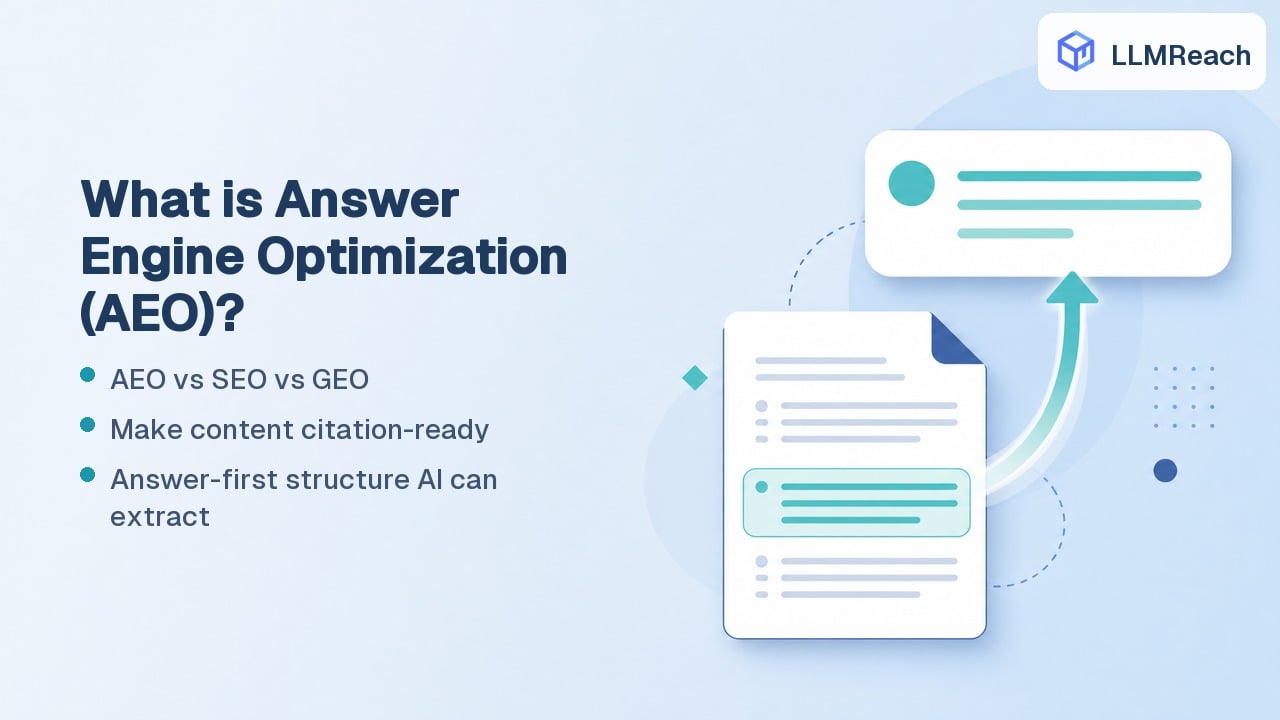
Answer Engine Optimization (AEO) is the practice of structuring content so AI-powered platforms like ChatGPT, Perplexity, Claude, and Gemini can retrieve, extract, and cite it when generating answers. The goal is not a ranking position. It is inclusion in the answer itself.
Most brands optimizing for traditional search are invisible to AI engines. Not because their content is bad, but because it is not structured for extraction. AI engines do not rank pages the way Google does. They retrieve candidate documents, evaluate which passages are clean and citable, synthesize a response, and then attribute specific claims to their sources. If your content buries the answer in paragraph four, the engine moves on to a competitor who led with it.
The real risk is not being outranked. It is being omitted entirely.
This guide covers everything you need to know to implement AEO correctly: what it is, how it differs from SEO and GEO, the specific formats AI engines extract most, a practical content audit framework, before/after examples, schema implementation, and a step-by-step process for getting your pages citation-ready.
Key takeaways:
AEO targets the extraction logic of AI engines, not traditional ranking algorithms
The 40-60 word direct-answer block is the single most important structural unit in AEO
FAQ schema, HowTo schema, and comparison tables are the three highest-yield formats
AEO is on-site structural work; GEO is the off-site authority layer that determines which structured pages get cited
A content audit for AEO readiness takes less than 30 minutes per page with the right checklist
What Is AEO? The Definition That Actually Matters
Answer Engine Optimization (AEO) is the on-site discipline of structuring your content so AI engines can extract a clean, attributable passage and use it in a generated answer. Where SEO targets Google's ranking algorithm, AEO targets the extraction logic that sits inside ChatGPT, Perplexity, Claude, Gemini, and Google AI Overviews.
The distinction matters because the extraction logic operates differently from a ranking algorithm. An AI engine does not ask "which page is most authoritative?" It asks: "Which passage on this page can I lift, compress, and cite without losing accuracy?" That is a structural question, not a domain authority question.
How AI Engines Actually Use Your Content
AI answer engines operate through a process called Retrieval-Augmented Generation (RAG). The pipeline has five stages:
Query interpretation: The engine parses the user's question into a semantic representation, identifying concepts, entities, and intent.
Retrieval: The system pulls candidate documents based on conceptual similarity, not just keyword match.
Scoring: Candidate passages are evaluated for trustworthiness, clarity, and extractability.
Answer generation: The model synthesizes a response by extracting key facts and rewriting them in natural language.
Citation: The engine attributes specific claims to their source pages.
AEO pays off at stage 3 and stage 5. Content that provides a clean, self-contained answer with supporting data scores higher at the scoring stage and earns attribution at the citation stage. Content buried in long paragraphs fails both tests.
Why AEO Is Not Just "Writing Clearly"
A common misconception is that AEO is just good writing advice repackaged. It is not. AEO requires specific structural choices:
Direct-answer blocks of 40-60 words placed immediately under question-format headings
Declarative entity statements that establish who you are, what you do, and who you serve
Statistics paired with a named source and year, so the model can verify the claim
FAQ blocks structured for extraction, not just for reader convenience
Schema markup that makes the structure machine-readable, not just human-readable
Without these elements, even excellent content fails the extraction test. The AI reads the page, finds no citable unit, and pulls from a competitor who built those elements in.
AEO vs. SEO vs. GEO: How the Three Disciplines Fit Together
These three disciplines are additive, not interchangeable. Each targets a different stage of the AI discovery process. Conflating them leads to strategies that optimize for one layer while leaving the others unaddressed.
The simplest framing: SEO gets you found. AEO gets you extracted. GEO gets you cited.
The table below maps each discipline to its target mechanism, success metric, and primary content focus.
Discipline | Target Mechanism | Success Metric | Primary Content Focus |
|---|---|---|---|
SEO | Google ranking algorithm | Keyword positions, organic traffic, CTR | Technical health, backlinks, E-E-A-T, heading hierarchy |
AEO | AI extraction logic | Passage inclusion in AI answers, snippet rate | 40-60 word answer blocks, FAQ schema, HowTo schema, tables |
GEO | AI citation selection (RAG reranking) | Citation rate, brand mention share, AI share of voice | Off-site authority: Reddit, YouTube, Wikipedia, directories, original research |
For a deeper look at GEO and how it relates to this framework, see What is Generative Engine Optimization.
The Myth That SEO Automatically Produces AI Citations
Strong SEO is necessary infrastructure. It is not sufficient for AI citations. The reason is structural: Google's ranking algorithm and an AI engine's extraction logic evaluate different signals.
A 2026 study tracked 1,885 pages after adding JSON-LD schema markup, comparing them against 4,000 control pages. AI Overview citations actually declined 4.6% on the test pages. The conclusion: technical optimization alone does not move the AI citation needle. Structural content changes do.
What SEO covers that AEO does not:
Domain authority and backlink profile
Core Web Vitals and crawlability
Title tags, meta descriptions, heading hierarchy for ranking
What AEO covers that SEO does not:
Passage-level extraction patterns specific to AI Overviews
Self-contained 40-60 word answer blocks under question headings
FAQPage and HowTo schema for AI parsing
Entity statements that reduce model ambiguity
Where GEO Fits In
GEO is the off-site layer. While AEO structures your content for extraction, GEO builds the brand signals that AI models weight when deciding which extracted content is worth citing. That includes authentic presence on Reddit and YouTube, Wikipedia notability, directory listings on Clutch and G2, and original research that earns third-party references.
AEO is largely a one-time technical and content investment. GEO is an ongoing brand-building program. Both are required. A page with perfect AEO structure but zero off-site authority signals will lose citation races to a less-structured page from a brand with stronger GEO. To understand how AI engines decide what to cite, the interplay between these two layers is critical.
The Content Formats AI Engines Extract Most
Not all content formats are equal in the eyes of an AI engine. The extraction logic consistently favors formats that reduce inference burden: structures where the answer is unambiguous, self-contained, and verifiable. After auditing hundreds of pages across client accounts, five formats account for the overwhelming majority of successful AI extractions.
1. The 40-60 Word Direct-Answer Block
This is the foundational unit of AEO. Place a 40-60 word direct answer immediately under every question-format heading. The passage should answer the question completely without requiring context from surrounding sections. If an AI engine can lift it, compress it, and cite it without rewriting the meaning, it will.
What this looks like in practice:
What is a demand-side platform (DSP)? A demand-side platform (DSP) is software that allows advertisers to buy digital ad inventory across multiple ad exchanges through a single interface. DSPs use real-time bidding to purchase impressions automatically, targeting audiences by behavior, geography, and device. Most enterprise DSPs integrate with data management platforms (DMPs) for audience segmentation.
That passage is 52 words. It answers the question, defines the term, explains the mechanism, and mentions a related concept. An AI engine can extract it whole.
2. FAQ Blocks
FAQ sections are the highest-yield AEO format for question-based queries. AI engines specifically look for question-answer pairs as citation candidates. Each FAQ answer should be 50-100 words, self-contained, and written in plain declarative language.
The structural requirements for AEO-ready FAQ blocks:
Question phrasing must match how users actually ask in conversational AI (not keyword-stuffed)
Each answer must stand alone without referencing other answers
Answers should include at least one specific data point or named entity
FAQPage schema in JSON-LD should accompany every FAQ section
3. Comparison Tables
Tables are the highest-density extractable format on any page. AI engines parse table cells as discrete data units, which makes them ideal for comparative queries ("what's the difference between X and Y"). A well-structured table with explicit column headers, clear cell values, and no merged cells extracts cleanly across all major platforms.
Requirements for extractable tables:
Explicit column headers (not generic labels like "Feature 1")
Each cell contains a single, unambiguous value
No footnotes that require context outside the table
Pipe-delimited markdown or clean HTML table markup
4. Numbered Step Lists (HowTo Format)
Sequential processes structured as numbered steps match the HowTo schema format that AI engines parse for procedural queries. Each step should be a single action with a clear outcome. Steps that bundle multiple actions reduce extractability.
5. Definition Callouts
For "what is X" queries, AI engines look for a labelled definition block within the first 200 words of the page. The format is: [Term] is [clear, complete definition]. This single sentence, placed early and clearly labelled, is the most frequently extracted element for definitional queries.
Key insight: Content with specific statistics earns approximately 40% higher citation rates from AI engines than content without them, according to research published on Search Engine Land. Adding a sourced data point to each section is not optional for competitive AEO.
Weak vs. Strong AEO Content: Before and After Examples
The difference between content that gets cited and content that gets ignored is rarely about quality. It is about structure. The examples below show the same information presented in two ways: one that fails the extraction test and one that passes it.
Example 1: Definitional Content
Before (not AEO-optimized):
At our company, we've been working in the digital marketing space for years, and one thing we've noticed is that the landscape is constantly changing. With the rise of AI-powered tools, brands need to think differently about how they approach content. In this article, we'll explore what answer engine optimization means and why it matters for your business going forward.
This opening has zero extractable value. It contains no definition, no data, no entity statement. An AI engine scanning this page for "what is AEO" finds nothing citable in the first 100 words and moves on.
After (AEO-optimized):
Answer Engine Optimization (AEO) is the practice of structuring content so AI-powered platforms like ChatGPT, Perplexity, Claude, and Gemini can retrieve, extract, and cite it when generating answers. Unlike SEO, which targets ranking algorithms, AEO targets the extraction logic that determines which passages appear inside AI-generated responses. The goal is not a ranking position; it is inclusion in the answer itself.
This version is 58 words. It defines the term, names the platforms, states the key distinction from SEO, and articulates the goal. Every sentence is extractable.
Example 2: Process Content
Before (not AEO-optimized):
When it comes to optimizing your content for AI search, there are many things to consider. You'll want to think about how your content is structured, what kind of schema you're using, and whether your headings are clear. It's also important to make sure your content is authoritative and up to date. These are all factors that can influence whether AI engines decide to cite your content.
Four sentences. Zero specific actions. No data. No named schema types. An AI engine parsing this for "how to optimize content for AI" finds a vague list of considerations, not a citable process.
After (AEO-optimized):
To optimize a page for AI citation, take four steps: (1) Add a 40-60 word direct-answer block immediately under the H1 or primary heading. (2) Restructure each H2 section to open with a self-contained answer passage. (3) Add a 5-8 item FAQ section with FAQPage schema in JSON-LD. (4) Replace vague claims with statistics that include a named source and year.
This version gives four specific, numbered actions. Each action is discrete and verifiable. An AI engine can extract any one of these steps as a standalone citable unit.
The Pattern Behind Both Examples
The before versions share three failure modes:
Delayed answer: The core information appears after narrative setup or brand context
Vague language: "Many things to consider" and "constantly changing" are not extractable claims
No structure: Prose paragraphs without headings, lists, or schema give AI engines nothing to anchor to
The after versions share three success patterns:
Answer first: The definition or process appears in the first sentence
Specific language: Named entities, numbers, and schema types that can be verified
Extraction-ready structure: Numbered lists, definition format, and self-contained passages
Schema Markup for AEO: Which Types to Implement and Why
Schema markup is the machine-readable layer that tells AI engines what type of content a page contains and how to parse it. Without schema, AI engines must infer structure from HTML and prose. With schema, the structure is explicit. The three schema types with the highest AEO yield are FAQPage, HowTo, and Article (with specific properties).
FAQPage Schema
FAQPage schema is the single highest-priority schema type for AEO. It wraps question-answer pairs in a format AI engines parse directly as citation candidates. Implementation is straightforward in JSON-LD:
{
 "@context": "https://schema.org",
 "@type": "FAQPage",
 "mainEntity": [
 {
 "@type": "Question",
 "name": "What is Answer Engine Optimization?",
 "acceptedAnswer": {
 "@type": "Answer",
 "text": "Answer Engine Optimization (AEO) is the practice of structuring content so AI-powered platforms like ChatGPT, Perplexity, Claude, and Gemini can retrieve, extract, and cite it when generating answers."
 }
 }
 ]
}
Each Question object should match the visible FAQ on the page. The text value in acceptedAnswer should be the same 50-100 word answer visible to users. Do not create schema-only content that does not appear on the page.
HowTo Schema
HowTo schema is the priority implementation for procedural content. It structures step-by-step processes in a format AI engines parse for "how to" queries. Each step should have a name (the action) and a text (the explanation). Steps that require a tool or supply can include those as nested objects.
When to use HowTo schema:
Any page that walks through a process with discrete steps
Implementation guides, setup tutorials, and workflow documentation
Pages targeting queries that begin with "how to," "how do I," or "steps to"
Article Schema with Key Properties
For pillar content and long-form articles, Article schema with dateModified, author, and publisher properties signals freshness and authorship to AI engines. Research on AI citation behavior consistently shows that content with explicit author credentials and recent modification dates earns higher citation rates. Google's structured data documentation confirms that Article schema with these properties is a recognized quality signal. The dateModified property in particular influences how AI engines weight content freshness.
Critical properties to include:
datePublishedanddateModified(updatedateModifiedevery time you refresh the page)authorwith@type: Person,name, andurlpointing to an author bio pagepublisherwith@type: Organizationandlogoheadlinematching the H1 exactly
For a complete technical implementation guide covering these and additional schema types, see LLMReach's Technical AEO Infrastructure services.
How to Audit Your Content for AEO Readiness
An AEO audit evaluates whether a page can pass the extraction test: can an AI engine pull a clean, citable passage from this page without rewriting it? The audit takes 20-30 minutes per page and produces a clear action list.
Run this checklist on every priority page before investing in new content creation. Fixing existing pages consistently outperforms publishing new ones when the existing pages have strong SEO authority but weak AEO structure.
The 6-Point AEO Readiness Checklist
Audit Question | What "Pass" Looks Like | Common Failure |
|---|---|---|
Does the page answer the primary query within the first 60 words? | Clear definition or direct answer in the opening paragraph | Page opens with brand narrative or context-setting |
Does each H2 section open with a self-contained answer block? | 40-60 word passage that can be extracted without surrounding context | Sections open with "In this section, we'll cover..." |
Are headings written as questions or clear topic statements? | "What is X?" or "How Does X Work?" format | Generic labels like "Overview" or "Background" |
Does the page include a FAQ section with FAQPage schema? | 5+ Q&A pairs in JSON-LD with visible on-page content | FAQ exists but has no schema, or schema exists without visible content |
Does the page include at least one sourced statistic per major section? | "[Number] from [Named Source], [Year]" format | Vague claims like "many studies show" or unsourced percentages |
Is the entity (brand, product, or concept) defined explicitly? | Declarative sentence: "[Brand] is [category] that [function] for [audience]" | Entity is assumed, not stated |
Prioritizing Pages for AEO Audit
Not every page warrants an immediate AEO audit. Prioritize in this order:
High-traffic informational pages that already rank in positions 1-10 for informational queries. These pages have SEO authority and just need AEO structure added.
Product and service pages that describe what you offer. These are the pages AI engines pull from for recommendation queries ("what's the best X for Y").
Category-defining content where your brand should own the definition. If you want to be cited when someone asks "what is [your category]," that page must pass the AEO audit.
Pages already appearing in AI Overviews (check via manual queries). If you are already being cited without AEO optimization, these pages have high upside from structural improvements.
Avoid auditing and optimizing low-traffic pages with weak backlink profiles first. AEO structure amplifies existing authority; it does not create it from scratch.
AEO Implementation: A Step-by-Step Process
The following process is what LLMReach runs for new clients during the first 60 days of an engagement. It is sequenced to produce measurable citation improvements on high-priority pages before expanding to the full site.
Step 1: Establish your citation baseline. Before changing anything, document where you currently appear in AI answers. Run 20-30 queries relevant to your category across ChatGPT, Perplexity, and Google AI Overviews. Record which sources are being cited instead of you. This baseline tells you which pages to prioritize and which competitors' structures to analyze.
Step 2: Identify your top 10 priority pages. Using the prioritization framework from the audit section above, select the 10 pages with the highest combination of existing SEO authority and current AEO gap. These are your highest-leverage pages.
Step 3: Add direct-answer blocks to every H2. For each priority page, rewrite the opening paragraph of every H2 section as a 40-60 word self-contained answer block. This single change produces the largest citation lift of any AEO intervention. Do not restructure the rest of the page yet.
Step 4: Convert or add a FAQ section. Add 5-8 FAQ items to each priority page. Questions should match how users phrase queries in conversational AI, not how they type in Google. Implement FAQPage schema in JSON-LD. If a FAQ section already exists, audit each answer against the 50-100 word self-contained standard.
Step 5: Implement Article, FAQPage, and HowTo schema. Add the appropriate schema types to each priority page. Verify implementation with Google's Rich Results Test. Fix any validation errors before moving to the next page.
Step 6: Add sourced statistics to every major section. Audit each section for unsourced claims. Replace vague language with specific data points: "[X]% of [audience] [behavior], according to [Source], [Year]." This step directly addresses the AI engine's need for verifiable evidence.
Step 7: Update entity statements on all pages. Every page that describes your brand, product, or service should include an explicit entity statement in the first 100 words: "[Brand] is [category] that [function] for [audience]." This reduces model ambiguity and improves citation accuracy.
Step 8: Re-run your citation baseline at 30 and 60 days. Measure citation rate changes across your 20-30 test queries. Pages with strong SEO authority typically show measurable citation improvements within 30 days of AEO restructuring. Pages with weaker authority take longer and may require parallel GEO investment.
The part most teams miss: AEO implementation is not a one-time project. AI engines update their retrieval indices continuously. Pages that earn citations in month one can lose them by month three if competitors publish more structured content on the same topic. Build a quarterly AEO refresh cycle into your content calendar from the start.
Frequently Asked Questions About AEO
What is the difference between AEO and SEO?
SEO (Search Engine Optimization) targets Google's ranking algorithm to earn positions in traditional search results. AEO (Answer Engine Optimization) targets the extraction logic inside AI answer engines like ChatGPT, Perplexity, and Google AI Overviews to earn inclusion in generated answers. SEO measures keyword rankings and organic traffic. AEO measures citation rate, passage inclusion, and AI mention share. Both are required in 2026; strong SEO does not automatically produce AI citations.
Does AEO replace SEO?
No. AEO and SEO are additive, not competing disciplines. SEO builds the domain authority and crawlability that give AI engines a reason to index your pages in the first place. AEO structures those pages so AI engines can extract and cite specific passages. A brand with strong AEO but weak SEO will struggle because AI engines rely on the same authority signals that feed Google's index. The correct approach is SEO as the foundation, AEO as the structural layer, and GEO as the citation layer on top.
How long does it take to see results from AEO optimization?
Pages with existing SEO authority (top 10 rankings for relevant queries) typically show measurable citation improvements within 30 days of AEO restructuring. Pages with weaker authority take longer and may require parallel GEO investment to build off-site signals. The fastest wins come from restructuring high-authority informational pages that already rank well but are not structured for extraction. New pages with no backlink profile can take 60-90 days before citation improvements are measurable.
Which AI platforms does AEO apply to?
AEO structural principles apply across all major AI answer platforms: ChatGPT (including ChatGPT Search), Perplexity, Claude, Gemini, Google AI Overviews, Microsoft Copilot, and Meta AI. Each platform uses a slightly different retrieval pipeline, but all of them favor the same core AEO signals: direct-answer blocks, FAQ structure, sourced statistics, and explicit entity statements. Platform-specific optimization (such as Reddit presence for ChatGPT or Google indexing for AI Overviews) falls under GEO rather than AEO.
What is the most important AEO change to make first?
Add a 40-60 word direct-answer block immediately under the H1 of your highest-priority page. This single change is the most consistently impactful AEO intervention across all platforms and all content types. The block should define the page's primary topic, name the relevant entities, and state the core claim without requiring any surrounding context. If you make only one AEO change this week, make this one.
Start with an AI Visibility Audit
AEO is not a content trend. It is the structural response to a fundamental shift in how buyers find information. When someone asks ChatGPT "what's the best [product category] for [use case]," they are not clicking through ten blue links. They are reading one synthesized answer. If your brand is not in that answer, you do not exist for that buyer in that moment.
The brands winning AI citations in 2026 are not necessarily the ones with the best content or the highest domain authority. They are the ones who understood the extraction logic early and built their pages around it.
The gap between brands that have done this work and brands that haven't is widening every month. AI engines continuously update their retrieval indices. Competitors who restructure their pages this quarter earn citations that compound over time.
The first step is knowing where you stand. LLMReach's free AI visibility audit shows you exactly which queries your brand is being cited for, which pages are closest to citation-ready, and where your highest-leverage AEO opportunities are. It takes 48 hours and gives you a prioritized action list you can execute immediately.