Which Agencies Specialize in AI Citation Optimization?
By Karim MezitiSeptember 22, 2026Updated June 2026
Most companies looking for an AI citation optimization agency are not shopping for a vendor. They are trying to answer one specific thing: a competitor appeared in a ChatGPT answer and they did not. Or clicks fell while rankings held. Or someone asked an engine about their category and got three brands named, none of them theirs.
That problem is real, and the number of agencies claiming to solve it has grown faster than the number that can. Most are traditional SEO or content shops that added GEO to a service page without changing what they do.
The distinction that matters: a real citation optimization agency measures citation frequency as its primary output and runs the work that moves it. An agency that cannot show you where a current client appears in ChatGPT or Perplexity today, on a live screen, in the first meeting, has not built the infrastructure the work requires.
Citation optimization is a different discipline from SEO
SEO helps a page rank in a list of links. Citation optimization decides whether an engine uses your page as a source when it writes an answer. The two share inputs and measure different outputs.
A page can rank fourth and never be cited. A page can be cited without ranking in the top three. They are separate decisions made by different systems, and the gap between them is measurable: Ahrefs, across 1.4 million ChatGPT prompts, found the model cites only about half the URLs it retrieves.
| Dimension | Traditional SEO | Citation optimization |
|---|---|---|
| Primary output | Keyword ranking position | Citation frequency per tracked prompt |
| Success metric | Organic traffic, impressions | Citation rate against your own baseline |
| Key inputs | Backlinks, on-page signals | Entity clarity, structure, corroboration |
| Measurement | Search Console, rank trackers | A fixed prompt set run repeatedly across four engines |
Why this matters when you are hiring
An agency measuring success by ranking position and organic traffic is not measuring citation. The two can move in opposite directions: a brand can gain citations while losing rankings, or hold rankings while disappearing from answers.
The practical test is simple. Ask any agency to show you, live, where one of their current clients appears in ChatGPT or Perplexity for a real buyer question. A case study PDF or a screenshot from three months ago is not the same answer.
The statistic that tells you whether an agency is reading carefully
You will hear a version of this on most sales calls: most AI brand mentions come from sources you do not own, so working on your own site solves a small fraction of the problem.
The figure usually quoted is AirOps' finding that 85% of brand mentions came from third-party pages. Muck Rack's May 2026 study of more than 25 million cited links across ChatGPT, Claude and Gemini points the same way, putting earned media at 84% of citations and paid or advertorial at 0.3%.
Then Yext analysed 6.8 million citations across Gemini, OpenAI and Perplexity and reported close to the opposite: 86% of citations coming from sources marketers can directly manage or strongly influence. Yext sorts sources into four levels of control: websites at 44%, listings at 42%, reviews and social at 8%, and news, forums and other at 6%.
Worth knowing who is publishing, too. Yext sells listings and structured-data management, and its study concludes that listings drive AI visibility. AirOps sells a product for earning third-party citations, and its research concludes that third-party pages are where visibility comes from. Both findings point at the vendor's own product. That does not make either one false, and it is a reason to read the methodology rather than the headline.
Which is what makes it a useful question to put to an agency. When someone quotes either number at you, ask which study it came from and how that study treats listings. An agency that can answer has read the research. An agency that cannot has read a competitor's blog post.
The practical conclusion survives either reading. Plenty of what decides whether an engine names you sits outside the pages you publish, whether you file listings under owned or not, so an agency that only touches your website is working on part of the picture.
What real citation optimization requires
A genuine programme runs five work streams at once. An agency executing one or two is optimising for a fraction of the signals engines use.
Prompt research and a baseline
The work starts with a defined set: the real questions your buyers put to ChatGPT, Perplexity, Gemini and Claude. A credible agency agrees that set before any optimisation begins, runs it across the engines and records the starting citation rate.
Without a baseline there is no way to show that anything later caused an improvement. An agency that skips it is either not measuring, or measuring something other than citations.
Technical access
Engines cannot cite what they cannot read. That means checking whether OAI-SearchBot, Claude-SearchBot, PerplexityBot and Googlebot can reach your pages, and whether content that only exists after JavaScript runs is invisible to them.
The commonly missed part is the edge. CDN and WAF bot rules are enforced before robots.txt is ever read, so a permissive robots.txt proves nothing on its own. Fetch the page as each agent and read the status code.
Content built to be extracted
Engines favour content that leads with a direct answer and holds together in pieces. Kevin Indig's analysis of 1.2 million AI answers, isolating 18,012 verified citations and reported by Search Engine Land, found 44.2% of citations came from the first 30% of a page. It is a distribution rather than a rule, and the read is that a section burying its answer competes from behind for nothing.
The working test for each section: does it stand alone, is it short, and does it carry a specific number or named thing?
Corroboration off your own domain
Engines treat independent agreement as a reason to trust a claim, which is why community discussion carries the weight it does on recommendation and comparison questions. It is also where the two studies above agree in spirit even while disagreeing on the number.
That work needs a deliberate approach rather than hope. LLMReach does not use fake accounts, automated comments, vote manipulation, undisclosed promotion, or content designed to imitate genuine community discussion.
Tracking across all four engines
Citation behaviour differs sharply between engines, and one engine is not a sample of the rest. Real measurement runs the same prompt set across all four on a fixed cadence and separates genuine movement from day-to-day variance.
That last part is not optional. These systems are not deterministic: a study of five LLMs run ten times each under settings meant to be deterministic reported "accuracy variations up to 15% across naturally occurring runs". A single run is one draw, not a measurement, which is why a credible agency reports a rate across repeated runs rather than a screenshot.
Six questions that sort the field
- Show me where a current client appears in ChatGPT or Perplexity right now. A real agency does this live. A PDF is not the same answer.
- How is citation work scoped separately from ranking work? The answer should describe two deliverables with two success metrics. If both fall out of the same activity, the disciplines have not been separated.
- What does your prompt set look like? How many, how they were chosen, which engines, what cadence. "We monitor AI visibility" is not a methodology.
- How do you handle variance? Engines cite different sources on different days for the same question. A credible answer names repeated runs and a rate, not a single check.
- Where does that statistic come from? The 85% or 86% from the section above, whichever they quote. If they cannot name the study or say how it treats listings, they are quoting a headline.
- What do you commit to, and against what? A commitment names a metric, a window, a baseline, and what happens if the target is missed.
Red flags worth knowing
| Signal | What it means |
|---|---|
| GEO appeared on their site this year with no work behind it | They rebranded, they did not rebuild |
| Reports show traffic and rankings but no citation rate | They are not measuring citations |
| They only touch your website | They are working on one part of the picture |
| They quote a statistic they cannot source | They are repeating the category rather than reading it |
| They cite vendor research without saying it is vendor research | They have not checked who benefits from the finding |
| They cannot show their own brand in AI answers | They have not done it for themselves |
The last one is the most revealing. An agency that cannot demonstrate its own presence for relevant questions has not validated the method it is selling.
The first step is knowing where you stand
Before evaluating anyone, you need a baseline: which prompts are live in your category, whether you appear, which competitors are named instead, and where the technical gaps are. Without it, any agency you hire is working without a starting point and nobody can tell whether the work moved anything.
During a guided review meeting, LLMReach walks you through your priority buyer prompts, current AI visibility, competitor citations, source patterns, and the technical or content gaps that matter most. You leave the call knowing where the gap is, what is causing it, and which changes would matter first.
Your audit is reviewed live on the call. It is not emailed as a PDF.
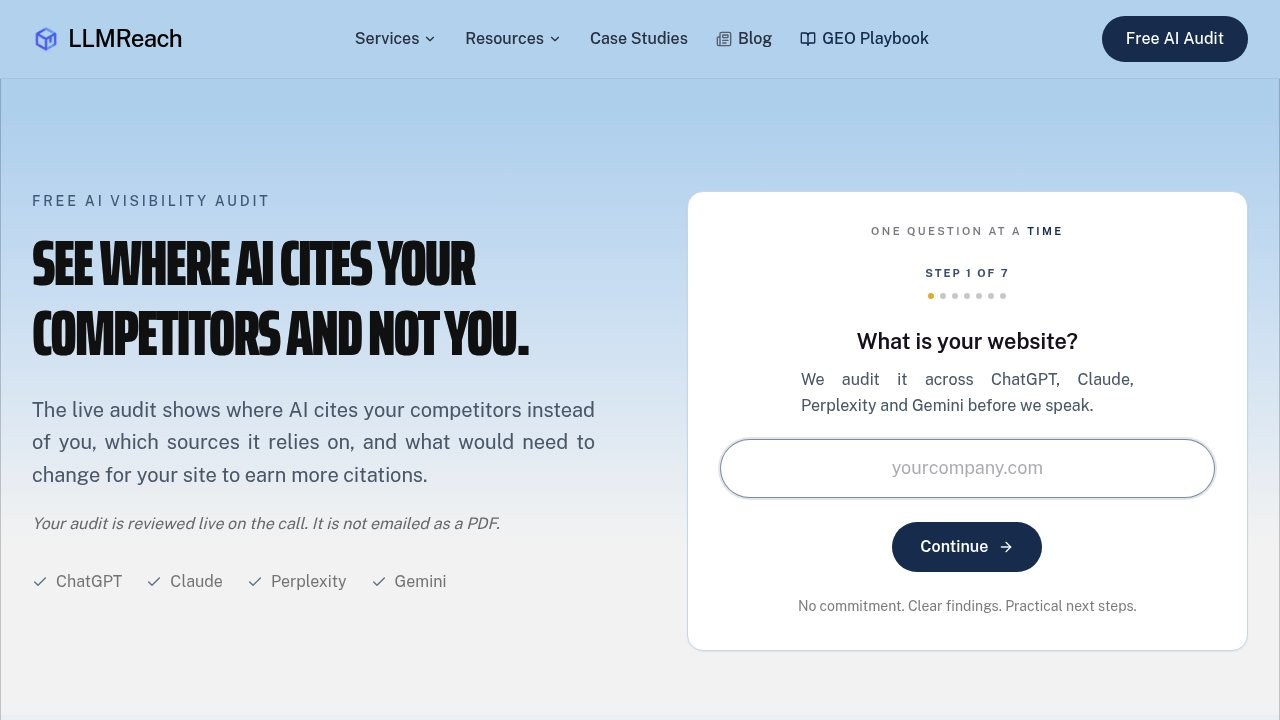
Get your free AI visibility audit before you compare agencies, not after.
LLMReach is built for this specifically
LLMReach does not sell SEO, paid media or content marketing as separate services. Every engagement is built around one output: citations, tracked against the client's own baseline.
| Discipline | What it does |
|---|---|
| Prompt research | The fifty prompts your buyers use before they decide, agreed with you before work begins |
| Technical optimisation | Crawler access at robots.txt and at the edge, rendering, schema, entity consistency |
| Content | Answer-first, specific, structured so a section survives being quoted alone |
| Community | Corroboration where buyers actually discuss the category |
| Citation tracking | The prompt set run across all four engines, reported against baseline in a shared dashboard |
The commitment
The Citation Stack is guaranteed as a whole: a 30% increase in total citations across your site, measured against your own baseline, within 90 days. If that is not reached, you choose between continued work at no charge and a full refund.
A baseline is recorded before work begins, and it is the benchmark everything afterwards is read against. You receive weekly updates and a fortnightly review.
Why the commitment is possible
Because the agency runs all five inputs rather than advising on them. A provider that only audits or reports has no lever on the outcome and therefore nothing to commit to. That is the whole difference, and it is why the commitment is written on total citations against your own baseline rather than on any single answer.
The category is early enough that the choice still changes the outcome
Citation authority compounds. A brand established across the four engines before its competitors get there is harder to displace later, because the position is not a ranking that resets with an update, it is accumulated corroboration.
The right starting point is a baseline. Before comparing agencies, before writing a brief, before signing anything, find out where you stand. Run the free AI visibility audit and see which engines are naming competitors instead of you.
Frequently asked questions
What is an AI citation optimization agency?
An agency whose primary measured output is how often AI engines cite your brand, rather than where your pages rank. The work spans prompt research and a recorded baseline, crawler access, content built to be extracted, corroboration on sources outside your own domain, and citation tracking across ChatGPT, Claude, Perplexity and Gemini. An agency running only one or two of those is optimising for a fraction of the signals engines use.
How is citation optimization different from SEO?
SEO works on ranking in a list of links. Citation optimization works on whether an engine uses your page as a source when it writes an answer. They share inputs and measure different outputs, and the gap is measurable: Ahrefs, across 1.4 million ChatGPT prompts, found the model cites only about half the URLs it retrieves. A page can rank fourth and never be cited.
How do I tell a real citation agency from an SEO agency that added GEO to its site?
Ask to see, live on the call, where one of their current clients appears in ChatGPT or Perplexity for a real buyer question. An agency that has built citation tracking can do this in a minute. A case study PDF or a screenshot from three months ago is not the same answer. Then ask what their prompt set looks like, how many prompts, which engines and at what cadence.
Do most AI citations come from your own site or from third-party pages?
It depends on who is counting, and the disagreement is worth understanding. AirOps reports that 85% of brand mentions came from third-party pages, and Muck Rack's analysis of more than 25 million cited links puts earned media at 84% of citations. Yext, analysing 6.8 million citations, reports 86% coming from sources marketers can manage or strongly influence, counting business listings as controllable. The classification of listings is what flips the headline. Both are vendor research, and both conclusions point toward the vendor's own product.
Can an agency guarantee citations in AI answers?
A commitment is only meaningful if it names a metric, a window and a baseline. LLMReach guarantees the Citation Stack as a whole: a 30% increase in total citations across your site, measured against your own baseline, within 90 days. If that is not reached, you choose between continued work at no charge and a full refund. What makes that possible is running all five inputs rather than advising on them, since a provider that only audits has no lever on the outcome.
Why does an agency need to track more than one engine?
Because citation behaviour differs sharply between engines, so one engine is not a sample of the rest. Repetition matters as much as coverage: a study of five LLMs run ten times each under settings intended to be deterministic reported accuracy variations up to 15% across naturally occurring runs. A single check is one draw, not a measurement, which is why a credible agency reports a rate across repeated runs.
During a guided review meeting, LLMReach walks you through your priority buyer prompts, current AI visibility, competitor citations, source patterns, and the technical or content gaps that matter most. You leave the call knowing where the gap is, what is causing it, and which changes would matter first.