How LLM Reach Uses Citation Graph Analysis to Identify the Sources Driving Competitor Model Performance
By Karim MezitiJune 30, 2026Updated June 2026
Executive Summary: Why Competitor Analysis Fails in AI Search
Key Takeaways
Most GEO competitor analysis tools summarize outcomes (mentions, rankings, share of voice) but cannot explain the source pathways that produce them.
Enterprise buyers need prescriptive guidance, source-level attribution evidence, and governance controls, not another dashboard.
LLM Reach's citation graph approach connects competitor performance back to the exact source clusters, influence patterns, and decision opportunities that actually drive AI recommendations.
The competitive intelligence problem in AI search is not a data problem. It is an attribution problem.
Enterprise teams can already see that a competitor is appearing more frequently in ChatGPT, Perplexity, or Claude responses. What they cannot see, with most tools currently on the market, is why. Which sources are being cited? Which documents, domains, or topic clusters is the model treating as authoritative for this category? Which specific relationships in the source graph are producing that competitor's prominence, and what would it take to displace them?
That gap between outcome visibility and source-level attribution is where most GEO competitor analysis breaks down. Tools track mentions. They aggregate share of voice. Some overlay sentiment. But when a strategy leader asks "what do we actually change to win more AI citations in this category," the answer is rarely in the dashboard.
LLM Reach addresses this by treating citation graph analysis as the core analytical layer, not a reporting add-on. The system maps competitor performance back to the specific sources, citation patterns, and topical clusters that shape model behavior, then converts that evidence into ranked, actionable recommendations with the lineage and governance controls enterprise procurement teams require.
The Market Gap: Where Current Competitor Analysis Tools Break Down
The GEO vendor landscape has grown quickly, but most platforms were built on an SEO-era assumption: that tracking what appears in outputs is the same as understanding what drives them. In AI search, that assumption is structurally wrong.
There are three specific gaps that enterprise buyers encounter when they pressure-test current competitor analysis tools.
Gap 1: Actionability
Most platforms can tell you that a competitor's brand appeared in 34% of AI responses for a given query cluster. Very few can tell you which source documents, which domain relationships, or which topical authority signals are producing that result, and fewer still can rank the interventions most likely to shift it.
The output is descriptive. The buyer need is prescriptive. That gap is not cosmetic; it is the difference between a monitoring product and a competitive intelligence system.
Gap 2: Depth of Analysis
Competitive AI visibility requires tracing model behavior back to its source layer. When a large language model surfaces a competitor in a recommendation, it is drawing on a retrieval or training signal that traces to specific documents, domains, and citation relationships. Tools that stop at the output layer, measuring what the model said, without examining what the model drew from, are measuring the shadow rather than the object.
Research across 252,000 trials and 21,000+ citations demonstrates that grounded attributions, linking model answers to specific documents, are essential for verifiability and trust. Without source-level attribution, a competitive analysis cannot distinguish between a competitor winning because of a single high-authority document versus a broad citation cluster, a distinction that changes the entire response strategy.
Gap 3: Enterprise Readiness
This is the gap most vendors underestimate. According to Kiteworks, 63.6% of AI-capable business software products do not disclose their AI subprocessors, creating material compliance exposure for enterprise buyers operating under GDPR, SOC 2, or internal AI governance mandates.
Enterprise procurement teams are no longer evaluating GEO tools purely on feature breadth. They are asking: Can you provide lineage for your recommendations? What data does your system process, and where? Who are your subprocessors, and are they contractually bound to equivalent safeguards?
The table below maps how these three gaps typically manifest across current tool categories:
Capability Dimension | Typical Dashboard Tool | Citation Graph System |
|---|---|---|
Actionability | Shows mention frequency and share of voice | Identifies specific sources, gaps, and ranked interventions |
Source Depth | Tracks model output text | Maps citation nodes, edges, influence centrality, and topic clusters |
Attribution Evidence | Aggregate score or index | Source lineage, document-level scoring, confidence signals |
Governance | Limited or undisclosed | Subprocessor transparency, lineage records, human review checkpoints |
Prescriptive Output | Trend charts and alerts | Prioritized action recommendations with supporting evidence |
The core problem: A tool that cannot answer "which sources are driving this competitor's performance, and what should we do about it" is not a competitive intelligence system. It is a monitoring feed.
What Citation Graph Analysis Actually Means in AI Visibility
The term "citation graph" comes from academic research infrastructure. Tools like Semantic Scholar and Connected Papers use directed citation graphs, where papers are nodes and citation relationships are edges, to surface influence patterns across a body of literature. The same structural logic applies to AI search visibility, but the stakes are commercial rather than academic.
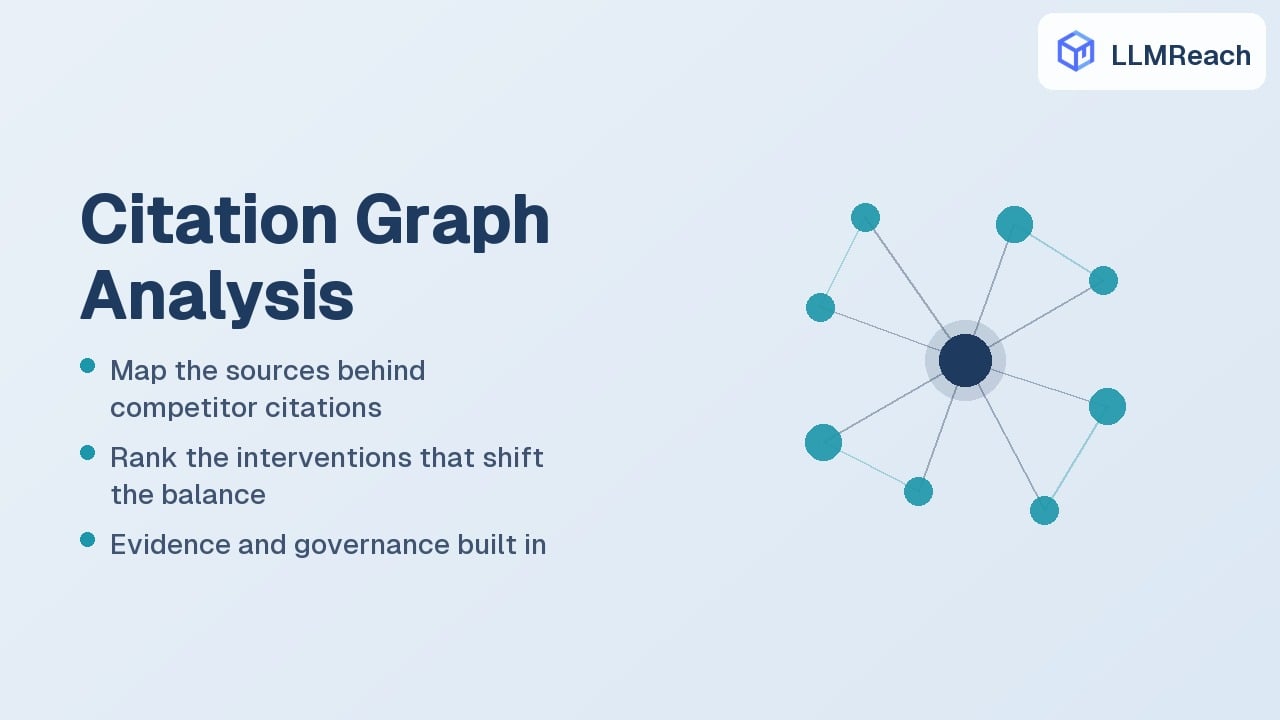
In an AI visibility context, a citation graph models the sources an AI system draws on as nodes, and the relationships between those sources (co-citation, referential dependency, topical clustering) as edges. Analyzing that graph reveals which documents and domains carry the most influence over model outputs in a given topic area, and by extension, which sources are shaping how a competitor is described, recommended, or ranked.
This is not visualization for its own sake. The analytical goal is inference: understanding which sources are doing the work inside the model's retrieval and weighting logic, and what that means for competitive positioning.
The Four Analytical Layers
A rigorous citation graph analysis for AI visibility operates across four layers:
Graph structure: Nodes (sources), edges (citation relationships), and centrality measures including in-degree (how often a source is cited), out-degree (how many sources it references), and eigenvector centrality (influence weighted by the authority of citing sources). These metrics, adapted from PageRank-style algorithms, identify which documents are structurally dominant in the citation network.
Retrieval behavior: How AI search engines, including ChatGPT, Perplexity, Claude, and Google AI Overviews, select, weight, and surface sources in response to specific queries. This layer requires multi-engine query testing because, as research has shown, there is low overlap between the source sets returned by different engines, meaning a source dominant on one platform may be invisible on another.
Source attribution: Linking specific model answers back to the documents that grounded them. As the research consensus in 2025 established, grounded attributions are a core requirement for trust and verifiability, not a UX enhancement. In competitive analysis, this means tracing a competitor's AI prominence back to the specific documents supporting it.
Topical clustering: Using community detection methods (Louvain-style modularity clustering is the current standard) to identify which topic neighborhoods a competitor's source cluster dominates, and where the gaps in that cluster create entry points for a challenger.
Key Terms
Term | Definition in AI Visibility Context |
|---|---|
Citation node | A source document or domain that appears in model outputs or is cited by sources that do |
Edge weight | The frequency and authority signal of a citation relationship between two nodes |
In-degree centrality | How often a source is cited across the graph; a proxy for model trust |
Topic cluster | A group of co-cited sources that collectively shape model behavior in a subject area |
Source gap | A topic cluster where a competitor has citation coverage and the target brand does not |
Grounded attribution | A traceable link between a model statement and the specific document that supported it |
The practical implication is direct: if a competitor is winning AI citations in a category, there is a source cluster producing that result. Citation graph analysis makes that cluster visible, measurable, and actionable.
Inside the LLM Reach System: From Raw Citations to Competitor Source Maps
Most competitive intelligence workflows in AI visibility start and end at the output layer: query a model, record what it says, count brand mentions. LLM Reach's citation graph pipeline starts one layer deeper, at the source level, and works backward from model outputs to the documents and domains producing them.
The pipeline has six stages.
Stage 1: Multi-Engine Query Collection
The process begins with a structured query set built around the target competitive category. Queries are designed to surface AI responses across intent types: informational, comparative, and recommendation-oriented. These are run simultaneously across ChatGPT, Perplexity, Claude, and Google AI Overviews.
Multi-engine coverage is not optional. Research testing nine AI search engines found low overlap between the source sets each returns, meaning a document that dominates competitor citations on Perplexity may not appear at all in Claude's outputs. A single-engine analysis produces a partial citation map at best and a misleading one at worst.
Stage 2: Answer Capture and Citation Extraction
Each model response is captured in full, including inline citations, source panels, footnotes, and referenced domains. Citations are extracted and normalized: URLs are resolved to canonical domains, redirect chains are collapsed, and entity references (brand names, author names, publication titles) are mapped to their source records.
This normalization step is where most ad-hoc citation tracking fails. A single source document may appear across multiple URLs, subdomains, and syndicated copies. Without resolution, the citation graph fragments, and influence scores become unreliable.
Stage 3: Graph Construction and Influence Scoring
Resolved citations become nodes in a directed graph. Edges represent citation relationships: co-citation (two sources cited together in the same model response), referential dependency (one source citing another within the same topic cluster), and competitive association (a source repeatedly cited alongside a specific competitor brand).
Each node is scored across six influence dimensions:
Dimension | What It Measures |
|---|---|
Frequency | How often this source appears across all query responses |
Centrality | In-degree and eigenvector centrality within the citation network |
Cross-engine overlap | Whether the source appears across multiple AI platforms |
Recency | Publication date weighted against citation frequency (freshness signal) |
Topical clustering | Which topic community the source belongs to and how central it is within that community |
Competitor association | How strongly the source co-occurs with competitor brand mentions |
The combination of centrality and competitor association is the core analytical signal. A source with high centrality and strong competitor association is a structural driver of that competitor's AI prominence. It is the kind of source that, if the target brand earned a citation from or built a comparable document for, would directly affect the competitive citation balance.
Stage 4: Source Map Generation
Graph output is resolved into source maps: structured views of which documents, domains, and topic clusters are repeatedly contributing to competitor model performance across the query set.
A source map answers three questions:
Which sources are driving this competitor's AI citations? (The top-centrality, high-competitor-association nodes.)
Which topic clusters does the competitor dominate? (The communities where their associated sources have the highest density and influence.)
Where are the gaps? (Topic clusters where the competitor has citation coverage and the target brand has none, or where high-centrality sources exist that neither brand has earned a citation from.)
Stage 5: Competitive Gap Identification
Source maps are compared across competitors and the target brand to produce a competitive gap analysis. This is not a share-of-voice comparison. It is a structural comparison of citation coverage: which source clusters each brand occupies, which clusters are contested, and which are currently owned by a single competitor with no meaningful challenger presence.
The part most competitive analyses miss: a competitor's AI prominence is often concentrated in a surprisingly small number of high-centrality sources. Displacing that prominence does not require outranking them everywhere. It requires identifying those structural nodes and building a credible citation presence in the same cluster.
Stage 6: Evidence Packaging
Every source map, gap analysis, and competitive finding is packaged with full lineage: the queries that produced each citation, the engines that returned it, the scoring parameters applied, the timestamp of collection, and the confidence level assigned to each influence score. This evidence package is not a supplementary report. It is the governance record that makes the findings defensible in enterprise procurement, legal review, and internal strategy presentations.
How LLM Reach Turns Graph Output Into Prescriptive Guidance
A citation graph is a diagnostic instrument. The source map it produces tells you what is happening and why. But the output that enterprise teams actually need is a ranked list of what to do next, with enough evidence to defend the priority order internally.
This is the action layer, and it is what separates a competitive intelligence system from a competitive intelligence report.
From Source Map to Intervention Priority
Once the citation graph identifies the high-centrality, competitor-associated sources in a category, the next step is ranking the interventions most likely to shift the competitive citation balance. LLM Reach scores each intervention opportunity across four dimensions:
Dimension | Description |
|---|---|
Probable impact | How much would earning a citation from this source cluster shift the target brand's AI prominence in this topic area? |
Feasibility | Is this source cluster reachable through content creation, PR outreach, partnership, or technical AEO? |
Source authority | How high is the centrality score of the target source? A citation from a structurally dominant node carries more weight than coverage from a peripheral one. |
Competitive saturation | How many competitors already have citation coverage in this cluster? Unsaturated clusters with high centrality are the highest-leverage entry points. |
The output is a prioritized action list, not a ranked chart. Each item specifies the source cluster, the recommended intervention type, the evidence supporting the priority score, and the expected impact on competitive citation share if the intervention succeeds.
Recommendation Types
Citation graph analysis generates five categories of prescriptive recommendation:
Content build: Create a new document designed to occupy a specific gap in the citation cluster. The brief specifies the topic, the structural format most likely to earn citations from the target engine, and the authority signals required.
Content refresh: An existing asset is already in the citation neighborhood but is losing recency weighting. Updating it to current standards and re-earning citations from high-centrality sources can recover lost ground faster than building from scratch.
Citation outreach: A high-centrality source in the competitor's cluster has not cited the target brand. Structured outreach to earn that citation, through contributed content, expert commentary, or data sharing, is the fastest path to entering the cluster.
Entity and relationship building: Some source clusters are shaped by entity associations (author authority, organizational credibility, partnership signals). Building these relationships directly strengthens the brand's position in the citation graph, independent of any single document.
Technical AEO: Structural changes to existing content, including schema markup, answer-first formatting, and citation-ready structure, that increase the probability of a document being selected as a grounded attribution source by AI retrieval systems.
Key insight: The most common finding from citation graph analysis is that a competitor's AI prominence in a category is anchored by three to five high-centrality source documents, not by broad coverage. Targeting those specific nodes with a credible alternative or earning a citation from them directly is consistently the highest-leverage intervention available.
This is the actionability gap closed. Instead of telling a team to "create more AI-friendly content," the system identifies the specific cluster, the specific documents, and the specific intervention type most likely to produce a measurable shift in competitive citation share.
Enterprise Readiness: Compliance, Security, and Decision Defensibility
Feature capability is no longer sufficient for enterprise GEO vendor selection. Procurement teams, legal counsel, and data governance leads are applying the same standards to GEO platforms that they apply to any AI system handling competitive data: can you prove what the system did, why it reached a conclusion, and whether it operated within our compliance requirements?
This is the standard of decision defensibility, and it is the dimension most current GEO platforms are least prepared to meet.
What Decision Defensibility Requires
Enterprise AI governance frameworks increasingly define trustworthiness not as accuracy alone, but as the ability to explain the operations behind a decision and defend the data conclusions that produced it. For a citation graph system, that means every recommendation must come with a complete evidence pack:
The queries that generated the citation data
The AI engines queried and the timestamps of collection
The scoring model applied to influence and centrality calculations
The source records for every node in the relevant citation cluster
The confidence level assigned to each finding
The human review checkpoints applied before recommendations were finalized
Without this record, a strategy team cannot defend a budget decision based on the analysis, a legal team cannot assess data handling risk, and a procurement team cannot verify the system's compliance posture.
Subprocessor Transparency
Kiteworks research found that 63.6% of AI-capable business software products do not disclose their AI subprocessors. For enterprise buyers operating under GDPR, CCPA, or internal AI governance mandates, this is not a minor gap. It is a material compliance risk.
"Opaque vendor ecosystems are now a central compliance risk in AI.", Kiteworks
Enterprise GEO buyers should require complete subprocessor inventories, contractual representations that bind subprocessors to equivalent data safeguards, and documented evidence of end-to-end governance over how competitive data is collected, processed, stored, and deleted.
Enterprise Evaluation Checklist
Use this checklist when evaluating any GEO competitor intelligence platform for enterprise deployment:
Does the vendor provide full lineage for every competitive finding (queries, engines, timestamps, scoring parameters)?
Can the vendor produce a complete subprocessor inventory with contractual safeguards?
Are confidence scores and uncertainty signals attached to every recommendation?
Does the system include human review checkpoints before findings are finalized?
Is source-level attribution available at the document and domain level, not just as an aggregate score?
Can the vendor demonstrate how the system handles data residency requirements relevant to your jurisdiction?
Is there an audit log of system operations that can be produced for internal governance review?
Does the vendor provide evidence packs that can be shared with legal, procurement, and executive stakeholders without additional translation?
The buying standard has shifted. A GEO vendor that cannot answer these questions with documented evidence is not enterprise-ready, regardless of how sophisticated its citation analysis claims to be. Decision defensibility is not a procurement formality. It is the proof that the system is trustworthy enough to base strategic decisions on.
A Repeatable Buyer Framework for Evaluating GEO Competitor Intelligence Platforms
The vendor evaluation conversation in GEO has been dominated by demo dashboards and share-of-voice screenshots. Neither tells a buyer whether the system can actually explain competitor performance or produce defensible recommendations.
A more rigorous evaluation scores vendors across four dimensions. The table below provides a scoring framework buyers can apply directly in vendor conversations:
Evaluation Dimension | What to Ask | Minimum Acceptable Answer |
|---|---|---|
Source Attribution Fidelity | Can you show me which specific sources drove this competitor's AI citations in this query set? | Document-level source records with citation frequency and centrality scores |
Prescriptive Actionability | Given this source map, what do you recommend we do next, and why in that order? | Ranked intervention list with impact scoring, feasibility assessment, and source evidence |
Graph Depth | How do you construct the citation graph, and what influence dimensions do you score? | Documented methodology covering frequency, centrality, cross-engine overlap, recency, and topical clustering |
Governance Readiness | Can you provide a sample evidence pack and your full subprocessor inventory? | Complete lineage documentation, subprocessor list, confidence scores, and audit log access |
The Best Buying Question
Most vendor evaluations ask: "Do you track citations?" Nearly every platform will say yes.
The question that separates monitoring tools from competitive intelligence systems is this:
"Can you prove which sources drove this conclusion, show me the confidence level you assigned to that finding, and tell me exactly what we should do about it?"
A credible platform answers all three parts. A dashboard tool answers the first and deflects the second and third. That deflection is the signal.
From Source Visibility to Strategic Control
The shift from traditional SEO to AI-driven search has not changed the fundamental competitive question: why does a competitor win, and what does it take to displace them? What has changed is where the answer lives.
In AI search, the answer lives in the citation graph, in the specific sources, clusters, and relationships that shape how models describe, recommend, and rank brands in a category. Monitoring outputs without mapping those sources is the equivalent of tracking stock prices without understanding the company.
Key takeaway: Source-level citation analysis gives enterprise teams a way to explain competitor performance instead of guessing at it. The combination of graph analysis, prescriptive guidance, and governance controls is what makes the system enterprise-ready and the findings defensible.
Citation graph analysis identifies the structural source drivers of competitor AI prominence, not just the outcomes.
Prescriptive recommendations convert graph evidence into ranked, feasible interventions with clear priority logic.
Enterprise governance controls make findings defensible across procurement, legal, and executive stakeholders.
Ready to see which sources are driving your competitors' AI citations?
LLM Reach's AI visibility audit maps the citation graph for your category, identifies the source clusters your competitors depend on, and delivers a prioritized intervention plan with full evidence lineage.
Book your AI visibility audit and get the source-level competitive intelligence your category strategy actually requires.
Frequently Asked Questions
What is citation graph analysis in AI visibility?
Citation graph analysis maps sources as nodes and citation relationships as edges, then measures influence, overlap, and clustering. In AI visibility, it shows which documents and domains most likely shape model answers, recommendations, and competitor prominence.
Why is source-level attribution important for GEO vendor evaluation?
Source-level attribution proves which documents or domains support a model output, instead of only showing that a brand appeared. That matters because enterprise teams need evidence they can defend internally, not just dashboards or share-of-voice summaries.
How does LLM Reach use citation graphs differently from standard competitor tracking tools?
LLM Reach goes beyond mentions and rankings by connecting competitor performance back to specific source clusters, centrality signals, and citation paths. The result is a prioritized action plan, not just a visibility report.
What makes a GEO platform enterprise-ready?
Enterprise-ready GEO platforms need lineage, confidence signals, source records, human review points, and transparent subprocessors. If a vendor cannot explain how recommendations are generated and governed, it is not ready for procurement-sensitive use.
What should buyers ask before choosing a competitor analysis platform for AI search?
Buyers should ask which sources drove the conclusion, how the citation graph was built, what confidence was assigned, and what action is recommended next. That separates a monitoring tool from a defensible decision system.
During a guided review meeting, LLMReach walks you through your priority buyer prompts, current AI visibility, competitor citations, source patterns, and the technical or content gaps that matter most. You leave the call knowing where the gap is, what is causing it, and which changes would matter first.