AEO and LLMO Explained: What the Terms Mean and Whether You Actually Need to Act
By Karim MezitiSeptember 19, 2026Updated June 2026
Someone pitched you on "AEO", "LLMO" or "generative engine optimization" recently. Maybe it was a vendor email, a conference slide, or a post from someone who had just discovered a new acronym. Your instinct was probably healthy scepticism: this sounds like SEO with a rebrand.
That instinct is worth examining, because it is partly right and partly wrong. The acronyms are genuinely confusing, the vendor hype is real, and some of the tactics sold under these labels do not work. But the underlying shift in how people find information is also real and already moving revenue.
This article gives the honest version: what the terms mean, where the signal is, where the noise is, and how to decide whether this belongs on your roadmap.
The short answer: AEO and LLMO are not snake oil. They describe a real change in how buyers discover brands. What is often snake oil is the specific tactic being sold to you, not the category itself.
Request your free AI visibility audit
Your audit is reviewed live on the call. It is not emailed as a PDF.
The Acronyms Are Confusing Because the Industry Made Them That Way
There are now at least four acronyms circulating for roughly the same work: SEO, AEO, GEO and LLMO. Wikipedia's entry on generative engine optimization notes that no consensus definition separating these terms exists in the academic literature and that practitioners use them interchangeably. That is not a knock on the field. It is what happens in a fast-moving space where vendors have an incentive to brand around their preferred term.
| Term | Stands for | What it optimises for | Genuinely distinct? |
|---|---|---|---|
| SEO | Search Engine Optimization | Rankings in Google and Bing | Yes, and it is the foundation the rest builds on |
| AEO | Answer Engine Optimization | Featured snippets, voice assistants, zero-click answers | Partly, for answer surfaces that predate generative AI |
| GEO | Generative Engine Optimization | Citations inside AI-generated answers | Overlaps heavily with LLMO |
| LLMO | Large Language Model Optimization | How models represent your brand, including from memory | Overlaps heavily with GEO |
The One Distinction That Actually Matters
AEO is the only term with a genuinely separate origin. It emerged before the current generation of generative AI, around featured snippets and voice assistants. Those surfaces still exist and still run on different mechanics from a ChatGPT or Perplexity answer, so AEO keeps a distinct meaning for non-generative answer features.
GEO and LLMO describe nearly identical work. Forbes set out the distinction in August 2026: GEO focuses on live generative-search citation while LLMO zooms out to include how the model represents your brand in its own knowledge. But the available tactics are the same, because you cannot edit a model's training data. What you can do is build the content, entity signals and third-party corroboration that shape what it learns.
The practical takeaway: stop worrying about which acronym to use. The question that matters is whether you appear when someone asks an AI engine about your category.
The Scepticism Is Justified, But Aimed at the Wrong Target
The snake oil critique is fair applied to specific tactics. It is not fair applied to the category.
A widely read piece from April 2026 examined the evidence behind common GEO deliverables and found that SE Ranking's analysis of a large domain sample showed no significant correlation between having an llms.txt file and AI citation rates. Removing the file from their prediction model reportedly improved its accuracy.
That finding deserves to be taken seriously, and it illustrates the actual problem with how this category gets sold. Vendors package a checklist of technical tweaks and call it GEO. When the checklist does not move the number, the whole category gets dismissed along with it.
It is worth being precise here rather than tribal. A file at your domain root is a declaration, not a ranking factor, and treating any single file as the lever was always going to disappoint. That is different from saying technical work does not matter: crawler access is binary and decides whether you are eligible at all. The distinction is between a checkbox and a system.
What the Critique Actually Reveals
The problem is not that citation work is fake. It is that most of what gets sold as citation work is:
- One-time deliverables, such as file uploads, schema changes and content audits, sold as though they produce lasting results
- Measurement tools that track where you appear without doing anything to change where you appear
- Checklist execution with no connection to how engines actually decide what to cite
The question for a marketing lead is not whether the category is real. It is whether the specific thing being sold is connected to citation outcomes. Most of it is not. But the underlying problem, your brand being absent when buyers ask about your category, is real and gets more expensive the longer it runs.
What Actually Moves Citations Has Nothing to Do With File Uploads
The researchers who coined the term GEO, in their 2023 paper from Princeton, Georgia Tech, the Allen Institute for AI and IIT Delhi, did not study file formats or technical checklists. They studied which content characteristics caused engines to cite a source more often, and the pattern was consistent: engines favour sources that are easy to trust, easy to parse and corroborated elsewhere. The mechanics are covered in more depth in how AI engines decide what to cite.
That translates into five categories of work, none of which is a one-time deliverable. Their interdependence is the argument behind the Citation Stack.
1. Prompt research
This starts with knowing which prompts your buyers actually run. Not keyword research, not search volume: the specific questions people type into ChatGPT and Perplexity when they are in your buying category. Those prompts are the target. Everything else is optimisation toward a target you have not identified.
2. Technical access
Crawlers need to be able to read your site: clean crawlability, structured data that declares what your business is, and content arranged so the relevant answer appears early rather than in the seventh paragraph. Analysis by Kevin Indig, reported in Search Engine Land, found a large share of LLM citations come from the opening portion of a page. If your key information is buried it will not be cited, however well everything else is optimised. This is the work covered by technical AEO infrastructure.
3. Citable content
Engines cite content that reads like a source rather than a marketing page. That means specific figures, named claims, clear definitions and answers that can be lifted and still make sense on their own. "We are the leading provider of X" is not citable. "X works by doing Y, and the constraint is Z" is.
4. Third-party corroboration
When real people discuss your brand, recommend it, or mention it in the context of a problem you solve, engines treat that as validation. Reddit is the most citation-dense community platform in this ecosystem, which is why it is part of the stack rather than an afterthought. It has to be done in a way that survives moderation, because a removed thread cites nothing: the rules are in getting mentioned on Reddit without getting banned, and the managed version is Reddit authority.
5. Citation tracking
You cannot improve what you cannot measure. This means running the target prompts against the major engines on a regular cadence, recording whether your brand appears, and tracking that against a baseline. Without it there is no feedback loop and no way to know whether anything is working.
The key point: none of these five is a one-time deliverable. Each needs ongoing execution, iteration and measurement, which is why the checklist-and-report model fails. It treats a continuous system as a project with an end date.
Request your free AI visibility audit
Your audit is reviewed live on the call. It is not emailed as a PDF.
The First Question Is Whether You Even Have a Problem
Before investing in any of this you need a baseline. Most marketing leads who reach this topic do not actually know whether their brand appears in AI answers. They have a suspicion, or they noticed a competitor mentioned in a ChatGPT response, but they have not tested it systematically.
A baseline audit does three things:
- Identifies the prompts that matter for your category, the questions real buyers run across the major engines
- Tests each one to see whether your brand appears and how accurately it is represented
- Benchmarks your position against competitors, so you know whether you are behind, level or ahead
Without a baseline, any work is optimisation toward an unknown target. With one you have a number, measured against a defined prompt set, that either moves or does not.
How to Evaluate What You Are Being Sold
Your job is not to become an expert in citation mechanics. It is to ask the right questions of anyone claiming they can improve your AI visibility.
1. What is the metric and how is it measured? The meaningful one is citation frequency: how often your brand appears in AI answers for a defined prompt set. If the answer involves visibility scores, readiness indexes or proprietary dashboards with no connection to actual engine output, that is a flag.
2. What is the baseline window? A credible engagement establishes a baseline before work begins. A vendor billing before measuring where you stand has no way to prove the work produced anything.
3. What does the execution actually include? Press for specifics. "Content optimisation" means nothing. "We will publish three answer-first pages targeting these five prompts and track citation frequency weekly" means something. The gap between vague and specific is usually the gap between theatre and work.
4. Is there a guarantee, and what is the remedy? Many providers say guarantees are impossible because AI responses are non-deterministic. That is true for a specific prompt on a specific day, and true generally for anyone who only advises or reports. It is not true for an aggregate across a defined prompt set when the provider controls the execution. Ask what the metric is, what the baseline is, and what happens if it is missed.
5. What happens after the initial engagement? The prompts your buyers run change, competitors invest in the same signals, and model behaviour shifts. If the answer is "we deliver a report and you implement", the results will not compound.
The Difference Between a Tool and an Agency
A large share of this market is software that measures AI visibility. Those tools are useful for understanding where you stand. They do not move the number. Paying for a dashboard that shows you are not being cited is not a solution to not being cited.
The distinction that matters is execution versus reporting. Reporting tells you the problem exists. Execution changes the outcome. If you are weighing an agency against a platform or an in-house hire, the trade-offs are in how to choose.
Taking It to Your Leadership Team
The conversation will come down to whether this is worth the budget, and the honest framing is more useful than a statistic.
AI assistants are now a real part of how buyers research, particularly in categories where people ask around before committing. Appearing in those answers does not only get you mentioned: it reaches the buyer earlier than any channel you currently measure, before a competitor's site ever loads. And relatively few teams have a documented strategy for it, which means the position is still available in most categories.
The risk is not investing in something that does not work. The risk is watching a competitor get cited while you run the same playbook you ran in 2023, because the source environment these engines read is built over months and it stacks. You can hire someone in six months. You cannot buy back the six months.
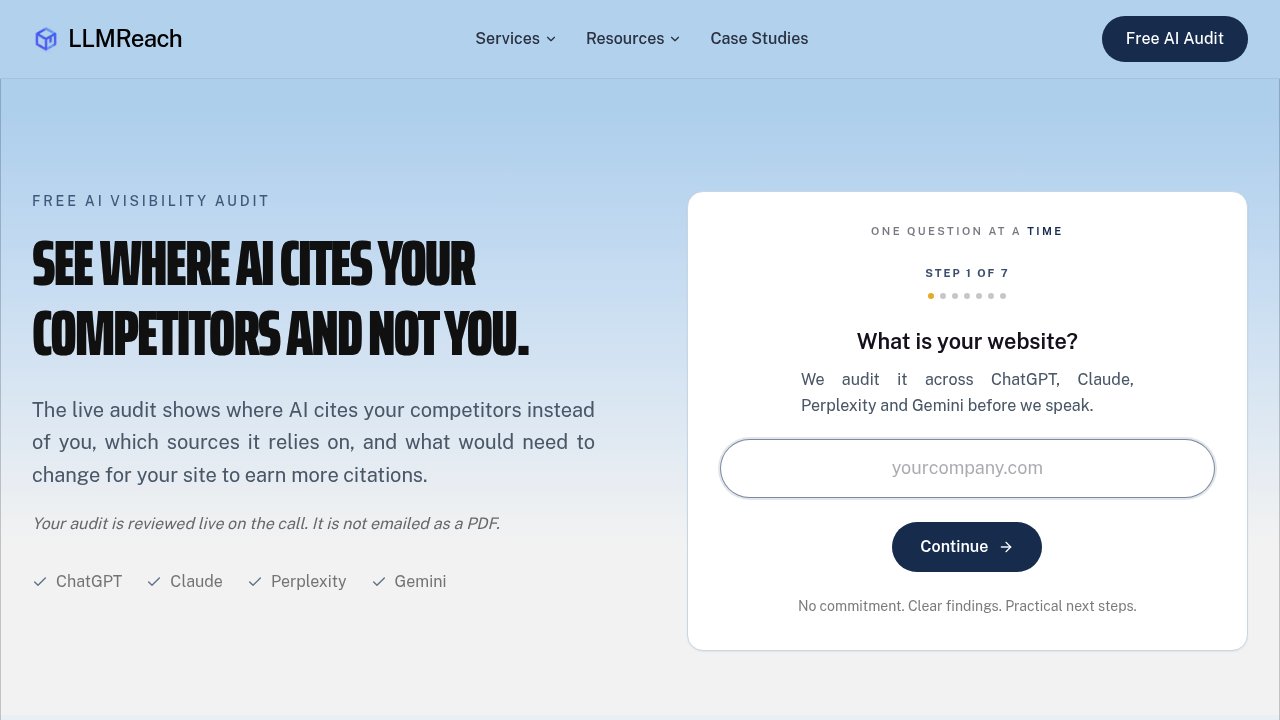
Start with the baseline. Before you evaluate any agency, any tool, or any internal allocation, find out where you stand: the prompts your buyers are running, which engines you appear in, and where competitors are winning instead.
Request your free AI visibility audit
Your audit is reviewed live on the call. It is not emailed as a PDF.
Frequently Asked Questions
What does AEO mean?
AEO means answer engine optimization. It focuses on getting your content surfaced in answer-style experiences such as featured snippets, voice results, and other direct-answer surfaces.
What does LLMO mean?
LLMO means large language model optimization. It refers to the work of making your brand easier for AI models to understand, trust, and mention in generated responses.
Is AEO the same as GEO?
Not exactly. AEO is an older term tied to answer surfaces, while GEO is usually used for generative AI citation work. The tactics overlap, but the labels reflect slightly different eras of search.
Is LLMO real or just hype?
LLMO is a real category of work, but the buzz around it can be overblown. The meaningful part is not the acronym itself, but whether your brand appears, is cited, and drives demand inside AI answers.
Do marketing leads need to care about AEO and LLMO?
Yes, if AI search is affecting how buyers discover your category. The practical question is whether your brand appears when people ask AI engines about your product or service, and whether competitors are winning that visibility instead.
During a guided review meeting, LLMReach walks you through your priority buyer prompts, current AI visibility, competitor citations, source patterns, and the technical or content gaps that matter most. You leave the call knowing where the gap is, what is causing it, and which changes would matter first.