Why Citation Authority Is the Core of Generative Engine Optimization
By Karim MezitiSeptember 18, 2026Updated June 2026
Citation authority is the deciding factor in generative engine optimization. It determines whether ChatGPT, Perplexity, Gemini or Claude names your brand in an answer, or names a competitor instead.
Most brands treat GEO as a content problem. They publish more pages, add FAQ sections and update their schema. Those things matter, but they address one layer of what the engines evaluate. The deeper layer is trust: whether a model considers your brand safe enough to cite in front of its users.
The core idea: engines are not optimising for the best answer so much as for the answer least likely to be wrong. A model that cites a brand incorrectly loses user trust, so the question it is really asking is which source is safest to repeat. Citation authority is how you become that source.
This article covers how citation authority works, why it differs from domain authority, which signals build it, and why three of the five sit off your own domain.
Request your free AI visibility audit
Your audit is reviewed live on the call. It is not emailed as a PDF.
Citation Authority Is Not Domain Authority
Domain authority is a backlink metric. It measures how many pages link to yours and how trusted those linking pages are. It was built to approximate Google's ranking behaviour and it does that reasonably well.
Citation authority is a different thing. It measures whether an engine trusts your brand enough to include it in a synthesised answer. The two use different inputs, reward different behaviour and produce different outcomes. A page can rank first and never be cited, and a page that ranks nowhere can be cited repeatedly.
The peer-reviewed work here is the GEO paper presented at KDD 2024 by researchers at Princeton, Georgia Tech, the Allen Institute for AI and IIT Delhi. It found that applying a set of content-level changes raised visibility in generative engine responses substantially over unoptimised baselines, and it did so independently of how authoritative the domain was.
What Engines Actually Evaluate
When a prompt arrives, the engine runs roughly four steps:
- Retrieve a candidate pool from its index or a live search
- Filter those candidates by relevance, factual density and source signals
- Synthesise the strongest passages into a coherent answer
- Attribute the sources it leaned on
Citation authority is decided at the filter step, where the engine is effectively asking three things about each candidate:
- Is this claim stated clearly enough to lift and repeat?
- Is this brand mentioned consistently across independent sources?
- Does the content carry signals, such as schema, structure and named entities, that make it safe to attribute?
A page with heavy backlinks but no direct-answer structure fails that. A page with no backlinks but a clear self-contained answer, consistent mentions elsewhere and valid structured data can pass it. The mechanics are covered in more depth in how AI engines decide what to cite.
The Backlink Parallel
The closest analogy in traditional SEO is the backlink. Just as links signal to a search engine that other sites vouch for your content, earned mentions on third-party platforms signal to an AI engine that other sources corroborate your claims.
The practical consequence is uncomfortable for most marketing teams: your own website is the weakest signal in the stack. A claim that appears only on your domain is a single data point. The corroboration that happens elsewhere is what tips the decision, which is why a content-only programme hits a ceiling.
The Five Signals That Build Citation Authority
Citation authority is not a single lever. It is built from five signals that compound, each addressing a different layer of how engines evaluate sources. That interdependence is the argument behind the Citation Stack.
| Signal | What it addresses | Where it lives |
|---|---|---|
| Answer-first page structure | Extractability | Your domain |
| Factual density with named sources | Risk reduction | Your domain |
| Structured data and crawler access | Eligibility and attribution | Your domain |
| Community corroboration | Independent verification | Off domain |
| Entity consistency across the web | Recognition | Off domain |
Two of the five sit entirely off your own domain, and they are the two most brands never touch.
Signal 1: Answer-First Content Structure
Models retrieve passages, not pages. If your answer sits in the seventh paragraph after three sentences of context-setting, the passage gets skipped. Analysis by Kevin Indig, reported in Search Engine Land, found that a large share of LLM citations come from the opening portion of a page.
The fix is structural. Every section of every page that matters should open with a direct, self-contained answer to the question it targets. Not "in this section we will explore", but the answer itself, stated plainly, in the first sentence.
The pattern that performs is a question-shaped heading followed immediately by a short, complete answer. Everything else on the page is support.
Signal 2: Factual Density and Cited Statistics
The KDD 2024 work found that adding statistics and citing sources were among the interventions that produced the largest visibility gains of anything tested. The mechanism is risk minimisation: a claim backed by a named, verifiable figure is safer for a model to repeat than an unsupported assertion.
The attribution is the part that carries the weight, not the number. "$1.32 billion" on its own is a claim. "$1.32 billion, according to [named source, dated report]" is a citable fact. A statistic with no source attached gives a model nothing to stand behind, and it is the first thing a careful reader checks.
Signal 3: Structured Data and Technical Access
The baseline requirement is crawler access, and it is binary. If robots.txt blocks OAI-SearchBot, PerplexityBot, ClaudeBot or Google-Extended, you cannot be cited regardless of how good the content is. It is also the most common silent failure in a GEO audit, because nothing in your analytics tells you it happened.
Above that floor, structured data and semantic markup make a page parseable and attributable: schema that matches what is visible on the page, clean heading hierarchy, and clear publication and modification dates so freshness can be assessed. This is the work covered by technical AEO infrastructure.
Signal 4: Community Corroboration
Engines weight community platforms as independent verification. A brand claim on your own domain is one data point. The same claim appearing in a community thread, a professional network post and a press mention is a corroborated fact, and corroboration acts as a trust multiplier.
This is not about gaming anything. It is about genuine presence in the communities where your buyers already talk, and it has to survive contact with moderators, because a removed thread cites nothing. The rules and what actually gets accounts removed are in getting mentioned on Reddit without getting banned, and the managed version is Reddit authority.
Signal 5: Entity Consistency Across the Web
Engines build an internal model of what each brand is and what it is authoritative about. That model is assembled from signals across your domain, your business listings, professional networks, community platforms and press.
Inconsistency weakens it. If your name, category and description differ across those surfaces, the engine has a blurrier picture of what you are, and a blurry entity is a riskier citation. Consistency sharpens the model, and a sharper model means a higher probability of being named when a relevant question is asked.
Request your free AI visibility audit
Your audit is reviewed live on the call. It is not emailed as a PDF.
Citation Authority Compounds, Which Is Why Starting Late Is Expensive
This is not a one-time optimisation. It is a compounding asset, and the loop is fairly direct.
- Build citable, answer-first content with sourced claims and clear entities
- Earn third-party mentions through community presence and press
- Those mentions strengthen brand recognition in the retrieval systems
- Stronger recognition makes the brand a safer citation on relevant queries
- More citations generate more branded searches and more mentions
- The loop repeats from a higher baseline
The brand that builds citation authority in your category first becomes progressively harder to displace. The source environment these engines read is built over months and it stacks. You can hire someone in six months. You cannot buy back the six months.
Why Most GEO Audits Miss the Off-Domain Layer
The typical audit covers on-page factors: schema, heading structure, robots.txt, page speed. Those are real inputs and they are necessary. They are also the easiest things to check, which is why they are what most audits check.
But the two signals that separate a cited brand from an uncited one are answerability and corroboration, and neither is a technical fix. Answerability is a content architecture decision. Corroboration depends on who references you and where. An audit that stops at the technical layer leaves the most powerful signals unaddressed, which is why sites pass their audit and still never get named.
You Cannot Improve What You Have Not Measured
Before any of this makes sense you need a baseline: which engines cite your brand today, on which prompts, how often, and how that compares with your closest competitors.
Most brands do not have it. They know they are not appearing, but not which prompts are triggering competitor citations, which signals are missing from their pages, or where the corroboration gap is widest.
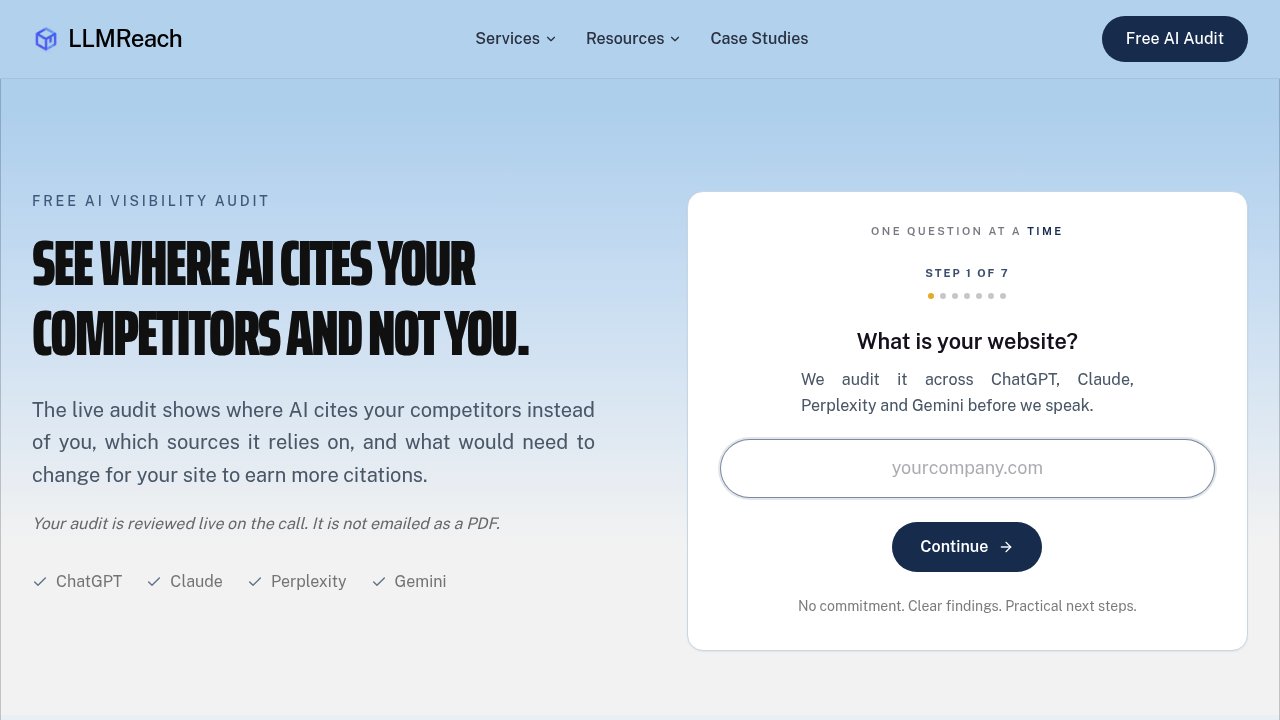
The audit establishes that baseline live on a call. It covers citation presence across ChatGPT, Perplexity, Gemini and Claude, identifies which competitors are being cited instead, and maps the specific gaps suppressing your frequency.
LLMReach Builds Citation Authority as a Managed System
Citation authority cannot be built by reading a guide and working through a checklist. The five signals require coordinated, ongoing execution across content, technical infrastructure, prompt research, community presence and tracking, and each depends on the others. A brand that fixes its schema but ignores corroboration sees limited growth. A brand that builds community presence with no answer-first content gives the engines nothing to extract.
LLMReach runs the whole system for clients, which is the difference between an agency that executes and a tool that reports. If you are weighing an agency against a measurement platform or an in-house hire, the trade-offs are in how to choose.
| Discipline | What LLMReach executes |
|---|---|
| Prompt research | The 50 prompts with demonstrated volume your buyers are already submitting, agreed jointly before work starts |
| Technical optimisation | Crawler access, schema, semantic HTML, metadata and freshness signals |
| Content | Answer-first rewrites and new pages built to survive passage extraction |
| Reddit authority | Genuine community presence that builds off-domain corroboration |
| Citation tracking | Measurement against the agreed prompt set, shared dashboard, weekly written updates |
The engagement runs a minimum of 90 days, then month to month with no lock-in. The baseline is averaged over the first 14 to 30 days.
The Guarantee
The Citation Stack is guaranteed as a whole: a 30% increase in total citations across your site, measured against your own baseline, within 90 days. If it is not reached, you choose between continued work at no charge and a full refund.
No individual page, prompt, platform or response is guaranteed separately, because no agency controls what any single model returns for any single question. The guarantee is on the aggregate, which is the honest version of the commitment.
It carries one condition: the client provides site access and approves what gets published. That is not a loophole, it is the minimum the execution requires. A brand that blocks publication cannot expect growth from content signals.
Citation Authority Decides Who Wins in AI Search
The shift from ranked links to synthesised answers changed the competitive unit. Ranking still matters for organic traffic. But the brand named in an AI answer reaches the buyer before a competitor's website ever loads, and that is a different kind of advantage. It is built through citation authority rather than keyword coverage.
The five signals are clear and the compounding dynamic is real. What separates the brands that build citation authority from the ones that read about it is execution.
Request your free AI visibility audit and get a live baseline covering citation presence, competitor gaps and the specific deficits suppressing your frequency.
Your audit is reviewed live on the call. It is not emailed as a PDF.
Frequently Asked Questions
What is citation authority in generative engine optimization?
Citation authority is the degree to which AI systems trust your brand enough to cite it in generated answers. It comes from clear content, structured data, third-party corroboration, and consistent entity signals across the web.
Why does citation authority matter for GEO?
Citation authority matters because AI engines prefer sources they can trust and safely repeat. If your brand lacks authority signals, competitors are more likely to be cited instead, even when your content is relevant.
Is citation authority the same as domain authority?
No. Domain authority is a backlink-driven SEO concept, while citation authority measures whether AI systems consider your brand safe enough to include in generated answers. They overlap, but they are not the same.
What signals build citation authority?
The biggest signals are answer-first content, factual density, structured data, Reddit, and consistent brand mentions across the web. Those signals work together to make your brand easier for AI models to trust and cite.
How does LLMReach help build citation authority?
LLMReach executes the full GEO system, including prompt research, technical optimization, content, Reddit authority, and citation tracking. The agency does the work needed to create and compound citation authority.
During a guided review meeting, LLMReach walks you through your priority buyer prompts, current AI visibility, competitor citations, source patterns, and the technical or content gaps that matter most. You leave the call knowing where the gap is, what is causing it, and which changes would matter first.