Do Generative Engine Optimization Agencies Guarantee Citations in AI Responses?
By Karim MezitiSeptember 18, 2026Updated June 2026
Most generative engine optimization agencies will tell you the same thing: citations cannot be guaranteed. AI engines are non-deterministic. The same prompt can return different sources on consecutive runs. No responsible provider promises a specific mention in ChatGPT or Perplexity.
That is the industry consensus, and it is mostly true.
But there is a meaningful difference between guaranteeing a specific citation on a specific prompt on a specific day, and guaranteeing a measurable increase in total citations across a tracked set of prompts over 90 days. The first is impossible. The second is what an execution programme can commit to.
The real question is not whether guarantees exist. It is whether the agency you are evaluating actually does the work or only reports on it.
Most providers in this market fall into one of two shapes:
- Measurement tools shaped like agencies. They track your AI visibility, send reports, and leave execution to you.
- Execution agencies with a results commitment. They build the signal stack, run the content, manage the authority layer, and tie the fee to citation growth.
This article explains what a guarantee can and cannot cover, what the standard offer looks like, and what to ask any agency before you sign.
Request your free AI visibility audit
Your audit is reviewed live on the call. It is not emailed as a PDF.
Why the Standard Position Is That Guarantees Are Impossible
The no-guarantees position is not dishonest. It reflects a real technical constraint. Language models are probabilistic. A model does not retrieve from a fixed index the way a search engine does. It generates an answer by predicting likely sequences, drawing on training data and, in retrieval-augmented systems, on a retrieved document set. Two runs of the same prompt can surface different sources.
That non-determinism is why most agencies stop short of any results commitment. They optimise inputs and observe outputs, but they will not tie their fee to what the outputs look like.
What the Standard Offer Looks Like
| What is promised | What is delivered |
|---|---|
| Improved technical foundations | Schema updates, crawlability fixes |
| Content optimisation | Answer-first page rewrites |
| Entity building | Knowledge graph and directory presence |
| Monthly reporting | Citation share across tracked prompts |
| No outcome guarantee | "We improve inputs, engines decide outputs" |
This is a defensible position, and for a provider that only advises it is the correct one. It is also a convenient one, because where there is no commitment to results there is no accountability for them.
The Distinction That Gets Collapsed
Two different claims get treated as one.
Guaranteeing a specific mention on a specific prompt requires predicting model behaviour on a single query. That is not possible, and anyone promising it is selling false certainty.
Guaranteeing a measurable lift in total citations across a defined prompt set, over a fixed window, with a remedy if the lift does not materialise, is a different claim. It requires building a strong enough signal stack that citation frequency rises across a population of prompts rather than on any one of them. That is achievable, and it is what an execution programme should be able to stand behind.
What a Citation Guarantee Actually Requires
A guarantee tied to citation growth is only credible if the agency controls enough of the inputs to move the output. That means the agency cannot only advise. It has to execute.
The academic work on this, including the GEO paper from researchers at Princeton, Georgia Tech, Allen Institute for AI and IIT Delhi, found that structured citation formatting and the inclusion of statistical evidence measurably increase a source's visibility in generative engine outputs. That improvement does not come from sending a recommendations document. It comes from a coordinated system of technical changes, content production and third-party authority building, executed by the agency.
The Five Inputs That Drive Citation Frequency
- Prompt research. Identifying the 50 prompts your buyers actually run across ChatGPT, Perplexity, Gemini and Google AI Overviews. Not keyword research repurposed. Actual prompt testing.
- Technical optimisation. Schema, structured data, AI crawler access and entity consistency across every page an engine might pull from. This is the work covered by technical AEO infrastructure.
- Answer-first content. Pages restructured so the opening of each section delivers a direct, quotable answer. Engines extract at the section level, not the page level.
- Third-party authority. Forum threads, review platforms and third-party publications feed the corroboration engines use when deciding what to trust. Reddit carries disproportionate weight here, and the rules for doing it without losing the asset are set out in getting mentioned on Reddit without getting banned.
- Citation tracking. A shared dashboard re-running the agreed prompt set on a fixed cadence, showing citations per engine over time. Without this a guarantee cannot be measured, let alone enforced.
Providers that cannot offer a guarantee are usually missing at least two of these five. They optimise content but do not build authority. Or they build authority but do not track citations. Or they track citations but do not execute the work themselves. The dependency between the layers is the whole argument behind the Citation Stack, and it is covered in more detail in how AI engines decide what to cite.
When all five run in parallel, citation frequency rises consistently. That does not make any single prompt run predictable. It makes the aggregate across a population of prompts measurable, which is the only level at which a commitment can honestly be made.
How the LLMReach Guarantee Is Structured
The Baseline Window
The first 14 to 30 days establish the baseline. LLMReach runs the agreed prompt set across the target engines and averages the citation count over that period. That average is the benchmark the 90-day result is measured against. There is no cherry-picking a low starting point, because the baseline is the average of the full window rather than a single day.
The Metric and the Remedy
The Citation Stack is guaranteed as a whole: a 30% increase in total citations across your site, measured against your own baseline, within 90 days. If it is not reached, you choose between continued work at no charge and a full refund.
Not impressions. Not readiness scores. Not traffic estimates. Citations, measured on the shared dashboard, which you can check at any point during the engagement.
No individual page, prompt, platform or response is guaranteed separately, because no agency controls what any single model returns for any single question. The guarantee is on the aggregate, which is the honest version of the commitment.
The Condition
The guarantee carries one condition: the client provides site access and approves what gets published. That condition exists because execution requires publishing. An agency cannot build an answer-first content layer without the ability to publish pages.
What the Engagement Covers
| Work stream | What LLMReach executes |
|---|---|
| Prompt research | 50 prompts, agreed jointly, with demonstrated volume before work starts |
| Technical optimisation | Schema, structured data, AI crawler access, entity consistency |
| Content | Answer-first pages, FAQ schema, quotable claim structure |
| Authority building | Reddit threads, third-party mentions, forum presence |
| Tracking | Shared dashboard, weekly written updates and fortnightly calls |
The client executes nothing. Every work stream is run by LLMReach, and that is the structural reason a commitment is possible: when the agency controls the inputs, it can be accountable for the output.
The engagement runs a minimum of 90 days, then month to month with no lock-in. The 90-day window reflects the time citation signals take to compound rather than a contract preference. If you are weighing an agency against a measurement platform or an in-house hire, we set out the trade-offs in how to choose.
Request your free AI visibility audit
Your audit is reviewed live on the call. It is not emailed as a PDF.
What to Ask Any Agency Before You Sign
Whether you engage LLMReach or evaluate another provider, these are the questions that separate execution from reporting.
1. Do you execute the work or advise on it? The answer determines whether a guarantee is even possible. If the agency sends recommendations and expects your team to implement them, no results commitment can follow. Ask specifically who publishes the content, who builds the schema, and who manages the forum and community presence.
2. What exact metric is the guarantee tied to? Vague guarantees about improving AI visibility are worthless. The metric should be total citations against a documented baseline across a named prompt set. If the agency cannot name the metric, there is no guarantee.
3. How is the baseline established? A baseline set on day one can be gamed. A baseline averaged over 14 to 30 days is verifiable. Ask how long the window is and whether you can see the raw daily data.
4. What happens if it is not met? A refund, continued work at no charge, or a choice between them are credible answers. An unbounded "we will keep working" with no cap is not a guarantee, it is an extension of the same engagement.
5. Can you show the dashboard live, today? A shared dashboard showing citations per engine, per prompt, over time is the only credible proof of measurement. Monthly PDF reports are not sufficient. If an agency cannot show a live dashboard on the call, they are estimating rather than measuring.
The point of these questions is not to catch anyone out. A provider that only advises and says so plainly is being honest about its model, and for some buyers that is the right fit. The problem is a provider that charges retainer money, offers no accountability mechanism at all, and does not say which of the two it is.
Start With Your Baseline Before You Evaluate Anyone
Before any engagement makes sense you need to know where you stand. How often does your brand appear across the prompts your buyers actually run? Which engines cite you, and which cite your competitors instead?
Without that baseline, any agency's pitch is impossible to evaluate. You cannot measure a 30% increase from no starting point.
The audit establishes that baseline before the call. It maps your current citation presence across ChatGPT, Perplexity, Gemini and Google AI Overviews against a prompt set relevant to your category.
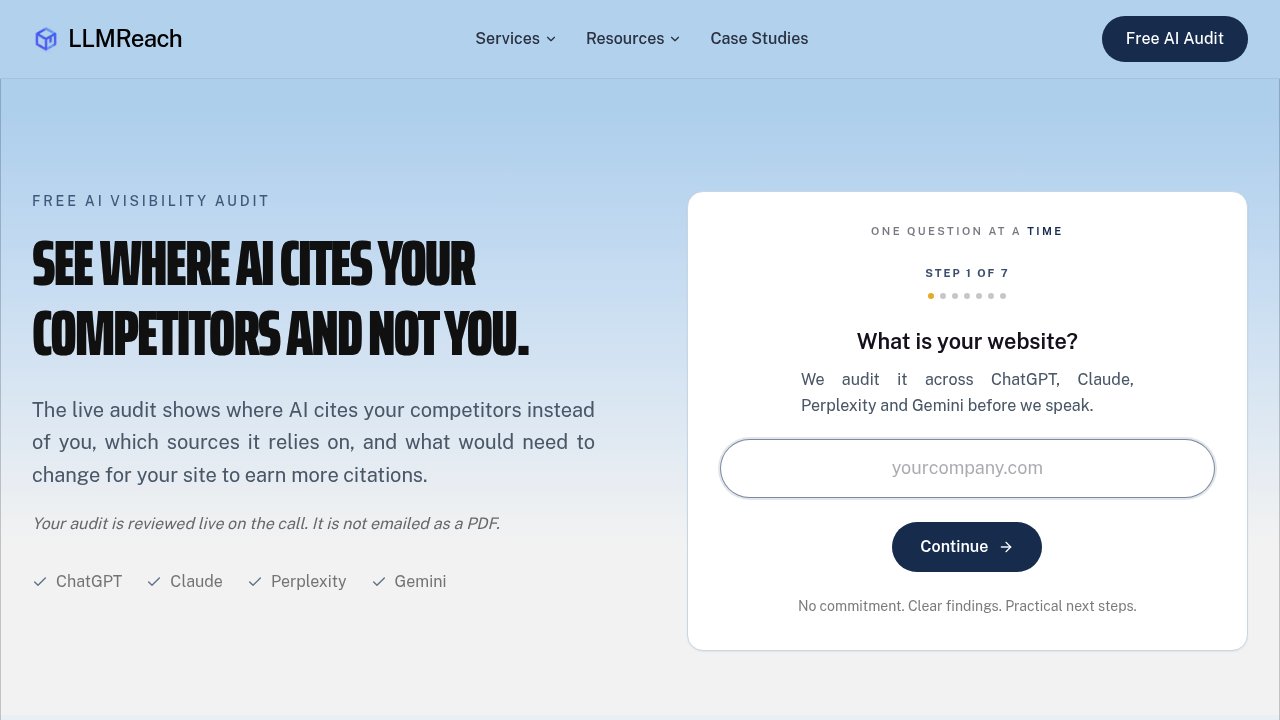
It takes thirty minutes and it gives you the number every one of these conversations should start with: your current citation baseline, measured against real prompts, across real engines. If your competitors are appearing and you are not, that is the gap the guarantee is designed to close.
The Answer, With One Condition
An agency can commit to citation growth in AI responses. Not every agency, and not on any single prompt. But across a defined prompt set, against a verified baseline, over a fixed window, with a stated remedy.
The condition is execution. A commitment requires an agency that publishes the content, builds the schema, manages third-party authority and tracks results on a shared dashboard. If any of those are handed back to the client, the accountability chain breaks.
LLMReach runs all five work streams. The guarantee is a 30% increase in total citations against your own baseline within 90 days, and if it is not reached you choose between continued work at no charge and a full refund.
Request your free AI visibility audit
Your audit is reviewed live on the call. It is not emailed as a PDF.
Frequently Asked Questions
Can generative engine optimization agencies guarantee citations?
Yes, but only if the agency controls the full execution system. A real guarantee has to be tied to a measurable metric like citation frequency over a defined prompt set, not a vague promise about visibility.
Why do most GEO agencies say guarantees are impossible?
Most agencies say that because AI responses are non-deterministic and they do not control enough inputs to promise outcomes. If they only advise or report, they cannot credibly guarantee citation growth.
What should a GEO citation guarantee include?
A credible guarantee should include a documented baseline window, a specific citation metric, a defined prompt set, a reporting dashboard, and a refund or credit if the target is not met.
What makes LLMReach different from measurement tools?
LLMReach runs the work itself. That includes prompt research, technical optimization, content, authority building, and visibility tracking, which is why the guarantee is tied to execution rather than reporting.
How do I know if my business is ready for GEO?
You need to know whether your brand already appears in AI answers, which engines cite you, and where competitors are winning instead. A baseline audit is the fastest way to find that out.
During a guided review meeting, LLMReach walks you through your priority buyer prompts, current AI visibility, competitor citations, source patterns, and the technical or content gaps that matter most. You leave the call knowing where the gap is, what is causing it, and which changes would matter first.