Best AI Visibility and GEO Agency for Food and Beverage DTC Brands
By Karim MezitiSeptember 22, 2026Updated June 2026
When a shopper asks ChatGPT "what is the best protein powder for muscle recovery" or asks Perplexity "healthiest energy drink without artificial sweeteners", they are not browsing. They are deciding. The brand that appears in that answer is on the shortlist. The brand that does not appear is not in the consideration set at all.
Food and beverage DTC brands are facing a structural shift in how buyers discover products. For brands that built their growth model on Google Shopping, Meta retargeting and influencer seeding, AI-assisted discovery is a channel already operating at scale with almost no presence from the brands competing in it.
The problem is not awareness. Most food and beverage DTC founders and marketing leads know AI search exists. The problem is execution. Getting cited by ChatGPT, Perplexity, Claude and Google AI Overviews takes a specific set of technical, content and authority signals, and they are not the ones that drive traditional SEO or paid social.
The brands that build that signal stack now will be difficult to displace. Citation patterns compound: once a model associates a brand with a category question, that association generates more mentions, more corroboration and more surface area for the next answer. Brands that wait are not just missing impressions, they are letting competitors build an advantage that gets harder to close every month.
Food and beverage DTC is one of the highest-stakes categories in AI search
Most product categories have a slow AI adoption curve. This one does not, for three reasons.
Buyers ask ingredient and benefit questions, not brand questions
A shopper looking for protein powder rarely starts with a brand. They ask about protein content, amino acid profiles, clean ingredients or dietary compatibility. Those are exactly the nuanced, multi-variable questions AI engines answer better than a results page. The brand that appears in the answer to "best clean protein powder without artificial sweeteners" wins the consideration moment without the buyer ever typing a brand name.
Intent is high at the point of the query
Perplexity switches behaviour when it detects commercial intent in a query, words like "best", "vs", "under" or "alternatives to", drawing on product data and retailer feeds rather than general retrieval and presenting named products with prices and merchant links. A buyer asking which protein powder to choose is landing in that experience, not in a research one.
The competitive set is crowded but AI visibility is not
Thousands of food and beverage DTC brands compete on Google Shopping and Meta. Most of them have no AI citation presence at all. That gap is the opportunity: a brand that builds citation authority in a crowded category does not need to outspend anyone on paid, it needs to be the answer when a buyer asks an engine which product to trust.
| Channel | Typical competition | AI citation presence |
|---|---|---|
| Google Shopping | Extremely high | Low to none for most DTC brands |
| Meta and Instagram | High | Not applicable |
| Influencer and UGC | High | Indirect signal only |
| AI search | Low | First-mover advantage available |
What AI citation actually takes for a food and beverage DTC brand
Getting cited is not a content marketing problem. It is a signal architecture problem, and each layer has specific requirements in this category.
Prompt research: know which questions trigger the opportunity
The starting point is identifying the exact prompts buyers use. "Best protein powder" is too broad to be useful. "Best protein powder for women over 40 with no artificial sweeteners" is the kind of specific, high-intent question where a well-positioned brand can own the answer.
LLMReach identifies the fifty prompts your buyers use before they decide, agreed with you before work begins. That set becomes the measurement baseline and the content target for the whole engagement.
Technical: make sure the crawlers can reach you
Most food and beverage DTC sites run on Shopify or similar. Many are inaccessible to AI crawlers through robots.txt, edge rules, or content that only exists after JavaScript runs. If the retrieval agents cannot read your product and ingredient pages, the content quality is irrelevant. The technical pass covers:
- Crawler access for
OAI-SearchBot,Claude-SearchBot,PerplexityBotandGooglebot, checked at the edge as well as in robots.txt, since CDN bot rules are enforced before robots.txt is read - Render parity: what the agent receives against what the browser shows
- Product schema and
OrganizationwithsameAs, for entity clarity - Sitemap health, canonical consistency and correct status codes
Content: answer the questions buyers are actually asking
Food and beverage DTC brands usually have strong brand content and weak answer-first content. What gets cited is built around a question, answers it directly in the opening lines, and then supports the answer with specific, checkable claims about ingredients, sourcing, certifications or nutrition.
A guide titled "Which protein powder is best for muscle recovery?" that opens with a direct 40 to 60 word answer and then goes to ingredient-level detail is the shape an engine extracts. A brand story page is not.
Community: the corroboration layer most brands ignore
Community discussion is a heavier signal in this category than most brands expect. Search Engine Land reported on a Peec AI analysis of 30 million citation events across ChatGPT, Google AI Mode, Gemini, Perplexity and AI Overviews, and Reddit ranked first or second on every platform tested.
The signal works both ways. A brand discussed accurately and positively in the places its buyers actually talk is easier for an engine to corroborate. A brand with nothing said about it anywhere outside its own domain has nothing corroborating it at all.
Building that presence means genuine, useful participation where your buyers already discuss nutrition, training, clean eating and ingredient quality. LLMReach does not use fake accounts, automated comments, vote manipulation, undisclosed promotion, or content designed to imitate genuine community discussion.
Citation tracking: measure what is actually happening
The last discipline is tracking citation frequency across the prompt set, across engines, and against named competitors. Without it there is no way to know whether the work moved anything or where the next opportunity sits.
| Signal | What it measures | Why it matters here |
|---|---|---|
| Prompt coverage | Which queries produce a citation | Shows which product questions the brand owns |
| Engine breakdown | ChatGPT, Perplexity, Claude, Gemini separately | Each engine weights signals differently |
| Competitor citations | Which brands appear instead | Names the exact gaps to close |
| Citation source | Which pages are being used | Shows which content is working |
Most food and beverage DTC brands do not know where they stand
Before any optimisation makes sense, a brand needs its current baseline: the prompt set run across ChatGPT, Perplexity, Claude and Google AI Overviews, every result logged, and the competitors appearing instead mapped.
Most brands in this category have never done it. They have analytics dashboards, attribution models and ROAS reports, and no visibility into whether they appear when a buyer asks an engine which product to buy.
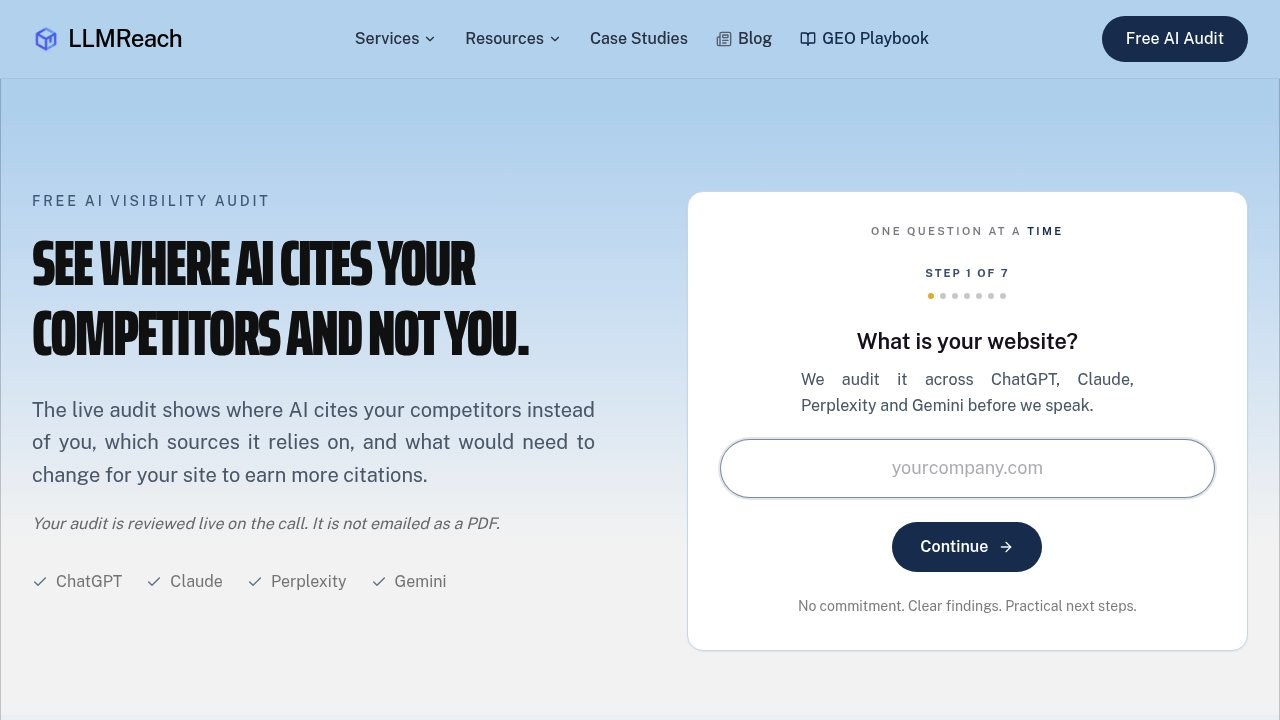
During a guided review meeting, LLMReach walks you through your priority buyer prompts, current AI visibility, competitor citations, source patterns, and the technical or content gaps that matter most. You leave the call knowing where the gap is, what is causing it, and which changes would matter first.
Your audit is reviewed live on the call. It is not emailed as a PDF.
Get your free AI visibility audit and find out where your brand stands before a competitor claims the category.
Why most agencies are not built for this work
The food and beverage DTC agency market is mature. There are strong agencies for paid social, influencer, email and traditional SEO. None of those disciplines translates directly into AI citation authority, and that is structural rather than a question of effort.
| Agency type | What they execute | What sits outside their remit |
|---|---|---|
| Paid social | Meta, TikTok, Google Shopping campaigns | Citation signal architecture |
| SEO | Rankings, backlinks, technical crawl | Prompt research and citation tracking |
| Content | Brand storytelling, editorial calendars | Answer-first structure built for extraction |
| Influencer | Creator partnerships, UGC | Community presence as a citation signal |
| Measurement tool | Citation reporting dashboards | Execution: they report, they do not fix |
The last row is the important one. A growing number of tools measure AI visibility and show which prompts cite a brand. Measurement alone does not move the number. What moves it is technical, content and authority execution.
The execution gap is where brands get stuck
A brand that buys a measurement tool learns it is absent from most relevant answers. That is useful. Without someone to execute the fixes, it stays useful and nothing else.
LLMReach runs the work. The prompt research, the technical fixes, the content, the community presence and the tracking, rather than the reporting on top of them.
LLMReach is the GEO agency built for this
The entire engagement model is built around one outcome: increasing how often AI engines cite a brand in answers relevant to its category. For food and beverage DTC that means owning the answers to ingredient questions, benefit claims, dietary compatibility and category comparisons across ChatGPT, Perplexity, Claude and Google AI Overviews.
How the engagement works
| Phase | What LLMReach executes |
|---|---|
| Prompt research | The fifty prompts your buyers use before they decide, agreed with you before work begins |
| Technical optimisation | Crawler access at robots.txt and at the edge, schema, render parity, crawl hygiene |
| Content | Answer-first guides, comparison pages and ingredient explainers, written against the agreed prompt set |
| Community | Genuine presence where your buyers discuss nutrition, training and ingredient quality |
| Citation tracking | Citations across the agreed prompt set, in a shared dashboard, with weekly updates and a fortnightly review |
The guarantee
The Citation Stack is guaranteed as a whole: a 30% increase in total citations across your site, measured against your own baseline, within 90 days. If that is not reached, you choose between continued work at no charge and a full refund.
A baseline is established before work begins, and it becomes the benchmark everything is measured against. Weekly reporting and a shared dashboard give you full visibility into what is moving and what is not.
Why the guarantee is possible
It is possible because the agency runs all five disciplines that drive citation frequency rather than advising on them. A provider that only audits or reports has no lever on the outcome and nothing to commit to. When the full system is running, citation growth is the expected result of the work.
The category leader position is still open in most niches here. Protein powders, functional beverages, clean snacks, supplements and specialty foods all have low AI citation competition relative to the size of the market. The brand that builds that authority first is the one that appears when a buyer asks which product to trust.
The brands that act now will own the category
Citation patterns in food and beverage DTC are still forming. The brands appearing consistently in answers about recovery, clean energy, functional nutrition and dietary compatibility are not necessarily the biggest. They are the ones that built the right signal stack first.
The first step is knowing where you stand today. Book your free AI visibility audit and find out whether your brand is visible where your buyers are already deciding.
Frequently asked questions
Why do food and beverage DTC brands need GEO?
Because buyers increasingly research products through AI tools before they visit a site or click an ad, and the shortlist can form in that answer. GEO is the work of making the brand easier for those systems to reach, understand and cite when a buyer asks about the category.
What makes food and beverage DTC different in AI search?
The category is heavily question-driven. Shoppers ask about ingredients, sweeteners, dietary fit, recovery benefits and direct comparisons rather than about brands, which makes answer-first content and independent corroboration matter more here than in categories where buyers search by name.
Can AI crawlers reach a Shopify store by default?
Not always. Plenty of DTC sites are inaccessible to retrieval agents through robots.txt, through CDN bot rules enforced before robots.txt is read, or through content that only exists after JavaScript runs. Fetching a product page as each agent and reading the status code is the only reliable check.
What does a GEO agency actually do for a DTC brand?
It runs the full set of inputs that decide citation: prompt research, technical access and schema, answer-first content, community presence where buyers discuss the category, and tracking against a baseline. The point is execution rather than a dashboard reporting on work nobody is doing.
How do I know if my brand is ready for GEO?
You need a baseline: which prompts mention your brand, which competitors are cited instead, and where the site is weak technically or editorially. That baseline tells you where the biggest gaps are and gives every later measurement something to be read against.
During a guided review meeting, LLMReach walks you through your priority buyer prompts, current AI visibility, competitor citations, source patterns, and the technical or content gaps that matter most. You leave the call knowing where the gap is, what is causing it, and which changes would matter first.