Best GEO Tactics for Local Businesses (And Why Most Get It Wrong)
By Karim MezitiSeptember 16, 2026Updated June 2026
A potential customer opens ChatGPT and types "best plumber near me". Your competitor's name appears in the answer. Yours does not. They call your competitor. You never knew the search happened.
That is the local business GEO problem in one scenario, and it is not hypothetical. Business owners report the same pattern repeatedly: assistants recommending specific local businesses by name, pulling from structured data, review signals and authoritative web mentions, while businesses with perfectly good websites sit invisible.
The hard part: appearing in AI answers is not an accident. It is the output of a deliberate, multi-layer system. Businesses that get cited have done the work, or had someone do it for them.
This article covers the five disciplines that determine whether a local business gets cited, why each requires ongoing execution rather than a one-time setup, and what separates a business that owns its category in AI search from one that hopes for the best.
Who this is for: local business owners and marketing managers who have noticed competitors appearing in ChatGPT, Perplexity or Google AI Overviews, and want a clear picture of what it takes to show up there too.
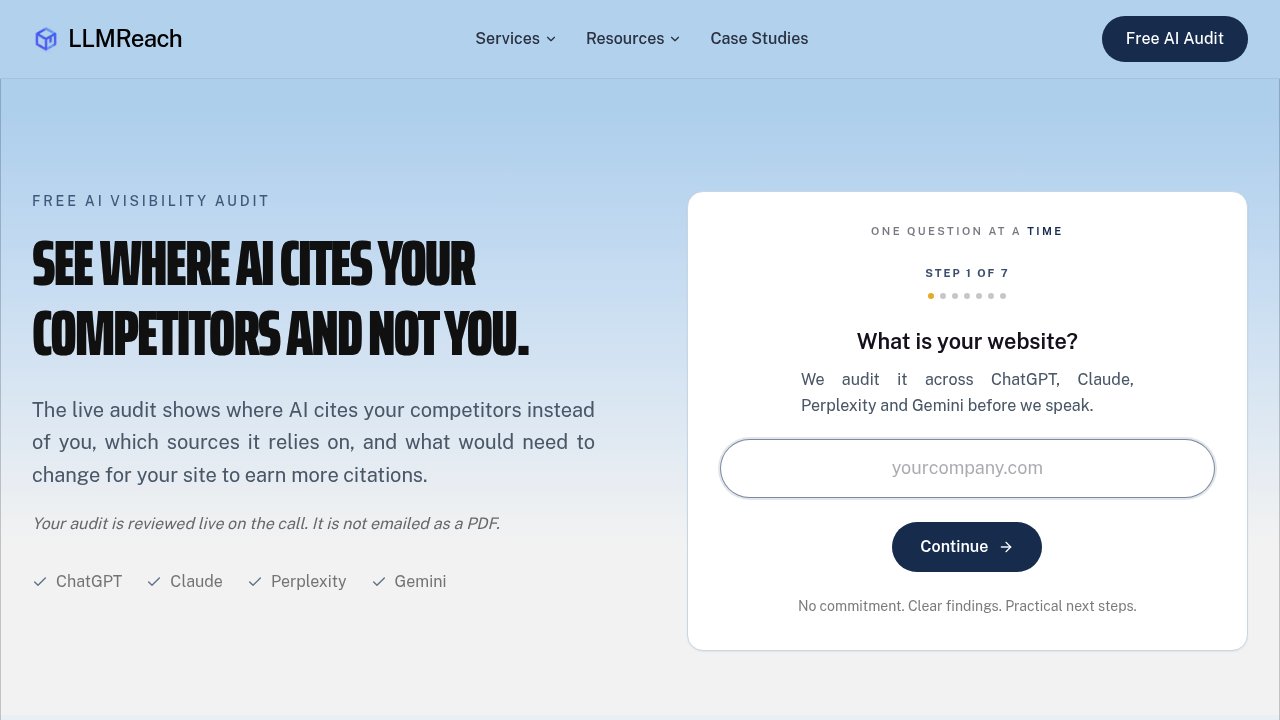
Request your free AI visibility audit
Your audit is reviewed live on the call. It is not emailed as a PDF.
GEO Is Not SEO With a Different Name
Most local businesses hear "GEO" and assume it means optimising their Google Business Profile or adding location keywords to the site. That is SEO. It matters, and it is a prerequisite, but it is not the same thing.
Generative Engine Optimization is the practice of structuring your business's digital presence so that assistants including ChatGPT, Perplexity, Claude, Gemini and Google AI Overviews select your business as a cited source when someone asks a relevant question.
| SEO | GEO |
|---|---|
| Gets your page indexed and ranked | Gets your business cited in an AI-generated answer |
| Optimised for crawlers and ranking algorithms | Optimised for model retrieval and synthesis |
| Measured in rankings and organic clicks | Measured in citations across AI platforms |
| Set and monitor | Requires active prompt research and content maintenance |
| One platform | Five or more platforms at once |
SEO makes a page eligible. GEO decides whether engines use that page as a source. The two work together but are not interchangeable. A business can rank on page one of Google and be completely absent from every AI answer in its category. The mechanics of that selection are covered in how AI engines decide what to cite.
Why Local Businesses Are Especially Exposed
Local search is where adoption is moving fastest, because the queries are conversational: "who is the best HVAC company in Austin?" or "find me a dentist near downtown Chicago who takes Delta Dental". These are not keyword searches. They are requests for a recommendation.
Models answer recommendation queries by drawing on a combination of structured business data, review volume and sentiment across platforms, third-party mentions in articles, directories and forums, the authority of the domains that reference the business, and the consistency of the business's information across the web.
A business that has not actively built that signal stack will not appear, regardless of how good its services are or how long it has been trading.
The Five Tactics That Actually Move the Needle
These are not tips. They are five operational disciplines that, executed together, determine whether a local business gets cited. Miss one and the system leaks. Execute all five and the citations compound. That dependency is the argument behind the Citation Stack.
1. Prompt Research: Know Exactly What People Are Asking
Every campaign starts with the same question: what are people actually asking assistants about businesses in your category and location?
This is not keyword research. The queries are longer, more conversational, and often carry qualifiers traditional tools do not capture: "best", "most trusted", "who do locals recommend", "which company has the best reviews in this city".
Prompt research produces a defined list of prompts people are running in your category, the answers those prompts currently return and which competitors appear in them, and the signal gaps between your business and the ones being cited.
Without it, every other tactic is directionally blind. You are optimising for prompts you have not confirmed exist, against competitors you have not mapped.
Volume has to be verified before optimisation starts. A prompt with no measurable volume is not worth targeting, however logical it seems.
2. Technical Optimisation: Give Engines Clean, Structured Data
Models retrieve and synthesise. The easier your business information is to retrieve, the more likely it is to be used. For local businesses this covers four areas.
Schema markup. Google's LocalBusiness structured data states exactly what your business is, where it is, what it does and who it serves. Most local business sites have incomplete or outdated schema, and missing fields such as service area, hours, payment methods and specialisms are fields where a competitor with complete data wins the citation.
Google Business Profile completeness. Google's AI surfaces draw on profile data, so an incomplete profile is an incomplete citation. Categories, services, attributes, questions and answers, photos and the primary description all matter.
NAP consistency. Name, address and phone number should be identical across every directory, citation and mention. Inconsistency reads as unreliability and suppresses confidence.
Crawlability and speed. Engines cannot cite content they cannot reach. Clean URL structure, proper indexing and reasonable performance are the floor, not the ceiling. This is the work covered by technical AEO infrastructure.
3. Content: Build the Answer Before the Question Gets Asked
Engines prefer to cite sources that already contain a well-formed answer to the question being asked. For local businesses that means content mirroring the conversational queries your customers run.
This is not a blog post about five tips for choosing a plumber. It is a structured page that answers who the most trusted plumber in a specific city is, with verifiable information, service detail, credentials and social proof.
- Service-specific pages with schema, clear descriptions and geographic qualifiers
- Question-and-answer content structured around the exact questions people ask, not the ones you wish they asked
- Comparison pages positioning your business against category alternatives on objective criteria
- Authority content demonstrating expertise in your trade, tied to local context
The goal is not traffic. It is to be the most citable source for a specific set of prompts.
4. Reddit and Third-Party Authority
Models weight third-party mentions heavily. A business referenced approvingly in a Reddit thread, a local news article, an industry directory or a trusted review platform carries more weight than one that only appears on its own website.
The authority stack has three tiers:
- Highest weight: local news outlets, regional business publications, industry association directories
- Strong weight: threads in local subreddits, editorial features, community forums
- Baseline: general business directories and chamber of commerce listings
Most businesses have the baseline covered. Few have recent, specific, indexed mentions in the top two tiers. Building that stack is active work: outreach, content placement and genuine community participation, not claiming a listing.
The part most guides miss: Reddit is disproportionately influential because the content is indexed, human-generated and full of exactly the conversational recommendation language models surface. A single well-placed thread in a local subreddit can outweigh dozens of directory listings.
It has to be done properly. No automation, no fake accounts, no vote manipulation. Removed threads cannot be cited, which makes authenticity an operational requirement rather than a brand value. The rules and what actually gets accounts removed are set out in getting mentioned on Reddit without getting banned, and the service in Reddit authority.
5. Visibility Tracking: Measure Citations, Not Rankings
The metric that matters is how often, across which platforms, for which prompts, your business appears in an AI-generated answer.
Traditional rank tracking does not measure this. A business running GEO without citation tracking is flying without instruments, and you cannot prove return on investment with a screenshot of your Google rankings.
- Citation monitoring across the assistants your customers actually use
- Prompt-level attribution: which target prompts are generating citations and which are not
- Competitor share: when answers appear for your target prompts, how often a competitor appears instead
- Trend over time, against a baseline established in the first 14 to 30 days
Without a baseline there is no way to prove improvement. Without prompt-level data there is no way to prioritise the next month's work.
Request your free AI visibility audit
Your audit is reviewed live on the call. It is not emailed as a PDF.
Most Local Businesses Do Not Know Where They Stand
Before any work can start you need a baseline. How often is your business cited across the major platforms? For which prompts? Against which competitors?
Most local businesses have no idea. They have never run the query. They assume that because their Google rankings are stable their AI visibility is fine, and that assumption is wrong more often than it is right.
The fastest way to find out is a structured audit: a systematic check of your business against the prompts your customers are actually running.
Execution Is the Differentiator, Not Information
The five tactics above are not secret. What most local businesses lack is the capacity to execute all five at once, maintain them month over month, and adjust based on real citation data.
This is the limitation of measurement-only tools. They tell you what is happening. They do not change it. A dashboard showing your citation count is falling does not write the content, build the authority or fix the schema that is costing you citations. If you are weighing an agency against a platform or an in-house hire, we set out the trade-offs in how to choose.
What Agency-Led Execution Means
LLMReach runs all five disciplines for local business clients. The client does not manage prompts, write citation-optimised content or build mention stacks. The client provides access and approves what gets published. LLMReach handles the rest. The full picture is on the GEO services page, and the sector-specific version on the local business page.
- 50 prompts agreed jointly before work starts, with confirmed volume
- 90-day minimum with a shared dashboard and weekly written updates
- Baseline established in the first 14 to 30 days, so every later result is measured against a real starting point
The guarantee: the Citation Stack is guaranteed as a whole: a 30% increase in total citations across your site, measured against your own baseline, within 90 days. If it is not reached, you choose between continued work at no charge and a full refund. No individual page, prompt, platform or response is guaranteed separately, because no agency controls what any single model returns for any single question. The guarantee is on the aggregate, and it carries one condition: you provide access and approve what gets published.
That commitment only makes sense if the execution is real. An agency that only measures cannot make it. An agency that only advises cannot make it.
Why All Five Together Compound
Each discipline reinforces the others. Prompt research identifies the gaps. Content fills them. Technical work makes that content retrievable. Third-party authority amplifies its weight. Tracking shows which prompts are converting and which need more support. As citations accumulate, models treat the business as an established reference, which lowers the threshold for future citations.
Run one discipline in isolation and the gains are marginal. Run all five and the system compounds, which is what a 90-day engagement is designed to capture.
The real risk is waiting. Every month a competitor spends building citation authority in your category is a month they are harder to displace, because the source environment models read is built over time and it stacks.
The Business That Acts First Wins the Category
AI-driven local search is not coming. It is already how a growing share of your customers find service providers. The businesses appearing in those answers are not there by luck. They are there because someone did the prompt research, the technical work, the content, the authority building and the tracking.
The question is not whether this matters for local businesses. It is whether your business will be cited when the next customer asks.
Request your free AI visibility audit and get a clear picture of your current citation baseline before a competitor builds theirs.
Your audit is reviewed live on the call. It is not emailed as a PDF.
Frequently Asked Questions
What is GEO for local businesses?
GEO, or generative engine optimization, helps local businesses appear in AI-generated answers from tools like ChatGPT, Perplexity, Gemini, and Google AI Overviews. It focuses on making your business easy for AI systems to understand, trust, and cite.
How is GEO different from local SEO?
Local SEO helps a business rank in search results. GEO helps that business get cited inside AI answers. SEO makes you eligible, but GEO influences whether AI systems actually use your pages, reviews, and mentions as sources.
Why do local businesses need prompt research for GEO?
Prompt research shows which questions real users ask AI engines in your category and city. That matters because GEO only works when you optimize for the prompts people actually run, not generic keyword ideas.
What are the most important GEO tactics for local businesses?
The most important tactics are prompt research, technical optimization, content creation, third-party authority building, and citation tracking. Together, they create the signal stack AI engines use when deciding what to cite.
How does LLMReach help local businesses with GEO?
LLMReach runs the full GEO system for clients, including research, optimization, content, authority building, and tracking. The work is executed for the client, which is the main difference from tools that only report visibility.
During a guided review meeting, LLMReach walks you through your priority buyer prompts, current AI visibility, competitor citations, source patterns, and the technical or content gaps that matter most. You leave the call knowing where the gap is, what is causing it, and which changes would matter first.