What Content Signals Most Improve Citation Rate in Answer Engines?
By Karim MezitiSeptember 16, 2026Updated June 2026
The answer is not a single signal. That is the most important thing to understand about citation rate in AI answer engines, and it is the thing most content teams get wrong.
Marketers have been conditioned to look for the one lever: the right keyword, the right backlink, the right schema tag. Answer engines do not work that way. ChatGPT, Perplexity, Google AI Mode, Claude, and Gemini each run their own retrieval logic, and only 11% of cited domains overlap between ChatGPT and Perplexity, according to a 2026 per-engine audit. That means a strategy optimized for one engine is, by definition, invisible to most of the others.
The real question is not which signal matters most. It is which combination of signals, stacked in the right order, produces a durable citation rate across all engines simultaneously.
This article breaks down the four signal layers that the research consistently identifies as load-bearing, explains why each one fails in isolation, and makes the case for why a coordinated execution approach is the only method that produces compounding results. If you want to know where your brand currently stands across these engines, request your free AI visibility audit and we will map your citation gaps before any work begins.
Your audit is reviewed live on the call. It is not emailed as a PDF.
The Research Has Settled on Four Signal Layers
Multiple independent datasets published in 2025 and 2026 now point to the same conclusion: citation eligibility is determined by four distinct layers of signals, each necessary, none sufficient on its own.
The GEO-16 framework, a preprint posted to arXiv, audited 1,100 unique URLs and harvested 1,702 citations across Brave, Google AIO, and Perplexity. It found that pages scoring above 0.70 on a normalized quality index, with at least 12 of 16 quality pillars satisfied, achieved a 78% cross-engine citation rate. The three pillars most strongly associated with citation were Metadata and Freshness (r=0.68), Semantic HTML (r=0.65), and Structured Data (r=0.63). The logistic model found that overall quality is a strong predictor of citation with an odds ratio of 4.2, meaning high-quality pages across all pillars are more than four times as likely to be cited as low-quality pages. As a preprint, it has not been through peer review.
No single pillar produced that result. The 78% citation rate required 12 or more pillars to be satisfied simultaneously.
The four layers those pillars map to are:
- Content structure, how the page is formatted for machine retrieval
- Evidence density, how claims are sourced, attributed, and grounded in data
- Technical eligibility, whether the page is crawlable, fresh, and semantically marked up
- Off-site authority, whether external signals corroborate the brand's expertise
The rest of this article examines each layer with the specific signals that move the needle, and the measured effect sizes from the most rigorous studies available.
Layer One: Content Structure Is the Strongest Controllable Lever
Structure is where most brands have the largest gap and the fastest potential for improvement. It is also the most misunderstood layer, because most teams conflate it with "readability" or "formatting for humans." Structure for AI citation is a different problem entirely.
AI retrieval systems evaluate structure before they process meaning. They are looking for signals that tell them: can I extract a precise, quotable answer from this page? If the answer is no, the page is skipped regardless of how authoritative or well-written it is.
The Five Structural Changes With Measured Lift
Research from Machine Relations synthesizing the GEO-SFE framework (University of Tokyo, March 2026) and subsequent analysis of 6.8 million AI citations found five structural changes with consistent, measurable effect sizes:
| Structural Signal | Measured Effect | Source |
|---|---|---|
| Answer-first block in first 40 to 150 words | 44.2% of all LLM citations come from the first 30% of page content | Kevin Indig, via Search Engine Land, 2026 |
| Strict heading hierarchy (H1 to H2 to H3) | 68.7% of cited pages use strict hierarchy vs. ~40% of uncited pages | Seer Interactive / BrightEdge, 2026 |
| Comparison tables (3+ HTML tables) | +25.7% more citations on pages with tables | Digital Applied / BrightEdge, 2026 |
| FAQ sections with question-shaped headings | 3.2x more likely to appear in AI Overviews | Authoricy benchmark, 2026 |
| 5 to 7 statistics concentrated in first 500 words | ~20% higher citation likelihood | Seer Interactive / BrightEdge, 2026 |
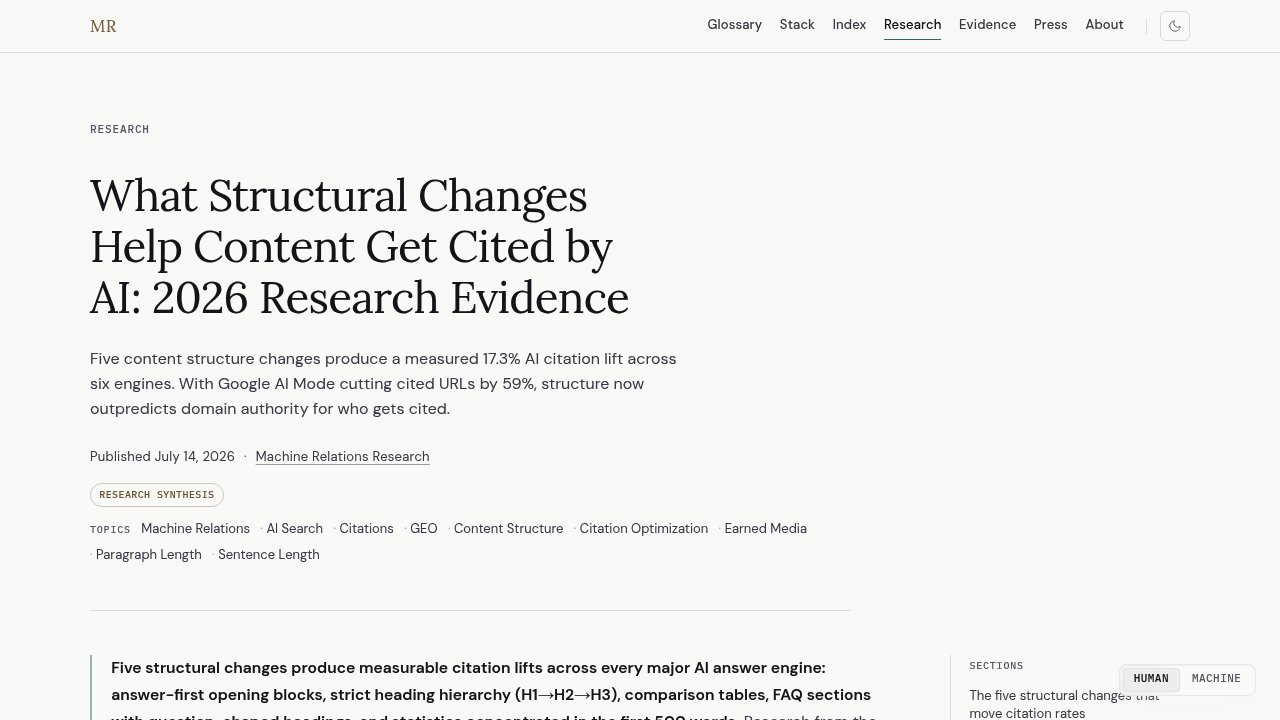
Structural readiness has a +0.71 correlation with citation rate. Domain authority, the metric that defined a decade of SEO, shows only a +0.42 correlation with AI citation. Structure now outperforms authority as a predictor of whether your content gets used as a source.
What Structural Optimization Alone Can Achieve
The GEO-SFE controlled experiment is the most important study in this space for one reason: it isolated structure from content quality. No changes were made to the substance of the pages. Only formatting, hierarchy, and presentation were modified. The result was a 17.3% consistent improvement in citation rates across six different generative engines.
That 17.3% is a floor, not a ceiling. It represents what structure alone produces when content quality, technical eligibility, and off-site authority are held constant. When those other layers are also optimized, the compounding effect is substantially larger.
The implication is direct: if your content is well-written but structurally unoptimized, you are leaving a measurable fraction of your potential citation rate on the table every day.
Request your free AI visibility audit
Your audit is reviewed live on the call. It is not emailed as a PDF.
Layer Two: Evidence Density Determines Whether AI Engines Trust the Source
Structure gets a page into consideration. Evidence density determines whether it gets selected. AI engines are not just matching content to queries; they are evaluating whether the content is trustworthy enough to put their name behind as a citation.
The distinction matters because it changes what "good content" means in this context. Content that reads well to a human but makes vague, unsourced claims is a low-trust source for an AI engine. Content with specific statistics, named attributions, and inline source links is a high-trust source, regardless of how polished the prose is.
The Signals That Build Retrieval Trust
Claim-to-source binding rate is one of the most actionable metrics in this space. Perplexity binds 78% of its own cited claims to sources; ChatGPT binds 62%. The implication: pages that match or exceed those rates are structurally compatible with how these engines think about evidence. Pages that do not are filtered out.
The specific evidence signals with the strongest documented effects include:
- Named statistics with inline attribution: content with specific, sourced data points in the first 500 words produces approximately 20% higher citation likelihood (Seer Interactive / BrightEdge, 2026). Vague quantifiers such as "many companies" or "significant growth" do not register as evidence.
- Competitor comparison sections: pages that include direct comparisons with named alternatives see a +38% citation lift overall, and +51% specifically in ChatGPT. This is one of the highest single-signal effects in the published literature.
- Trends and analysis content: a Search Engine Land study by Saltbox Solutions (May 2026) measuring 150,000 indexed pages found that trends and analysis content is cited at a 78% rate, while educational how-to content sits at 12%. That is not a rounding error. The content type itself is a citation signal.
- Original data and named-author attribution: E-E-A-T signals including identified authors, first-party research, and declared expertise are load-bearing for authority-sensitive engines like Claude and Google AI Mode.
The Content Freshness Dimension
Evidence density is not only about what is on the page; it is also about when it was last updated. An Ahrefs study of 17 million AI citations found that AI-cited content averages 1,064 days old versus 1,432 days for traditional organic results, a 25.7% freshness advantage. ChatGPT shows the strongest preference, citing content that is on average 458 days newer than what organic search surfaces.
Content updated within 90 days is cited 1.7x more often than content older than one year (Presenc AI, June 2026). For most brands, this means a regular refresh cycle is not optional; it is a citation rate variable that compounds over time.
What this means for your brand: a page with strong structure but stale, unattributed claims will lose citation share to a newer, better-sourced competitor page. Evidence density and freshness are the second layer of the stack, and they determine whether a structurally eligible page actually gets selected.
Layer Three: Technical Eligibility Is the Floor, Not the Ceiling
Technical eligibility is the layer most brands assume they have covered because their SEO agency checked a few boxes. The reality is that technical requirements for AI citation are meaningfully different from traditional crawlability requirements, and the gap between the two is where many otherwise strong pages fail.
What Technical Eligibility Actually Requires for AI Citation
The GEO-16 framework identified Semantic HTML and Metadata and Freshness as two of the three pillars most strongly associated with citation. Both are technical signals, not content signals. Specifically:
- Semantic HTML structure: proper use of heading tags, article elements, and machine-readable markup allows retrieval systems to parse and extract content accurately. Pages with broken or inconsistent HTML hierarchy are structurally ambiguous to AI parsers.
- Recency metadata: visible publication dates, last-modified timestamps, and structured date markup help engines assess freshness. Pages without clear date signals are treated as potentially stale, regardless of when the content was actually written.
- llms.txt at domain root: a valid llms.txt file produces a +24% citation lift by explicitly signaling to AI crawlers which content is authorized for retrieval. This is a relatively new technical requirement that most sites have not yet implemented.
- Entity markup and Wikidata grounding: for Gemini and Claude, Knowledge Graph anchoring through Wikidata entity IDs and sameAs markup is a load-bearing technical signal. Brands without a populated entity graph are effectively invisible to these engines' primary retrieval mechanism.
The Schema Question
The schema picture is more nuanced than most guides suggest. A controlled study of 1,885 pages found that generic Schema.org JSON-LD markup produces no statistically significant citation uplift on Google AI Overviews, AI Mode, or ChatGPT. However, 65% of AI Mode-cited pages carry structured data, and 71% of ChatGPT-cited pages do. The difference is specificity: FAQPage schema, Article schema with named authors, and BreadcrumbList markup each have documented positive effects. Blanket schema implementation without targeting the right types is not the same as strategic schema deployment.
The technical layer is a prerequisite, not an advantage. Brands that meet the minimum technical requirements are in the citation pool. Brands that do not are excluded before any content or authority signals are evaluated. The ceiling is set by structure and evidence; the floor is set by technical eligibility. This is the work covered by technical AEO infrastructure.
Request your free AI visibility audit
Your audit is reviewed live on the call. It is not emailed as a PDF.
Layer Four: Off-Site Authority Signals Complete the Stack
The first three layers are all on-page. The fourth layer is what happens everywhere else, and it is the layer that most brands have the least control over without a deliberate strategy.
AI engines do not evaluate your content in isolation. They evaluate it in the context of what the broader web says about your brand. This is a fundamentally different model from traditional SEO, where backlinks were the primary off-site signal. In AI citation, the signal set is wider and the weighting has shifted.
What Off-Site Authority Looks Like for AI Citation
Brand mentions outweigh backlinks by 3x in determining AI citation authority, according to 2026 analysis from Authoritytech. A brand that is discussed, referenced, and quoted across authoritative platforms has a higher prior probability of being cited than a brand with strong link equity but low mention volume.
The specific off-site signals with the strongest documented effects:
- Reddit co-mentions: Reddit accounts for 11.97% of ChatGPT's top citation sources. Brands that appear in relevant Reddit discussions are more likely to be grounded in ChatGPT's retrieval model. This is the layer Reddit authority covers.
- LinkedIn presence: LinkedIn represents 14.3% of ChatGPT's top citation signals. For B2B brands, this is the highest-leverage off-site platform for citation authority.
- Wikipedia and Wikidata entries: Wikipedia represents 13.15% of ChatGPT citations. For Gemini and Claude, Wikidata entity grounding is the primary retrieval mechanism. Brands without a Wikipedia presence or Wikidata entry are absent from the entity graph that these engines use to verify claims.
- Multi-platform brand co-occurrence: brands that appear consistently across multiple authoritative platforms develop a citation prior that individual page optimization cannot replicate.
The SEO Relationship
Traditional SEO is not dead in this context, and it is important to be precise about the relationship. SEO makes a page eligible for indexing and retrieval. The AI citation work determines whether that eligible page actually gets used as a source. They stack; they do not compete. We cover the retrieval side of this in how AI engines decide what to cite.
A brand that ranks well in organic search but has no AI citation optimization is leaving the AI-driven portion of its visibility untouched. A brand that optimizes for AI citation without maintaining organic eligibility is building on an unstable foundation. Both layers are required.
The practical implication: off-site authority cannot be manufactured quickly. It requires a sustained presence across the right platforms over time. This is why citation rate improvement is a 90-day minimum commitment, not a one-time project.
Why Isolated Fixes Fail and the Citation Stack Works
Understanding the four layers individually is useful. Understanding why they must be executed together is what separates a strategy from a checklist.
The most common failure pattern in this space is sequential optimization: a team reads that structure matters, so they reformat a few pages. They read that schema helps, so they add JSON-LD. They read that Reddit mentions are important, so they post a few comments. Each intervention is technically correct. None of them produce a sustained improvement in citation rate, because none of them address the full picture.
The Interdependency Problem
Each layer has a dependency on the others:
- Structure without evidence density produces pages that are easy to parse but that AI engines do not trust enough to cite. The retrieval system can extract an answer; it just does not have enough confidence in the source to use it.
- Evidence density without technical eligibility means well-sourced content that AI crawlers cannot reliably access, date, or attribute. The quality is there; the machine-readable signals are not.
- Technical eligibility without off-site authority means a technically perfect page from a brand the AI engine has no prior knowledge of. The page passes every technical check; the brand has no citation prior to draw on.
- Off-site authority without on-page signals means a brand the AI engine knows about but cannot extract a precise, quotable answer from. The brand is in the model; the content is not usable as a citation.
The Citation Stack is the method that addresses all four layers in sequence, with each layer building on the one before it. It is not a proprietary framework in the sense of being invented from scratch. It is the logical structure that the research itself implies: four layers, each necessary, none sufficient, executed in a specific order because the dependencies run in one direction.
What the Citation Stack Looks Like in Practice
The five components of a complete Citation Stack execution are:
- Prompt research, identifying the specific queries in your category where AI engines are actively citing sources, and establishing a citation baseline before any work begins
- Technical optimization, closing the eligibility gaps that prevent structurally strong content from entering the citation pool
- Content production and optimization, building or restructuring pages with answer-first blocks, strict heading hierarchy, comparison tables, FAQ sections, and evidence-dense writing that matches how AI engines retrieve and quote
- Off-site authority building, establishing brand co-occurrence across Reddit, LinkedIn, Wikipedia, and industry publications to build the citation prior that on-page signals alone cannot create
- Visibility tracking, measuring citation rate per engine on a weekly cadence against the pre-work baseline, so improvement is quantified rather than assumed
The order matters. Technical optimization before content means new content is immediately eligible. Content before off-site authority means there is something worth citing when the brand's authority signals arrive. Tracking throughout means the work is accountable to a measurable outcome, not a set of activities.
The guarantee: the Citation Stack is guaranteed as a whole: a 30% increase in total citations across your site, measured against your own baseline, within 90 days. If it is not reached, you choose between continued work at no charge and a full refund. That commitment is only possible because the Citation Stack addresses all four layers simultaneously, with execution tracked against a real baseline from day one. See how the audit works before committing to anything.
How LLMReach Executes the Citation Stack
Most agencies in this space sell measurement. They connect to your analytics, run your queries through a dashboard, and report back on where you appear and where you do not. That is useful information. It is not execution. If you are weighing an agency against a platform or an in-house hire, we set out the trade-offs in how to choose.
LLMReach does the work. Every component of the Citation Stack is executed by LLMReach's team, not handed back to the client as a to-do list. The client provides CMS access and content approval. LLMReach handles the rest: prompt research, technical optimization, content production, off-site authority building, and weekly citation tracking against a documented baseline.
What the Engagement Looks Like
The engagement structure is designed around accountability, not activity:
- Baseline first: before any optimization work begins, LLMReach establishes a citation baseline across the 50 priority prompts agreed on jointly with the client. The baseline is averaged over the first 14 to 30 days. Every subsequent improvement is measured against this number.
- 90-day minimum: the Citation Stack takes time because off-site authority signals take time. The 90-day minimum is not a contract term; it is the minimum period required for all four layers to be in place and compounding.
- +30% guarantee: if total citations across the site do not increase by at least 30% against your own baseline within 90 days, you choose between continued work at no charge and a full refund. The guarantee is only possible because the work is tracked against a real baseline from day one, and because the Citation Stack addresses every layer that determines citation rate.
- Shared dashboard, weekly reporting: citation rate per engine is tracked weekly. Clients see the same data LLMReach sees, on the same cadence.
The Measurement-Only Gap
The sharpest contrast available in this market is between agencies that measure and agencies that execute. Measurement tools tell you that your citation rate is low. They do not change it. The Citation Stack changes it, because all five execution steps are completed by the agency, not reported back to the client.
For companies whose buyers are already consulting AI models before making decisions, the cost of not being cited is not a visibility metric. It is a revenue metric. Every conversation where a competitor is cited and your brand is not is a conversation where the buyer is being directed away from you before they have ever seen your content.
The question is not whether to improve your citation rate. The question is whether you are going to execute the work required to do it.
The Decision Is About Execution, Not Information
The content signals that improve citation rate in answer engines are well-documented at this point. Structure, evidence density, technical eligibility, and off-site authority each have measured effect sizes, and the studies consistently point to all four layers being required for a durable citation rate across multiple engines simultaneously.
What is not well-documented is how most brands actually close the gap. Reading about the Citation Stack is not the same as implementing it. Knowing that structural readiness has a +0.71 correlation with citation rate does not restructure your content. Knowing that brand mentions outweigh backlinks by 3x does not build your off-site presence.
The brands that will lead on AI citation over the next twelve months are not the ones with the most information. They are the ones that execute all four layers before their competitors do.
LLMReach exists to close that gap. The work is done by the agency. The results are tracked against a real baseline. The guarantee is in writing.
Request your free AI visibility audit and find out exactly where your brand stands across the five major answer engines today.
Your audit is reviewed live on the call. It is not emailed as a PDF.
Frequently Asked Questions
What content signals most improve citation rate in answer engines?
The biggest lifts usually come from four layers working together: clear content structure, strong evidence density, technical eligibility, and off-site authority signals. No single signal wins consistently on its own, which is why isolated fixes tend to stall.
Why is structure so important for AI citations?
Structure helps answer engines extract a precise response quickly. Strong heading hierarchy, answer-first blocks, tables, and FAQs make it easier for systems to quote the right passage and understand what the page is about.
Does schema markup alone improve citation rate?
Not reliably. Schema helps when it matches the page purpose and supports machine readability, but it does not replace strong content, fresh evidence, or authority signals. It works best as one part of a broader stack.
Why does the Citation Stack work better than one-off fixes?
The Citation Stack works because it treats citation rate as a system. Structure gets the page eligible, evidence makes it trustworthy, technical optimization makes it crawlable, and off-site authority helps it get selected across engines.
How can LLMReach help improve citation rate?
LLMReach executes the full process end to end: prompt research, technical optimization, content production, Reddit authority, and visibility tracking. The free AI audit is the first step and shows where the biggest citation gaps are.
During a guided review meeting, LLMReach walks you through your priority buyer prompts, current AI visibility, competitor citations, source patterns, and the technical or content gaps that matter most. You leave the call knowing where the gap is, what is causing it, and which changes would matter first.