What Is AI SEO and What Does It Cost?
By Karim MezitiSeptember 14, 2026Updated June 2026
AI search has changed the decision surface. Your buyer opens ChatGPT, types a category question, and gets a named answer before they ever reach a results page. If your company is not in that answer, you were not considered.
That is the problem AI SEO exists to solve.
The term itself is still being defined. Some use it to mean optimizing for Google's AI Overviews. Others use it to describe the broader discipline of becoming a cited source across AI assistants: ChatGPT, Claude, Perplexity, Gemini. The distinction matters because the tactics, the investment, and the results look completely different depending on which surface you are targeting.
The core question is not "how do I rank?" It is "how do I become the source an AI model retrieves when my buyer asks a question?"
This article answers what AI SEO actually involves, what it costs across the options available, and what separates a monitoring subscription from the work that moves the number. If you already know you have a gap and want to see exactly where competitors are being cited instead of you, request a free AI visibility audit and we will walk through it live on a 30-minute call.
AI SEO Is Not Traditional SEO With a New Name
Traditional SEO is built around a predictable system: Google crawls pages, indexes them, ranks them by relevance and authority, and a user clicks a link. The goal is position. The metric is rank.
AI assistants do not work that way.
When a user asks ChatGPT or Perplexity a question, the model retrieves sources at the moment it answers. It does not pull from a ranked list. It pulls from whatever it considers most useful for assembling a credible response. That means a page that ranks nowhere in Google can still be cited by an AI model, and a page sitting at position one in Google can be ignored entirely.
The data makes this concrete
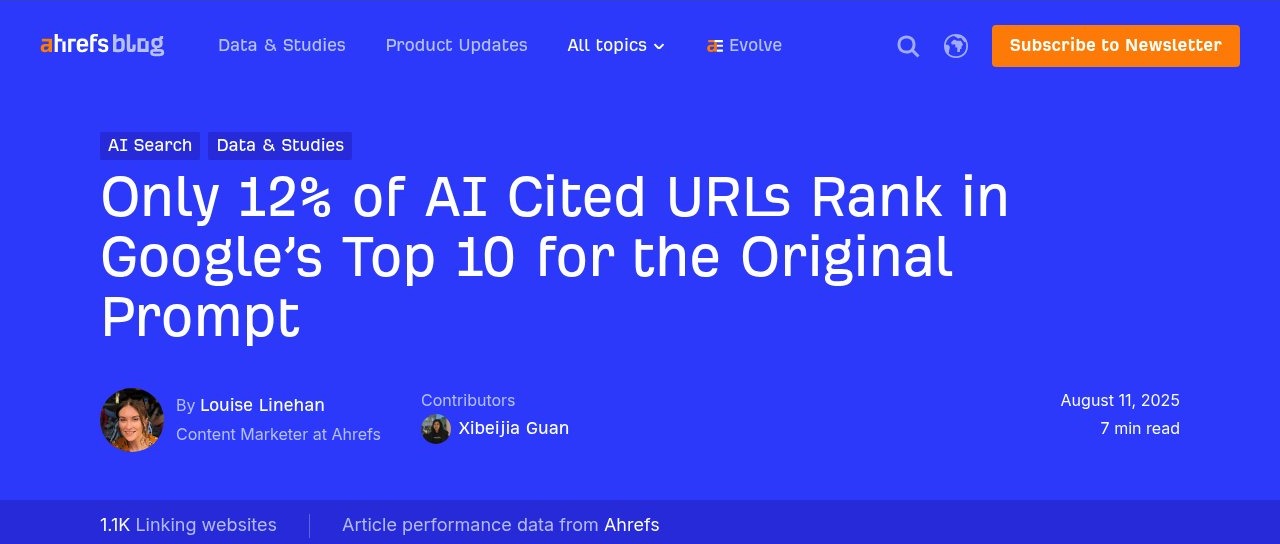
An Ahrefs study of 15,000 long-tail queries, tested across ChatGPT, Gemini, Copilot, and Perplexity and published on 11 August 2025, found:
Just 12% of citations in AI assistants also rank in Google's top 10, on average
80% of those citations do not rank anywhere in Google for the original query
What this means for your budget: optimizing for Google rank and optimizing for AI citations are largely separate investments. You need both, but they are not the same job.
A later Ahrefs analysis, reported by Search Engine Journal on 2 March 2026, examined 863,000 keywords and 4 million AI Overview URLs and found that 38% of cited pages also appeared in the top 10 results for the same query. A July 2025 version of the same study put that figure at 76%.
Treat the change between those two numbers carefully, because we do. Ahrefs states that its parsing method improved between the two studies and that it now detects more of the citations that appear in AI Overviews, which makes the two datasets not directly comparable. The honest reading is that 38% is the current measurement, not that the overlap collapsed by 38 points in seven months.
Why the separation exists
Google's algorithm is built to surface the most authoritative, relevant page for a keyword. AI models are built to assemble the most useful answer for a question. The signals they trust are different. A model looks for pages that directly answer the question in clear, structured language, that are retrievable at the moment it is asked, and that come from sources it has learned to treat as credible.
Traditional SEO makes a page eligible. AI SEO decides whether it gets used.
The two investments stack. A page that ranks well and is structured for AI retrieval performs on both surfaces. A page that only ranks well is winning on one surface and absent from the other.
What AI SEO Actually Involves
Most coverage of AI SEO focuses on one lever: write content that sounds like an answer. That is a starting point, not a system. The gap between "we published some FAQ pages" and "AI models consistently cite us" is where most companies get stuck.
The discipline has several names in circulation: GEO (Generative Engine Optimization), AEO (Answer Engine Optimization), and AI SEO are used interchangeably by different practitioners. The label matters less than the underlying logic, which is consistent regardless of terminology: structure your brand's information so that AI models can retrieve it, trust it, and use it as a source when your buyers ask questions.
A complete AI SEO program covers five distinct areas. Each one is necessary. None of them replaces the others.
1. Prompt research
Before any content is written or any technical fix is made, you need to know which prompts your buyers actually use. Not keyword research in the traditional sense: the questions people type into ChatGPT when they are evaluating a category, comparing options, or deciding whether to reach out.
These prompts are the foundation of everything else. Content built against the wrong questions will not be retrieved for the right ones. Measurement against the wrong prompts will not tell you whether the work is succeeding. The working set has to be agreed before work starts and validated against demonstrated search behavior, not guesswork.
2. Technical optimization
AI models retrieve pages at the moment they answer. If a page cannot be crawled, lacks proper schema, or sends confusing authority signals, it will not be retrieved regardless of how well-written it is. Technical AI SEO covers crawlability, structured data, page authority signals, and the conditions that make a page accessible to a model's retrieval layer. This is covered in more depth in our guide to technical AEO infrastructure.
This is the area most companies underestimate. A well-written page that fails a basic crawl check is invisible to the model. Technical optimization is the prerequisite that makes everything else work.
3. Content built to be cited
This is not content marketing in the traditional sense. The pages that get cited by AI models are the ones that directly answer the question, in clear language, with enough specificity that the model can quote or paraphrase them confidently. General brand content does not perform here. Specific, well-structured answers do. If you want the mechanism behind that selection, we cover it in how AI engines decide what to cite.
The format matters as much as the substance. Short paragraphs, direct answers at the top of each section, and structured data that signals what the page is about all contribute to whether a model retrieves a page or skips it.
4. Reddit authority
OpenAI's partnership with Reddit, announced in May 2024, gave OpenAI access to Reddit's Data API, which provides real-time, structured content. Google signed a similar agreement. This means the communities where your buyers discuss your category are live sources for AI answers. A brand that has genuine presence in those conversations becomes a reference point. A brand that does not is absent from a major source layer. Our approach to this is described in Reddit authority.
This is not about advertising in communities. It is about being present in the conversations AI models draw from. Promotional content in forums gets ignored or removed. Genuine, useful contributions become part of the source layer.
5. Visibility tracking
You cannot manage what you cannot measure. AI visibility tracking means monitoring how often your pages are cited across a defined prompt set, establishing a baseline before any work begins, and measuring change against that baseline. Without this, you cannot tell whether the work is moving the number. We cover the metrics themselves in AI visibility metrics and KPIs.
The baseline is not optional. Without it, any improvement is anecdotal. With it, you have a verifiable starting point that makes the outcome of the work provable to leadership.
The point most AI SEO coverage misses: these five areas are interdependent. Technical work without the right content leaves gaps. Content without prompt research risks answering the wrong questions. Off-site authority without tracking cannot prove whether it is contributing. Tracking without execution only tells you what is wrong.
What AI SEO Costs: The Three Options
AI SEO investment breaks down into three categories. The cost difference between them is significant. The difference in what you get for that cost is larger. If you want the full breakdown of ranges and what drives them, see our AI visibility and GEO pricing guide.
Option 1: A measurement tool
AI visibility platforms let you track citations across a prompt set and see where competitors appear.
What you get: data. You will know where you appear, where you do not, and where competitors are cited instead of you.
What you do not get: any change in that data. A measurement tool reports the gap. It does not close it. If your team does not have the bandwidth and expertise to act on what the tool reports, the subscription tells you what is wrong every month without moving the number.
This is the most common entry point for companies that are new to the space. It is also where most of them stall. The data is useful. Acting on it requires a separate investment of time and expertise that the tool does not provide.
Option 2: In-house execution
Building an internal AI SEO capability means hiring or retraining people across prompt research, technical SEO, content production, community presence, and tracking.
What you get: full control and institutional knowledge built inside the company.
What it costs: beyond salary, the real cost is time-to-competence. The field is moving fast. Building internal expertise from scratch while the competitive landscape shifts is a significant organizational bet, and the early months tend to go on learning the discipline rather than executing it.
Option 3: Done-for-you execution
A specialist agency runs all five areas. You review what gets published and read a weekly update. The work happens without requiring your team to develop a new discipline from scratch.
What it costs: varies by scope and guarantee structure. The relevant comparison is not the monthly fee in isolation. It is the fee against the cost of the alternative: a measurement subscription that reports the problem, or an internal build that takes months to reach competence.
What to look for: a defined prompt set agreed before work starts, a baseline measurement established before any execution begins, and a clear metric for success. If an agency cannot tell you exactly how they will measure whether the work is working, they are selling effort, not outcomes. We set out the full decision in software, in house, or an agency.
| Measurement tool | In-house | Done-for-you agency | |
|---|---|---|---|
| Prompt research | Measures only | Your team | Included |
| Technical optimization | Not included | Your team | Included |
| Content production | Not included | Your team | Included |
| Off-site authority | Not included | Your team | Included |
| Visibility tracking | Core product | Your team | Included |
The question to bring to leadership is not "what does AI SEO cost?" It is "what does it cost to remain absent from the answers your buyers are already reading?"
The Citation Stack Is the Method That Runs All Five
Most AI SEO approaches address one or two of the five areas. A content agency writes pages. A technical SEO firm fixes schema. A measurement platform tracks citations. None of them are built to run the full system, and the full system is the only thing that moves the number consistently.
The Citation Stack is the framework LLMReach uses to run all five areas as a single, integrated program. It is the operating logic that makes each layer reinforce the others: the right prompts drive the right content, the technical foundation makes that content retrievable, the off-site presence makes the brand a reference point, and tracking makes the outcome verifiable.
How the Citation Stack works in practice
Step 1: Prompt research. Before any work begins, LLMReach identifies the 50 prompts your buyers use before they decide. These are agreed with you, and they have to demonstrate real volume before they become the working set. A prompt set that has not been validated against actual buyer behavior is a list of guesses.
Step 2: Technical optimization. A full audit of the site in the first weeks, then continuous corrections, so that every page worth citing is retrievable when a model answers one of the agreed prompts. This is not a one-time fix.
Step 3: Content. Twenty pieces per month, written against the agreed prompt set rather than a content calendar. Content built for a calendar answers what a content team finds interesting. Content built against a prompt set answers what a buyer is asking.
Step 4: Reddit authority. Five to ten posts and fifteen to twenty comments per month, placed where genuine conversations already exist. Not automated, not manufactured.
Step 5: Visibility tracking. Citations per day, across the agreed prompt set, in a shared dashboard. A baseline is established before work begins. Weekly updates and a fortnightly review. The number either moves or it does not, and both of you can see which.
The guarantee that comes with it
The Citation Stack is guaranteed as a whole: a 30% increase in total citations across your site, measured against your own baseline, within 90 days. If that is not reached, you choose between continued work at no charge and a full refund.
That guarantee is only possible because the Citation Stack runs the full system. A partial program cannot make a credible commitment to a specific outcome. Running all five areas, with a baseline established before work starts and measurement throughout, is what makes the number verifiable.
What the 90-day engagement asks of you
Agree the prompt set at the start, in one session
Provide CMS access and approval to publish, which is a condition of the guarantee
Read a weekly update and join a fortnightly review
Evaluate the result at 90 days against a number agreed before work began
After 90 days the engagement moves to month to month.
How to Make the Case Internally
The person reading this article is often not the final decision-maker. They are the one who identified the problem and now needs to bring a recommendation to someone who controls the budget.
The problem in one sentence
Your buyers are asking AI assistants which companies to consider, and competitors are being named in those answers while you are not.
The evidence to bring
The Ahrefs study of 15,000 queries shows that 80% of AI citations come from pages that do not rank in Google for the original query. Existing SEO investment does not automatically carry over.
AI answers are assembled from sources at the moment the question is asked. The source environment is reachable and changeable, not a fixed outcome.
A measurement-only subscription is real spend that produces no change in citations. The question is whether the company wants to know how big the gap is, or to close it.
The objections you will hear
"We already have an SEO agency." SEO decides whether you are eligible. AI SEO decides whether you get used as a source when an assistant answers. They are different jobs and they stack. The existing investment is not wasted. It does not cover this surface.
"How do we know it will work?" The engagement starts with a baseline measurement before any work begins. At 90 days you compare the citation count against that baseline. The guarantee covers the outcome.
"Can we not do this ourselves?" Yes, if you have skilled time available every week across prompt research, technical SEO, content production, community presence and tracking. Most marketing teams do not, and the early months of an internal build go on learning the discipline rather than executing it.
The First Step Is Knowing Where You Stand
Most companies do not know their current AI citation baseline. They do not know which prompts their buyers use, which competitors are being named instead of them, or which pages, if any, AI models are already drawing on.
That is the starting point for everything else. You cannot build a program around a prompt set you have not identified. You cannot measure improvement against a baseline you have not established. And you cannot make a credible internal case for investment without showing what the gap actually looks like.
The free AI visibility audit is a live, 30-minute session that covers:
The buyer prompts where competitors are cited and you are not
The sources AI models are currently drawing on in your category
What would need to change structurally for your pages to be retrieved
Which of the five Citation Stack areas is your most urgent gap
Your audit is reviewed live on the call. It is not emailed as a PDF. You leave with a clear picture of the gap and what closing it would require. The audit is the same first step LLMReach uses before any engagement begins: the baseline has to exist before the work can start.
Either way, the answers keep getting assembled. From whatever sources exist when your buyer asks. The question is whether your company is one of them.
Request your free AI visibility audit
Frequently Asked Questions
What is AI SEO?
AI SEO is the work of making your brand retrievable and citeable inside AI answers from tools like ChatGPT, Perplexity, Gemini, and Claude. It combines prompt research, technical optimization, content, Reddit authority, and visibility tracking so models can use your pages as sources.
How is AI SEO different from traditional SEO?
Traditional SEO focuses on ranking pages in search results. AI SEO focuses on becoming a cited source in an AI-generated answer. A page can rank well in Google and still be ignored by a model, so the two disciplines overlap but are not the same job.
What does AI SEO cost?
The cost depends on the path you choose. A monitoring tool is the lowest-cost option but only reports the gap. In-house execution requires skilled time across several disciplines. Done-for-you execution costs more than software but includes the work needed to actually move citations.
Why is prompt research important for AI SEO?
Prompt research identifies the real questions buyers ask before they choose a vendor. If you build content for the wrong prompts, the model will not retrieve it for the right ones. A working prompt set is the foundation for content, technical fixes, and measurement.
Why does Reddit matter in AI SEO?
Reddit matters because it is part of the source layer AI systems use when assembling answers. Real participation in relevant conversations can make your brand a reference point, while promotional posts are usually ignored or removed. The goal is authority, not spam.
How do you measure AI SEO success?
Measure citations per day against a baseline established before any work starts. Track a fixed prompt set, compare current citation volume to the starting point, and review changes consistently. Without a baseline, you only know what is happening, not whether the work is working.
During a guided review meeting, LLMReach walks you through your priority buyer prompts, current AI visibility, competitor citations, source patterns, and the technical or content gaps that matter most. You leave the call knowing where the gap is, what is causing it, and which changes would matter first.