What Does an AI Visibility Agency Do? Services, Process and Results (2026)
By Karim MezitiJune 22, 2026Updated June 2026
Searches for "answer engine optimization agency" grew 680% year-over-year through June 2026, according to DataForSEO. The demand is real. The category definition is not.
Most agencies pitching AI visibility services are offering a repackaged version of what they already sold: blog posts, backlinks, and technical SEO, now described with words like "GEO" and "AEO." Buyers evaluating these offers face a genuine problem: the vocabulary is new, the claims are vague, and there is no established benchmark for what a credible service actually delivers.
The real question is not "what is AI visibility?" It is "how do I tell whether an agency can actually move it?"
This guide answers that question directly. If you are a marketer comparing vendors, a founder deciding whether to invest budget here, or a team trying to separate real GEO/AEO work from relabeled SEO, this is the clearest breakdown of the category available.
Here is what this guide covers:
What an AI visibility agency actually does and how it differs from an SEO agency
The specific services a credible agency provides, and the outcomes each one drives
How results are measured, including the metrics that separate real work from vague claims
When hiring an agency is justified versus when in-house is the smarter move
A practical framework for evaluating and choosing the right provider
What Does an AI Visibility Agency Do?
An AI visibility agency helps brands get cited, referenced, and recommended inside AI systems such as ChatGPT, Perplexity, Claude, and Gemini. The job spans prompt research, answer-first content, technical infrastructure, off-site authority building, and cross-platform citation tracking. The defining output is measurable citation presence across target queries, not just higher rankings in traditional search.
Category definition: An AI visibility agency is a service provider that systematically improves a brand's presence inside AI-generated answers by aligning content structure, technical signals, and third-party authority so that AI systems can retrieve, trust, and cite the brand at scale.
This is meaningfully different from what most digital agencies do. Traditional SEO is built around search engine rankings and click-through rates. AI visibility work is built around a different question: when someone asks ChatGPT or Perplexity about a problem your brand solves, does your brand appear in the answer?
The answer is usually no, even for well-known brands with strong SEO. Research from Princeton's KDD 2024 study found that only around 12% of URLs cited by AI engines rank in Google's top 10. That gap is the core business case for the category: Google rankings and AI citations are not the same signal, and they do not move together.
To understand what GEO and AEO actually are at a deeper level, the distinction between generative engine optimization and answer engine optimization matters. But for evaluating an agency, what matters most is whether the provider can show you your current citation baseline, tell you which prompts your competitors are winning, and run a system to change both.
What Services Does an AI Visibility Agency Provide?
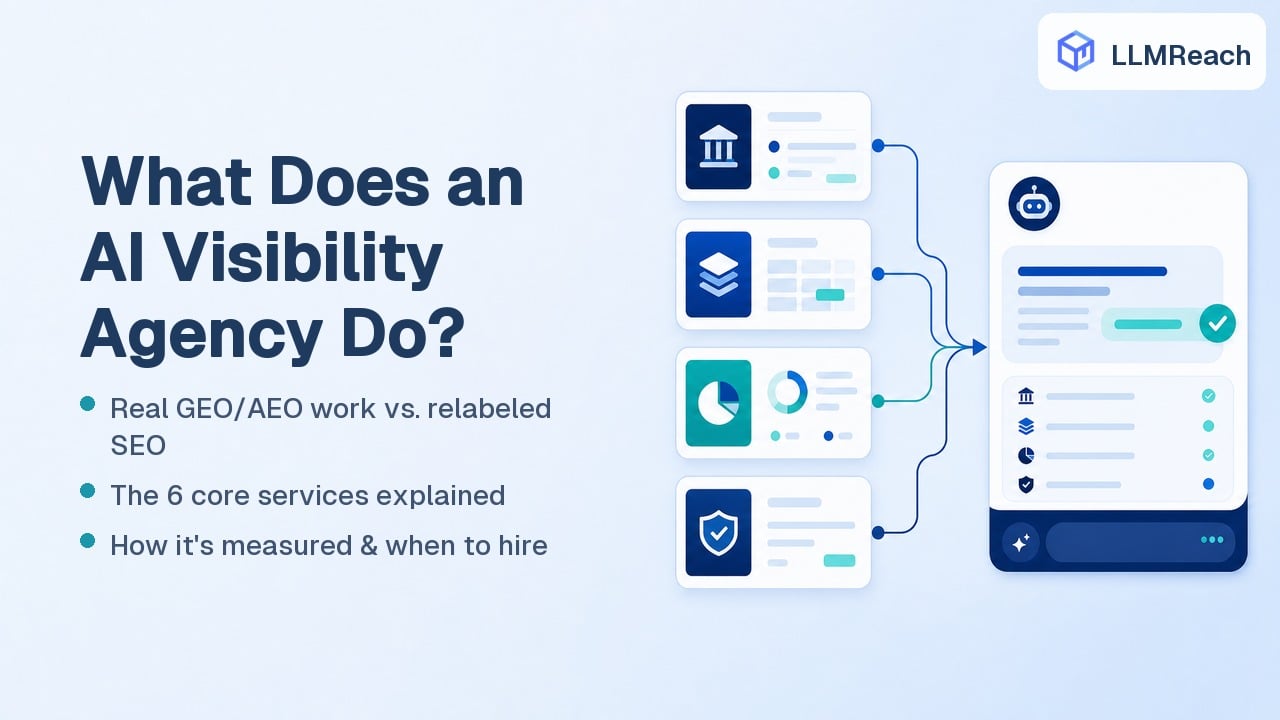
A credible AI visibility agency provides six interconnected service layers: prompt research and citation baselining, answer-first content engineering, technical AEO infrastructure, off-site authority building, cross-platform citation tracking, and ongoing strategy. Each layer is necessary because AI systems draw on content quality, technical signals, and third-party trust simultaneously.
Here is what each layer involves:
Prompt research and citation baselining. The agency maps the prompts your buyers are actually asking AI systems, then measures which brands, sources, and URLs are currently being cited in the answers. This baseline is the starting point for all subsequent work and the benchmark against which results are measured.
Answer-first content engineering. Content is restructured or created to lead with direct, extractable answers. This means shorter paragraphs, self-contained sections, factual density, and the inclusion of statistics and attributed quotes. Princeton's KDD 2024 research found that adding statistics to content improves AI citation rates by 32%, and quotes improve them by 41%. Content that reads like a press release or SEO article will not perform here.
Technical AEO infrastructure. Schema markup, entity clarity, crawlable site architecture, and structured data formatting all help AI systems interpret and trust a site. This layer is often missing entirely from agencies that are genuinely running SEO under a GEO label.
Third-party authority building. YouTube, Reddit, and LinkedIn are among the top three sources most cited by AI engines. A real agency builds brand presence on those platforms, not just on the client's own domain. This is off-site work, and it is structurally different from traditional link building.
Cross-platform citation tracking. Results are tracked across ChatGPT, Perplexity, Claude, and Gemini using defined prompt sets and share-of-voice metrics. This is what separates a real reporting layer from a vague "AI optimization" retainer.
Strategy and iteration. The agency synthesizes findings across layers, identifies what is moving, and adjusts the content, technical, and authority work accordingly. Without this, the other five layers are disconnected tactics.
How Is an AI Visibility Agency Different From an SEO Agency?
An AI visibility agency and a traditional SEO agency start from different questions. SEO asks: how do we rank higher in Google and drive more clicks? AI visibility asks: how do we appear in AI-generated answers and get cited across ChatGPT, Perplexity, Claude, and Gemini? The research model, deliverables, measurement layer, and tools are all different as a result.
The table below shows the practical differences:
AI Visibility Agency | Traditional SEO Agency | |
|---|---|---|
What they optimize | Citation presence and mention share across AI answer engines | Rankings and click-through rates in Google and Bing |
Research model | Prompt mapping, model behavior analysis, citation source audits | Keyword research, SERP analysis, competitor ranking gaps |
Core deliverables | Answer-first content, schema and entity work, platform authority building, citation tracking reports | On-page optimization, link building, technical crawl fixes, content calendars |
Measurement | Brand citations per prompt cluster, share of voice across AI platforms, citation source mix | Keyword rankings, organic traffic, domain authority, backlink count |
Primary tools | AI engine query simulators, citation trackers, entity mapping tools, structured data validators | Rank trackers, crawl tools, keyword platforms, backlink databases |
Off-site focus | YouTube, Reddit, LinkedIn, and high-authority platforms cited by AI engines | Backlinks from news sites, directories, and niche publishers |
The most important distinction is measurement. An SEO agency can show you a ranking report. An AI visibility agency should show you a citation report: which prompts trigger your brand, on which platforms, at what frequency, compared to your competitors.
The best agencies can do both, and there is real overlap in technical work and content quality. But buyers should apply one clear test: if an agency cannot show you your AI citation baseline before you sign, and cannot commit to tracking it across multiple platforms afterward, the offer is SEO with new vocabulary.
How Does an AI Visibility Agency Measure Results?
A credible AI visibility agency measures results by tracking citation presence across defined prompt sets on multiple AI platforms, before and after engagement. The baseline comes first: which prompts matter, which brands are currently cited, and what the client's starting share of voice is. Every subsequent report is measured against that baseline.
The Metrics That Matter
A real reporting layer should include all of the following:
Brand citation rate: How often does the brand appear in AI-generated answers for target prompts, expressed as a percentage across a defined prompt set?
Share of voice by prompt cluster: Which competitors are being cited more frequently, and for which query types?
Citation source mix: Which URLs, platforms, and third-party sources are being pulled into AI answers? Is the brand represented in those sources?
Answer inclusion rate: Is the brand mentioned directly in the generated answer, or only as a cited link?
Platform coverage: Are results tracked across ChatGPT, Perplexity, Claude, and Gemini separately? Each platform has different retrieval behavior.
Movement over time: Is citation presence improving, and at what rate?
Connecting Visibility to Business Outcomes
Visibility metrics matter more when they connect to business signals. According to Seer Interactive's 2024 research, traffic referred from ChatGPT converts at 15.9%, compared to 1.76% for traditional organic search. That conversion gap is why AI citation presence translates into pipeline quality, not just brand awareness.
A strong agency will help clients connect citation improvements to downstream signals: qualified traffic from AI referrals, assisted conversions, branded search lift, or changes in pipeline quality. Not every engagement will reach that level of attribution in the first quarter, but the agency should have a clear path toward it.
If an agency cannot show you a pre-engagement baseline and post-engagement movement on defined prompts, the reporting is decorative, not diagnostic.
What Does It Cost to Work With an AI Visibility Agency?
AI visibility agency pricing depends on scope, baseline visibility, platform coverage, technical complexity, and reporting depth. There is no single market rate because the work varies significantly: an audit-only engagement looks nothing like a full retainer covering content, technical infrastructure, authority building, and monthly citation tracking.
What Drives Cost
The factors that most affect pricing are:
Scope of service layers: Audit only, strategy only, or a full system covering content, technical, authority, and reporting all carry different cost structures.
Baseline visibility: Brands with zero citation presence require more foundational work than brands already appearing in some AI answers.
Platform coverage: Tracking and optimizing across ChatGPT, Perplexity, Claude, and Gemini simultaneously is more resource-intensive than single-platform work.
Technical complexity: Sites with poor crawlability, entity confusion, or schema gaps require more infrastructure work before content improvements can take effect.
Content volume: The number of pages needing answer-first restructuring or new content creation directly affects cost.
Reporting depth: Prompt set size, frequency of citation tracking, and the granularity of competitive share-of-voice analysis all affect what a reporting layer costs to maintain.
The Right Buying Question
The most useful question is not "what is the cheapest retainer?" It is "does this agency provide a measurable system with defined inputs, tracked outputs, and a clear feedback loop?" A low-cost engagement with no baseline and no citation tracking is not a bargain. For a full breakdown of what AI visibility work costs in 2026, the dedicated pricing guide covers scope-by-scope benchmarks in detail.
Can I Improve AI Visibility In-House Instead of Hiring an Agency?
Yes. Brands can improve AI visibility in-house if they have strong content operations, technical resources, subject matter expertise, and someone who can own prompt-based measurement. An agency is not necessary for every brand, and saying otherwise would be dishonest. The real question is whether your team has the capacity and capability to run all six service layers simultaneously and iterate on them consistently.
When In-House Works Well
Your content team already publishes at a strong clip and can restructure existing pages for answer-first formatting without significant additional headcount.
Your site is technically sound, with clean crawlability, structured data already in place, and clear entity signals.
Your category is lightly contested in AI answers, meaning even modest improvements move the needle.
You need a pilot to learn the space before committing to an agency retainer.
You already have a narrow, well-defined prompt set and can measure citation movement without a dedicated tracking infrastructure.
When In-House Falls Short
Your team lacks the time or expertise to run prompt research, answer-first content, technical AEO, authority building, and cross-platform tracking at the same time.
Your category is highly competitive in AI answers and competitors are already running coordinated visibility programs.
You need faster learning cycles than internal bandwidth allows.
Leadership needs documented baselines and cross-platform reporting for budget justification, and the team cannot produce that independently.
The honest answer: if your team can dedicate one experienced person to this work full-time, starting in-house is reasonable. If that person does not exist or is already at capacity, an agency will compress timelines significantly. The Nexum Automations case study shows how LLMReach turns AI search uncertainty into a measurable visibility system.
When Should a Brand Hire an AI Visibility Agency?
Hire an AI visibility agency when AI-driven discovery is already influencing your buyers' decisions and your brand is absent from the answers they are receiving. If your category is actively contested in ChatGPT, Perplexity, or Gemini and you are not appearing, the cost of inaction compounds every month a competitor does.
Hire Now If:
Your buyers are using AI tools to research vendors, compare options, or shortlist providers in your category.
Your brand is absent from AI answers despite being a credible option in your market.
Your internal team lacks either the technical layer, the measurement layer, or the capacity to run content and authority work simultaneously.
You need cross-platform baselines and documented citation movement to justify continued investment to leadership.
You have tried one-off content improvements but have not seen citation movement, suggesting a systemic gap rather than a content gap.
Do Not Hire Yet If:
Your brand lacks a clear category definition, a differentiated offer, or a content owner. Agency work will not fix foundational positioning problems.
You have not yet defined which prompts matter to your business. An agency needs a starting brief, not a blank slate.
Your site has severe technical issues that need to be resolved before content or authority work can take effect.
You are not yet ready to invest in a measurement layer. If you will not track citation movement, you cannot evaluate whether the work is working.
For a deeper look at how the top AI visibility agencies compare across these criteria, that comparison covers the specific questions worth asking at the evaluation stage.
How Do I Choose the Right AI Visibility Agency?
The right AI visibility agency can show you your current citation baseline before you sign, tracks results across multiple AI platforms, and distinguishes its work clearly from standard SEO. Use the checklist below when evaluating any provider.
Seven Questions to Ask Before You Sign
Can you show me my current citation baseline? A credible agency runs a baseline audit before engagement, not after. If they cannot show you where you stand today across ChatGPT, Perplexity, Claude, and Gemini, they cannot credibly claim to improve it.
Which platforms do you track, and how? Single-platform tracking is insufficient. Each AI engine has different retrieval behavior, and citation presence on one does not guarantee presence on others.
What are the exact deliverables? Ask for a breakdown across strategy, content engineering, technical infrastructure, authority building, and reporting. Vague deliverables ("AI optimization" or "GEO content") are a warning sign.
Can you show platform-specific case studies? Evidence should include before-and-after citation data, not just traffic numbers or rankings.
How do you distinguish your work from standard SEO? If the answer focuses on blog posts and backlinks without mentioning prompt research, citation tracking, or technical AEO, the offer is relabeled SEO.
What does your reporting cover? The report should show brand citation rate, share of voice by prompt cluster, citation source mix, and movement over time. Anything less is incomplete.
When would you tell a client not to hire you? Agencies that have honest disqualification criteria, such as "we do not take clients who have not yet defined their category" - are more trustworthy than those who will take any budget.
For a structured walkthrough of how to vet a GEO agency before you sign, that guide covers the full evaluation process with additional red flags and contract considerations.
The Core Services a Real AI Visibility Agency Delivers
The services below are ordered by their practical impact on citation results. Real AI visibility work is a system, not a single tactic. Each layer depends on the one before it.
AI visibility audit and citation baseline - Maps target prompts, measures current citation share across platforms, and identifies competitor presence. Without this, there is no starting point and no way to prove improvement. Outcome: a defensible baseline and a prioritized gap list.
Answer-first content engineering - Restructures existing pages and creates new content designed for extractability: direct answers, factual density, statistics, and attributed quotes. Outcome: higher citation inclusion rates and improved answer engine presence.
Technical AEO infrastructure - Implements schema markup, entity clarity, crawlable architecture, and structured data so AI systems can interpret and trust the site. Outcome: improved AI retrievability and reduced citation friction. See LLMReach's technical AEO infrastructure service for what this involves in practice.
Third-party authority building - Builds brand presence on YouTube, Reddit, LinkedIn, and other platforms AI engines cite heavily. Outcome: off-site citation signals that reinforce on-site authority.
Cross-platform citation tracking - Tracks brand mention share, citation source mix, and prompt-level visibility across ChatGPT, Perplexity, Claude, and Gemini. Outcome: a reporting layer that proves ROI and guides iteration. LLMReach's AI mention tracking and reporting covers this layer in detail.
Strategy and iteration - Synthesizes all layer outputs, identifies what is moving, and adjusts the program accordingly. Outcome: a compounding system rather than a one-time optimization. This is covered under LLMReach's AI visibility strategy service.
Frequently Asked Questions
How long does it take to see results from an AI visibility agency? Citation presence can begin moving within the first 30 to 60 days for brands with a solid content foundation and clear category. Timelines depend on baseline visibility, competitive density, and how quickly technical and content changes can be implemented.
Does AI visibility work replace SEO? No. AI visibility work and SEO address different discovery channels and should run in parallel. Google rankings still drive significant traffic, and the technical work involved in AEO often improves SEO performance as well. The goal is presence across both traditional search and AI-generated answers.
Which AI platforms does an agency typically cover? A credible agency covers at minimum ChatGPT, Perplexity, Claude, and Gemini. Each platform has distinct retrieval behavior, so single-platform optimization is not sufficient for brands with broad buyer audiences.
What deliverables should I expect in the first 90 days? A citation baseline report, a prompt map covering target queries and competitor share, an answer-first content audit with prioritized recommendations, initial technical AEO fixes, and a first citation tracking report showing movement against the baseline.
Is AI visibility only relevant for large brands? No. Smaller brands in lightly contested categories can see faster citation gains precisely because the competitive field is less crowded. The investment threshold matters more than brand size.
What is the single most important question to ask an AI visibility agency before signing? Ask them to show you your current citation baseline. If they cannot produce one before the engagement starts, they have no credible way to demonstrate that their work changed anything.
See What an Agency Would Fix First
The fastest way to evaluate whether an AI visibility agency is worth hiring is to see what they find before you commit to anything.
LLMReach's free audit shows you your current citation baseline across ChatGPT, Perplexity, Claude, and Gemini, which prompts your competitors are winning, and the highest-priority gaps to close. It is with no sales call required to receive it.
See what an agency would fix first - no commitment.
If you would rather talk through your situation first, book a call and we will tell you honestly whether this is the right moment to engage.
During a guided review meeting, LLMReach walks you through your priority buyer prompts, current AI visibility, competitor citations, source patterns, and the technical or content gaps that matter most. You leave the call knowing where the gap is, what is causing it, and which changes would matter first.