How to Get Cited by Claude: The 2026 Playbook
By Karim MezitiJune 23, 2026Updated June 2026
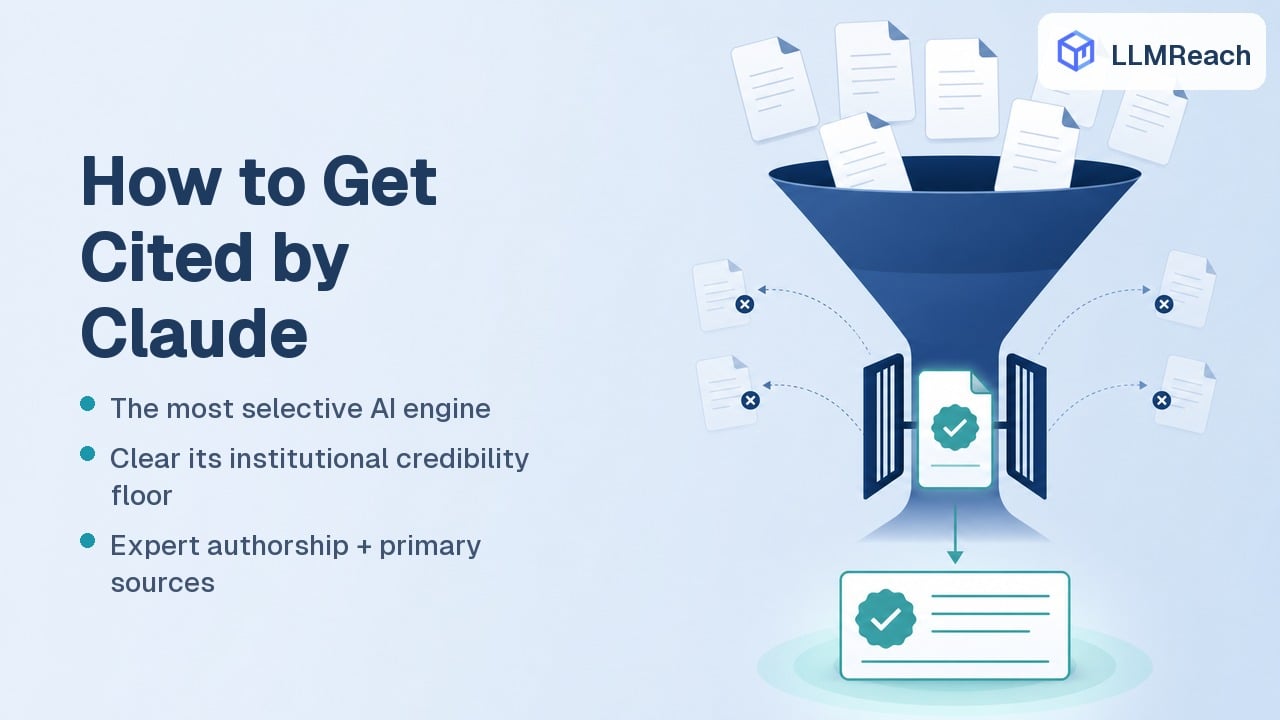
Claude is the hardest citation to earn in AI search. It cites fewer sources per response than any other major engine, skips citation entirely on roughly 25% of queries, and applies a credibility filter that eliminates most content before it ever appears in an answer. For brands selling to enterprise buyers, that selectivity is precisely the point: a Claude citation carries institutional weight that a ChatGPT or Perplexity mention does not.
The signal that matters: Only ~12% of URLs cited by AI engines rank in Google's top 10, which means traditional SEO authority alone does not explain who Claude cites. Something else is doing the filtering.
This playbook covers that filter in full. It explains how Claude selects sources, what content profile it rewards, how its retrieval mechanics differ from other engines, and how to build the author and entity credibility it requires. Three levers drive Claude citation performance:
Retrieval: Can ClaudeBot actually fetch your page?
Verification: Does your content look institutionally credible and easy to attribute?
Entity trust: Does Claude's model recognize your brand and author as reliable sources?
Each section opens with a direct answer you can act on immediately.
How Do You Get Cited by Claude?
Earning a Claude citation requires five things working simultaneously: answer-first page structure, named expert authorship, primary-source citations within the content, server-side rendered pages that ClaudeBot can fetch, and off-site credibility signals that corroborate your brand's authority. Claude rewards verifiable content over broad topical coverage.
Research from Princeton's KDD 2024 study (Aggarwal et al., 2024) quantified exactly how much each signal moves citation rates:
Named expert quotes: +40.9% citation lift
Statistics with named sources: +30.6% citation lift
Inline citations within the content: +27.5% citation lift
Those are not marginal improvements. They represent the difference between content Claude extracts and content it ignores. The five core requirements, in priority order:
Answer-first structure: Lead every page and every major section with a 40-60 word direct answer. SparkToro-cited analyses confirm that 44.2% of all LLM citations originate from the first 30% of content.
Named expert authorship: A real byline with verifiable credentials and a consistent author profile across the web.
Primary-source citations: Link to the original study, report, or institution, not to a summary post.
SSR accessibility: Your pages must render fully server-side. Claude's live fetch crawler cannot execute JavaScript-heavy single-page applications.
Off-site credibility: Earned media placements, expert mentions, and authoritative third-party profiles that corroborate what your site claims.
This article is itself structured to meet all five criteria. That is intentional: what GEO and AEO actually are begins with building content that models the behavior you want engines to reward.
How Does Claude Decide What to Cite?
Claude combines training-data knowledge with selective live retrieval, then applies a narrow trust filter before including any source in a response. The practical test is not relevance alone: Claude asks whether a claim is easy to verify, attribute, and extract cleanly. Content that fails that test gets used silently or not at all.
Key definition: Claude's citation decision is a three-stage filter, not a single ranking signal. Content must pass all three stages to appear as a named source.
Claude's Three-Stage Citation Filter
Stage 1: Retrieval eligibility Can ClaudeBot fetch the page? If your site blocks the crawler via robots.txt, renders content only via client-side JavaScript, or returns a non-200 status, the page does not enter the pipeline. Anthropic's ClaudeBot checks robots.txt before every fetch and does not maintain a persistent index.
Stage 2: Credibility assessment Does the content meet Claude's institutional trust threshold? This is where most content fails. Claude's training reflects a strong preference for expert-authored, primary-source-backed material. A page that looks like a summary, aggregation, or opinion piece without credentials is filtered here.
Stage 3: Extraction quality Can Claude isolate a clean, attributable answer from the page? Content with clear definitions, structured bullet points, and explicit sourcing is up to 30% more likely to be selected at this stage. Walls of unbroken prose, vague claims, and promotional language all reduce extraction quality.
Understanding this filter explains why content that performs well in Google or Perplexity still fails Claude: those engines apply a less stringent credibility gate at Stage 2. For a deeper look at how all major engines weight these signals differently, see how AI engines decide what to cite.
Why Is Claude the Most Selective of the Major AI Engines?
Claude is the most selective major AI engine because it applies a higher institutional credibility floor than its peers, and it frequently chooses not to cite at all rather than cite a source it cannot verify. When Claude averages 5.5 sources per response on queries where it does cite, and skips citation entirely on approximately 25% of queries, the implication is clear: appearing in Claude's response as a named source is a meaningful signal, not a default behavior.
What Makes Claude's Floor Higher
The upside of Claude's selectivity for enterprise brands:
A Claude citation is a stronger trust signal than a mention in engines with lower citation thresholds
Claude's preference for institutional sources aligns with the research and evaluation behavior of enterprise buyers
Appearing in Claude on regulated or high-stakes queries (finance, legal, cybersecurity, compliance) carries credibility that lighter engines cannot replicate
The challenge Claude's selectivity creates:
Content that earns citations in ChatGPT or Perplexity may still be invisible in Claude
Generic GEO tactics, such as adding FAQ schema or improving page speed alone, are insufficient without the underlying credibility signals
The citation floor means brands need to invest in author authority and off-site proof, not just on-page optimization
The strategic implication: Claude's selectivity is not a bug to work around. It is the mechanism that makes Claude citations valuable. Brands that clear the credibility floor do not just appear in Claude; they appear in the same citation tier as institutional publishers, compliance-grade references, and named expert sources. For enterprise-facing brands, that positioning is the goal.
What Sources Does Claude Trust, and Which Does It Avoid?
In B2B contexts, Claude consistently favors brand sites with named expert authors, institutional publishers, compliance-grade references, and research-backed expert content. It avoids user-generated content, social platforms, and aggregation layers in top citation slots. A Conductor seven-month analysis (May 2026) tracked 16 rank-one citation slots across repeated Claude queries and found zero appearances from YouTube, Wikipedia, or Reddit. That pattern is directional, not anecdotal.
Claude's Source Trust Hierarchy
Source type | Claude's behavior | Why it matters |
|---|---|---|
Expert-authored brand content | Consistently cited in B2B contexts | Combines institutional affiliation with direct attribution |
Institutional publishers (journals, industry bodies) | High citation rate | Meets credibility and primary-source criteria simultaneously |
Compliance/regulatory references | Cited in high-stakes verticals | Low ambiguity, high verifiability |
Wikipedia | Rarely cited in top slots (0 of 16 tracked rank-one slots) | Collaborative authorship undermines attribution clarity |
Reddit / forum UGC | 0.6% of Claude's deep-tier citations overall (Lee, 2026) | Fails credibility assessment at Stage 2 |
YouTube | Not observed in rank-one Claude citations (Conductor, 2026) | Non-text format; no extractable structured answer |
The UGC Caveat: When the Pattern Shifts
One important nuance: Yext's 2026 analysis of 17.2 million citations found that Claude cites UGC at 2-4x the rate of some other engines in specific verticals, and nearly 10x more than Gemini for certain query types. This is a real finding, but it applies primarily to local, consumer, and review-driven categories, not to the B2B and enterprise queries this playbook targets.
The operational takeaway for B2B teams: Do not optimize for the UGC exception. Build toward the institutional pattern. If your content looks like a research-backed expert resource, you are targeting the source type Claude defaults to on the queries your buyers ask.
UGC representing only 0.6% of Claude's deep-tier citations (Lee, 2026) is the number that governs B2B citation strategy. The Yext finding is a caveat for specific verticals, not a reason to invest in forum presence.
What Content Profile Does Claude Reward?
Claude rewards content that reads the way a credible institutional source writes: named authorship, cited claims, explicit definitions, concise extractable paragraphs, and structured sections with bullets or tables. Promotional language, vague generalizations, and slow-building narrative structures all reduce citation probability. The content profile Claude favors is precise, sourced, and self-contained at the section level.
The Claude Content Rubric
Use this as a pre-publish checklist before targeting Claude citations:
Signal | What Claude rewards | What it penalizes |
|---|---|---|
Authorship | Named expert with verifiable credentials | Anonymous or generic "staff writer" bylines |
Claims | Attributed to named sources with links | Vague quantifiers ("many companies," "studies show") |
Structure | Clear H2/H3 hierarchy, bullets, tables | Unbroken prose walls, slow narrative builds |
Opening | Direct 40-60 word answer in the first paragraph | Preamble, context-setting before the answer |
Tone | Institutional, precise, non-promotional | Hype language, superlatives, sales copy |
Citations | Inline links to primary sources | No links, or links to secondary summaries |
Length per section | Concise, extractable chunks | Sections that require reading the full page for context |
Why Tone Matters as a Credibility Signal
Claude's training data skews heavily toward institutional and academic sources. That means the register of your writing functions as a credibility proxy. Content written in a precise, evidence-backed voice pattern-matches to the source types Claude already trusts. Content written in a conversational or promotional register pattern-matches to the source types Claude avoids.
The practical implication: Review your highest-priority pages against this rubric before anything else. In many cases, restructuring existing content to be answer-first, adding named authorship, and replacing vague claims with cited statistics will move Claude citation rates faster than publishing new pages.
Content structured with clear definitions and bullet points is up to 30% more likely to be selected by Claude at the extraction stage. That is not a reason to bullet-point everything; it is a reason to make every section scannable and self-contained.
Does Claude Use Live Web Retrieval or Rely on Training Data, and How Does That Change Strategy?
Claude can answer from training data or fetch live pages via ClaudeBot, its web crawler. The distinction matters strategically: training-data presence alone is not enough for brands that launched recently, updated their positioning, or want to be cited on current topics. Live fetch is the mechanism that makes fresh, well-structured pages competitive against older content that exists only in Claude's training memory.
How ClaudeBot Works
ClaudeBot performs live page fetches before responding to queries that benefit from current information. Key technical behaviors:
Checks
robots.txtbefore every fetch. If your crawler rules block ClaudeBot (or use a wildcard that catches it), your pages are invisible to live retrieval regardless of content quality.No persistent index. Unlike Google, ClaudeBot does not maintain a crawl database. Each fetch is a fresh request, which means your page's current state, not its historical state, is what Claude sees.
JavaScript-heavy SPAs without SSR are invisible. If your page content loads via client-side JavaScript and you have not implemented server-side rendering, ClaudeBot receives an empty shell. This is a common and silent failure mode.
Training Data vs. Live Fetch: Strategic Implications
Scenario | What this means for your strategy |
|---|---|
Brand is well-established, content is older | Training-data presence may help, but live fetch is still required for current queries |
Brand is new or recently repositioned | Live fetch is the primary path; training data has not caught up yet |
Topic is time-sensitive or regulatory | Live fetch pages with explicit dates and sourcing outperform static training assumptions |
Site uses a JavaScript framework without SSR | Live fetch fails silently; fix SSR before any other optimization |
The practical priority: Confirm that ClaudeBot is not blocked in your robots.txt, implement SSR if your site relies on client-side rendering, and ensure your highest-priority pages return a clean 200 response with fully rendered content. These are retrieval prerequisites, not advanced tactics. Without them, every other optimization in this playbook is moot.
How Do You Build the Author and Entity Credibility Claude Needs?
Claude's credibility assessment extends beyond the page itself to the author and organization behind it. Building the entity signals Claude needs means establishing verifiable expertise on-site and corroborating it off-site through earned media, expert mentions, and authoritative third-party profiles. According to the Muck Rack Generative Pulse report (December 2025), 85%+ of non-paid AI citations originate from earned media, which means off-site authority is not optional.
Author Credibility Framework
On-site signals:
Named byline with role title and area of expertise (e.g., "Karim Meziti, GEO Strategist")
Dedicated author bio page with credentials, publications, and professional history
Consistent author attribution across all content on the domain
Schema markup using
Persontype, linking the author to the organization
Off-site corroboration:
LinkedIn profile that matches the on-site bio in role, expertise, and employer
Guest contributions or expert quotes in institutional publications (industry journals, recognized trade media)
Earned media placements where the author or brand is cited as a source, not just mentioned
Consistent entity name and description across all third-party profiles (Google Business Profile, Crunchbase, industry directories)
Entity Trust: The Brand Layer
Author credibility operates alongside brand entity credibility. Claude's model builds a representation of your organization from everything it has encountered: your site, press coverage, third-party mentions, and structured data signals. Strengthening that representation requires:
Consistent entity name: Use the same brand name format everywhere. Variations create ambiguity in the model's entity graph.
Primary research and original data: Publishing proprietary research gives Claude a reason to cite your brand specifically, not just your topic category.
Institutional citations: When authoritative sources cite your brand or your research, that signal propagates into Claude's trust model.
For a full framework on the technical and off-page signals that move AI visibility, see how to actually move your AI visibility score.
How Do You Track Your Claude Citations?
Claude does not generate referral traffic data that appears in standard analytics platforms. There is no Google Search Console equivalent, no UTM source labeled "Claude," and no public API for citation monitoring. Tracking Claude visibility requires a manual prompt-testing cadence combined with mention monitoring and server-side crawl log analysis.
A Lightweight Claude Citation Monitoring Workflow
Step 1: Define your target query set Identify 10-20 queries your enterprise buyers are likely asking Claude. Include category queries ("best [your category] tools"), problem queries ("how to solve [specific pain point]"), and comparison queries ("[your brand] vs [competitor category]").
Step 2: Run prompt variants monthly Test each query in Claude using at least two phrasings. Log whether your brand or content appears, whether it is cited as a named source, and what position it holds in the response. Screenshot every citation for the record.
Step 3: Check crawl logs for ClaudeBot activity Server-side logs will show ClaudeBot fetch requests by user agent. Regular ClaudeBot visits to your high-priority pages are a positive signal that those pages are in Claude's live retrieval pipeline.
Step 4: Monitor brand mentions in institutional sources Set up alerts for your brand name and author names in press coverage and industry publications. Third-party mentions that Claude's training data or live fetch can access contribute to entity credibility over time.
Step 5: Benchmark quarterly Track citation rate (how often your brand appears per 10 queries tested), citation position (first named source vs. later mention), and query coverage (how many of your target queries return a citation). For the full KPI framework, see the KPIs and how to track Claude citations.
How Is Optimizing for Claude Different from ChatGPT, Perplexity, and Gemini?
Each major AI engine applies a different citation logic. Claude is the most institutionally selective. Understanding where Claude sits relative to other engines helps prioritize effort, especially for teams with limited resources who need to decide which engine to optimize for first.
Engine | Selectivity | Top citation signal | Source types favored | Live retrieval |
|---|---|---|---|---|
Claude | Highest; skips citation on ~25% of queries | Named expert authorship + primary-source citations | Institutional publishers, expert-authored brand content | Yes, via ClaudeBot; checks |
ChatGPT | Moderate; cites more frequently | Topical authority + broad content coverage | Broad range including news, brand sites, some UGC | Yes, via Bing integration (with web browsing on) |
Perplexity | Lower; cites most aggressively | Recency + relevance to query | News sources, brand sites, Reddit, Wikipedia | Yes; real-time web search is core to its model |
Gemini | Moderate-high; selective on UGC | Google authority signals + structured content | Authoritative web sources; avoids UGC more than ChatGPT | Yes, via Google Search integration |
The key contrast: ChatGPT drives 87.4% of all AI referral traffic (Demand Local, 2026), making it the highest-volume engine for traffic generation. Claude drives less referral traffic but carries more credibility weight with enterprise buyers who use it as a research and evaluation tool. A brand that appears in Claude on a high-stakes query is positioned differently than one that appears only in Perplexity.
For a complete cross-engine breakdown, see the complete cross-engine guide to earning AI citations.
The Highest-Impact Moves to Earn Claude Citations
These are the Claude-specific levers ranked by impact, based on the evidence and mechanisms covered in this playbook. Retrieval prerequisites come first because no content signal matters if Claude cannot fetch the page.
Fix retrieval blockers first. Confirm ClaudeBot is not blocked in
robots.txt. Implement SSR on JavaScript-heavy pages. Verify target pages return clean 200 responses. This is a prerequisite, not an optimization.Add named expert authorship to every priority page. The Princeton KDD 2024 study found named expert quotes produce a +40.9% citation lift. A real byline with verifiable credentials is the single highest-impact content signal.
Open every section with a direct 40-60 word answer. 44.2% of LLM citations come from the first 30% of content. Answer-first structure is not a formatting preference; it is where Claude extracts from.
Replace vague claims with cited statistics. Statistics with named sources produce a +30.6% citation lift (Aggarwal et al., 2024). Every major claim needs a source link to a primary reference.
Add inline citations throughout the content. Inline citations produce a +27.5% citation lift. Link to the original study, report, or institution, not to a summary post.
Build off-site earned media. 85%+ of non-paid AI citations originate from earned media (Muck Rack, December 2025). Press coverage, expert mentions, and institutional citations corroborate what your site claims.
Publish proprietary research or original data. Original data gives Claude a specific reason to cite your brand rather than a generic source in your category. It also creates the earned media opportunities that drive off-site credibility.
Structure content with clear definitions, H3 subheadings, and comparison tables. Structured content is up to 30% more likely to be selected at the extraction stage. Every H2 section should contain at least one non-prose element.
For a done-for-you AI visibility strategy that implements all eight levers across your highest-priority pages, LLMReach runs the full audit, content engineering, and entity-building process.
Frequently Asked Questions
Does Claude use Brave Search or another external search index?
Claude's live retrieval operates through ClaudeBot, Anthropic's own crawler, which fetches pages directly rather than querying an external search index like Brave. ClaudeBot checks robots.txt before every fetch and does not maintain a persistent crawl database. This differs from ChatGPT's web browsing mode, which uses Bing's index as its retrieval layer.
Can Reddit or Wikipedia ever appear in Claude citations?
In specific consumer and local verticals, yes. Yext's 2026 analysis of 17.2 million citations found Claude cites UGC at 2-4x the rate of some other engines in those contexts. However, in B2B and enterprise query categories, a Conductor seven-month analysis (May 2026) found zero appearances from Reddit, Wikipedia, or YouTube across 16 tracked rank-one citation slots. For B2B optimization purposes, treat those platforms as low-probability citation targets.
How long does it take to see Claude citation improvements?
There is no published timeline from Anthropic. Based on observed GEO results, on-page changes such as answer-first restructuring and named authorship can influence live fetch citations within days of implementation. Training-data-based entity recognition takes longer, typically several months of consistent entity signals and earned media accumulation. Retrieval fixes (SSR, robots.txt corrections) produce the fastest measurable change.
Does ranking in Google top 10 guarantee Claude citations?
No. Only approximately 12% of URLs cited by AI engines rank in Google's top 10. Claude's citation selection is driven by credibility and extraction quality signals that do not map directly to traditional SEO ranking factors. High-ranking pages without named authorship, inline citations, or answer-first structure can still fail Claude's credibility filter.
Can smaller brands earn Claude citations without large content budgets?
Yes, if the content they publish meets Claude's credibility criteria. A single well-structured, expert-authored page with primary-source citations and answer-first sections can outperform a large volume of generic content. Claude rewards verifiability, not volume. Smaller brands should prioritize depth and credibility on a focused set of pages rather than broad topical coverage.
Does Claude cite the same sources consistently across repeated queries?
Not necessarily. Because Claude uses live retrieval without a persistent index, citation patterns can shift as pages are updated, as new content enters the retrieval pool, or as query phrasing changes. Regular prompt testing across query variants is the only reliable way to monitor citation stability over time.
Is a high domain authority score enough to earn Claude citations?
Domain authority is a proxy for general web credibility, but it does not directly map to Claude's citation signals. Claude's filter operates at the page and author level, not just the domain level. A high-DA domain with anonymous authorship, vague claims, and no inline citations will still fail Claude's credibility assessment. Page-level signals, particularly named authorship and cited statistics, carry more weight than domain-level metrics alone.
See Whether Claude Is Citing You Today
Claude's citation floor is high, but it is clearable. The brands appearing in Claude on enterprise queries right now are not larger or better-funded than yours; they have answer-first pages, named expert authorship, and retrieval infrastructure that passes ClaudeBot's fetch. Those are engineering decisions, not luck.
See whether Claude is citing you today across ChatGPT, Perplexity, and Gemini as well with no sales call required. LLMReach's free AI visibility audit identifies exactly which queries your brand appears in, which competitors are taking the citations you should own, and the highest-priority fix for each engine.
Prefer to talk it through first? Book a call and we will walk through your current Claude visibility and what it would take to move it.
During a guided review meeting, LLMReach walks you through your priority buyer prompts, current AI visibility, competitor citations, source patterns, and the technical or content gaps that matter most. You leave the call knowing where the gap is, what is causing it, and which changes would matter first.