How to Get Cited by ChatGPT: The 2026 Playbook
By Karim MezitiJune 23, 2026Updated June 2026
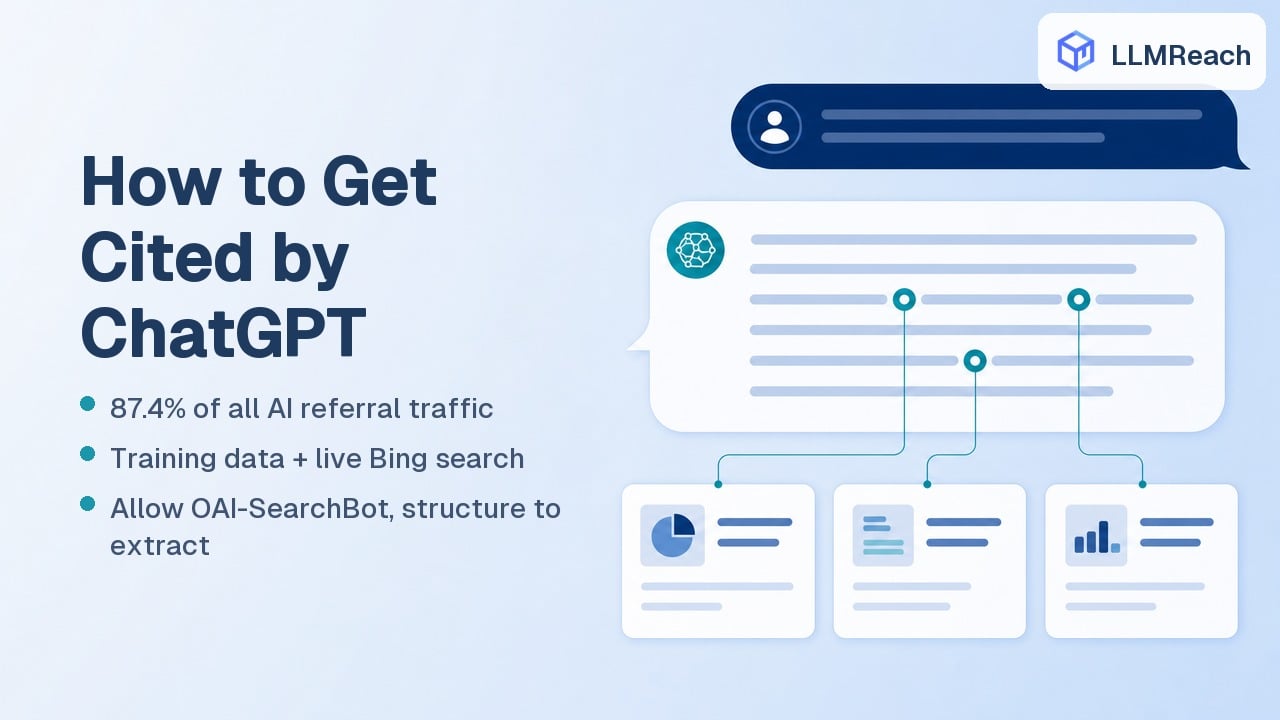
ChatGPT is not just the largest AI engine. According to Conductor's 2026 AEO/GEO Benchmarks Report, it accounts for 87.4% of all measured AI referral traffic across industries. For most B2B brands, that makes it the single most important citation channel to understand and optimize for, before any other engine.
But ChatGPT citations are not random. They come from a specific retrieval system that rewards accessible, attributable, consensus-backed content. Understanding that system is what separates brands that appear consistently in ChatGPT answers from those that never do.
This article is the engine-mechanics overview for ChatGPT: how it retrieves, what it selects, why authority signals matter, and how to track results. For granular execution, see the 7 proven tactics for earning ChatGPT citations. For the cross-engine picture, start with the complete cross-engine guide to earning AI citations.
The core insight: ChatGPT citations are earned through content that is structured for extraction, attributed to named authors, backed by third-party consensus, and technically accessible to OpenAI's crawlers. Each of those conditions is controllable. This playbook covers all of them.
How Do You Get Cited by ChatGPT?
To get cited by ChatGPT, your content needs to satisfy two conditions simultaneously: it must be technically accessible to OpenAI's crawlers, and it must match the content profile that ChatGPT's retrieval system rewards. That profile is built around structured formatting, named authorship, third-party corroboration, and answer-first organization. Meeting both conditions is the baseline.
ChatGPT operates through two distinct retrieval modes. When a user asks a question without enabling search, ChatGPT draws on patterns from its training data, which means your brand's presence in high-authority third-party sources (publications, analyst reports, industry directories) directly influences whether it surfaces your name. When a user enables search, or when ChatGPT triggers its browsing capability automatically, it queries Bing's live index and fetches pages in real time.
The practical implication is that citation eligibility is not a single lever. You need training-data presence (earned through third-party coverage and entity authority) and live-search accessibility (earned through technical crawler access and indexed content). Brands that focus only on one layer consistently underperform.
For a deeper look at the signals that drive citation decisions across all engines, see how AI engines decide what to cite.
How Does ChatGPT Decide What to Cite?
ChatGPT's citation selection is driven by two overlapping inputs: statistical familiarity from training data and real-time retrieval from its live search layer. A source that appears frequently and consistently across high-authority web content during training carries weight even in browsing mode, because the model's prior knowledge shapes how it evaluates live results. Familiarity and freshness work together, not in isolation.
The Training Data Layer
During training, ChatGPT processes enormous volumes of web content and develops statistical associations between entities, topics, and sources. Brands that appear repeatedly in credible third-party contexts, such as industry publications, analyst reports, review platforms, and editorial roundups, build what researchers call entity authority. The model learns to associate those brands with specific topic areas.
This is why Wikipedia accounts for 7.8% of total ChatGPT citations (Demand Local, 2026) and why Reddit surfaces in roughly 12% of responses. Both platforms carry dense, cross-referenced content that the model encountered at scale during training. Brands that have been covered in similar high-authority contexts inherit some of that citation weight.
Key insight: 65.3% of ChatGPT citations come from domains with a Domain Rating of 80 or above (Ahrefs analysis). High domain authority is not just an SEO metric. It is a proxy for the kind of third-party editorial presence that makes a source familiar to ChatGPT's training corpus.
The Live Search Layer
When ChatGPT's search mode is active, it queries Bing's index using OpenAI's crawlers and fetches pages in real time. The model then synthesizes retrieved content into its response, citing the sources it draws from. This is where technical accessibility becomes decisive: if OpenAI's crawlers cannot reach your pages, you cannot be cited in search mode regardless of how well your content is written.
Research from Profound tracking citation behavior in Q4 2025 found that ChatGPT typically draws on 4 to 6 unique sources per cited turn, with 66% of cited responses using between 1 and 4 unique sources. The model does not cite exhaustively. It selects the sources that are most extractable and most corroborated by other results in the same retrieval set.
Critically, only approximately 12% of URLs cited by AI engines rank in Google's top 10 (industry analysis, 2026). ChatGPT's retrieval logic and Google's ranking logic are not the same. A page can be highly citation-worthy for ChatGPT without ranking prominently in traditional search, and vice versa.
Training Data vs. Browse Mode: Why the Distinction Matters
The difference between ChatGPT's training-data mode and its browse/search mode is not just technical. It determines which optimization levers actually move your citation rate, and on what timeline.
Training Data Mode (No Search Active)
In this mode, ChatGPT generates responses entirely from patterns learned during training. It has no access to live web pages. Your citation eligibility here depends on whether your brand, your content, or your claims appeared in the training corpus in a form the model found credible.
This is a slow-moving channel. Training data has a cutoff, and updates happen on OpenAI's schedule. The practical implication: if your brand is new, niche, or has minimal third-party coverage, you will not appear in training-data responses regardless of how good your website content is. Building entity authority through earned media, analyst coverage, and directory presence is the only lever here.
Browse and Search Mode (Search Active)
When ChatGPT's search capability is active, it behaves more like a retrieval-augmented generation system. It queries Bing's index, fetches live pages via OAI-SearchBot, and synthesizes retrieved content into its response. This mode is increasingly the default for factual, commercial, and comparison queries, precisely the query types that B2B buyers use when evaluating vendors.
"OpenAI explicitly recommends allowing OAI-SearchBot in robots.txt if you want your site to appear in ChatGPT search results.", OpenAI's official crawler documentation
This is the faster-moving channel. A page published today can appear in ChatGPT search results within days if it is indexed by Bing and accessible to OAI-SearchBot. Content quality and structure matter here more than domain age.
Why Both Layers Matter Together
The brands that earn the most consistent ChatGPT citations operate on both layers simultaneously. They have enough third-party coverage to be familiar to the training data, and they publish structured, crawlable content that performs in live search. Focusing exclusively on one layer is the most common strategic error in ChatGPT optimization.
For the full picture on what GEO and AEO actually are and how they map to these two layers, the LLMReach explainer covers both in depth.
What Content Format Does ChatGPT Favor?
ChatGPT favors content that is easy to extract, easy to attribute, and easy to corroborate. In practice, that means structured listicle and comparison formats, named author bylines, clear H2/H3 hierarchy, and answer-first organization where the key claim appears in the first sentence rather than buried in paragraph three.
Structured Formats Dominate Citations
Listicle-format pages represent a disproportionate share of ChatGPT citations. Analysis from Masset across a large AI citation dataset found that listicles are either the top or co-top cited format across AI models, with commercial queries showing listicles at roughly 40% of citations. The structural reason is straightforward: ChatGPT's synthesis process extracts discrete, labeled items more reliably than it extracts flowing prose. A numbered list of vendor options is easier to incorporate into a response than an essay about the same vendors.
Comparison pages follow the same logic. When a user asks "best [tool] for [use case]," ChatGPT is most likely to cite a page that already structures the answer as a comparison, because that structure maps directly to the response format it needs to generate.
Named Authors Carry Measurable Weight
Attribution matters to ChatGPT's citation selection in ways that parallel how it matters to human editorial judgment. Research published by Aggarwal et al. at Princeton (KDD 2024, arXiv:2311.09735) found that adding named expert quotations to content produced a 40.9% lift in AI citation rates, and adding statistics with named sources produced a 30.6% lift. The common thread is attribution: content that names its sources and authors signals credibility in a form the model can evaluate.
Demand Local's analysis of citation patterns found that pages with named authors carry a citation odds ratio of 1.40, compared to 1.12 for content overall. Anonymous or corporate-byline content consistently underperforms attributed content at the same domain authority level.
Answer-First Structure
Research from SparkToro and subsequent LLM citation analysis found that 44.2% of all LLM citations reference content from the first 30% of a page. ChatGPT's retrieval process does not read an entire article the way a human editor would. It identifies extractable answers, and those answers are far more likely to be found near the top of the page.
The practical implication is direct: every page targeting ChatGPT citations should open with a concise, self-contained answer to the question it targets, within the first 50 to 100 words. Burying the answer in a long preamble is the single most common structural mistake in content written for AI citation.
Formatting checklist for ChatGPT-citeable content:
Open with a direct, self-contained answer in the first paragraph
Use H2 and H3 headings that match likely query phrasing
Structure comparisons and lists with named, labeled items
Include a named author byline with a brief credential
Cite named sources for statistics rather than attributing to "studies show"
Avoid keyword stuffing: the Princeton KDD study found it produced an 8.3% negative citation effect
How Much Do Third-Party Authority and Consensus Matter?
Third-party authority and cross-source consensus are among the strongest citation signals ChatGPT responds to, and they are the hardest to manufacture quickly. The model is not just evaluating your content in isolation. It is evaluating your content in the context of what other sources say about the same topic, and whether those sources agree with you.
The Consensus Signal
ChatGPT's retrieval process is designed to surface information that multiple credible sources corroborate. A claim that appears on your site alone carries less citation weight than a claim that appears on your site, in an industry publication, and in a third-party review platform. The model interprets cross-source agreement as a reliability signal, which is why brands with strong earned media coverage consistently outperform brands relying solely on owned content.
This is the mechanism behind the Muck Rack Generative Pulse finding (December 2025) that 85% or more of non-paid AI citations originate from earned media. Owned content can make you discoverable. Earned media makes you credible enough to cite.
Domain Authority as a Proxy for Consensus
The Ahrefs finding that 65.3% of ChatGPT citations come from domains with a Domain Rating of 80 or above reflects the same underlying dynamic. High-DR domains have earned their authority through years of inbound links from other credible sources. That link graph is, in effect, a large-scale consensus signal: many authoritative sources have vouched for this domain's content. ChatGPT's training data absorbed that signal.
What this means for B2B brands:
Signal Type | What It Looks Like | Citation Impact |
|---|---|---|
Earned media coverage | Mentions in industry publications, analyst reports | High (consensus signal) |
Third-party reviews | G2, Capterra, Trustpilot listings | High (entity authority) |
Named expert quotes | Attributed statements in your content | +40.9% citation lift (Princeton KDD 2024) |
Named statistics | Data points with source attribution | +30.6% citation lift (Princeton KDD 2024) |
Inline citations | Links to named sources within content | +27.5% citation lift (Princeton KDD 2024) |
Keyword stuffing | Repeated target phrases without substance | -8.3% citation effect (Princeton KDD 2024) |
The implication for B2B SaaS brands is particularly direct. Research cited by Conductor's 2026 benchmarks report indicates that for B2B SaaS queries specifically, ChatGPT cites brand websites 11.1 percentage points more frequently than Google does. B2B buyers are already using ChatGPT as a research and shortlisting tool, and ChatGPT is more willing than Google to send them directly to brand pages, provided those pages carry sufficient authority signals.
Can ChatGPT Actually Access Your Site?
Yes, but only if you have configured your robots.txt to allow the right crawlers. OpenAI operates three distinct bots with different roles, and blocking the wrong one is a common technical mistake that silently removes you from ChatGPT's search results entirely.
OpenAI's Three Crawlers
Crawler | User-Agent | Role | What Blocking It Does |
|---|---|---|---|
GPTBot |
| Training data collection | Removes your content from future model training |
OAI-SearchBot |
| Powers ChatGPT search results | Removes you from ChatGPT search-mode citations |
ChatGPT-User |
| Real-time fetching when a user shares a URL | Prevents live page fetching within a chat session |
Per OpenAI's official crawler documentation, disallowing GPTBot tells OpenAI not to use your content for model training. Many brands made this choice for IP protection reasons after GPTBot launched in 2023. That is a defensible decision, but it has no effect on ChatGPT search-mode citations. The crawler that controls search visibility is OAI-SearchBot, and it must be allowed separately.
The most common misconfiguration: a brand blocks GPTBot in robots.txt, assumes they have opted out of ChatGPT entirely, and never realizes that OAI-SearchBot is a separate bot that still needs explicit permission. The result is that they are invisible in ChatGPT's live search results while believing they have made an intentional choice.
If you want to appear in ChatGPT search citations, your robots.txt must allow OAI-SearchBot. If you also want your content considered for training data, allow GPTBot. These are independent decisions.
For a full technical walkthrough of crawler configuration, indexing checks, and common accessibility failures, see the diagnostic guide on why your brand isn't showing up in ChatGPT.
How Do You Track ChatGPT Citations and Referral Traffic?
Tracking ChatGPT citations requires two separate measurement approaches: referral traffic analysis in your analytics platform, and direct citation monitoring through prompt-based testing. Neither alone gives you the complete picture.
Referral Traffic from ChatGPT
When a user clicks a link within a ChatGPT response, the traffic typically arrives in your analytics platform tagged with a referral source of chatgpt.com or chat.openai.com. This is the most straightforward signal to track, and it is significant: Conductor's 2026 benchmarks report attributes 87.4% of all measured AI referral traffic to ChatGPT, making it the dominant source in most analytics dashboards.
The conversion case for prioritizing this channel: Analysis by Seer Interactive found that AI-referred visitors convert at materially higher rates than traditional organic search visitors, in some datasets reaching 15.9% versus 1.76% for organic. The mechanism is intent: a user who asked ChatGPT a specific question and clicked a cited source is far further along in their research process than a user who found the same page via a keyword search.
Citation Monitoring Beyond Traffic
Referral traffic only captures clicks. ChatGPT frequently cites sources in responses that users read without clicking through. To measure your true citation share, you need to run structured prompt tests: submit the queries your buyers are most likely to ask, record which sources ChatGPT cites, and track changes over time.
This is the foundation of AI Share of Voice measurement. The KPIs worth tracking include:
Citation frequency: How often does your brand appear in responses to target queries?
Citation position: Are you cited first, or buried in a list of five?
Query coverage: Across how many distinct buyer queries does your brand appear?
Competitor citation share: Which competitors appear in responses where you do not?
For the full KPI framework and tracking methodology, see the KPIs and how to track ChatGPT citations at LLMReach's AI mention tracking service.
Key takeaway: Referral traffic from
chatgpt.comis the floor of your measurement, not the ceiling. Most ChatGPT citations never generate a click. Prompt-based citation monitoring is the only way to see your full AI Share of Voice.
How Is Optimizing for ChatGPT Different from Perplexity, Gemini, and Claude?
Each major AI engine has a distinct retrieval architecture, and the optimization levers that move ChatGPT citations are not identical to those that move Perplexity, Gemini, or Claude. Understanding the differences prevents wasted effort and helps you prioritize correctly.
Engine | Primary Retrieval Method | Top Citation Signal | Referral Traffic Share (2026) | Avg. Unique Sources Per Cited Response |
|---|---|---|---|---|
ChatGPT | Training data + Bing index (OAI-SearchBot) | Entity authority + structured content | 87.4% (Conductor, 2026) | 4-6 (Profound, Q4 2025) |
Perplexity | Real-time web search (every query) | Freshness + Bing/Google index presence | ~7-8% | 13.8% per-query citation rate (highest of any engine) |
Gemini | Google index + Google Knowledge Graph | Google E-E-A-T signals + structured data | ~11-13% (Demand Local, Q1-Q2 2026) | Varies by query type |
Claude | Training data (limited live search) | Training corpus coverage + document quality | ~2-3% | Lower citation frequency overall |
What Makes ChatGPT Distinct
ChatGPT's retrieval combines training familiarity with Bing-indexed live search, which means it responds to both long-term authority building and short-term content publishing. Perplexity, by contrast, is almost entirely real-time: it searches the web on every query, which makes freshness and Bing/Google indexing the dominant levers. A brand with no training-data presence can still earn Perplexity citations through fast indexing and structured content, but that same brand will struggle with ChatGPT's training-data mode.
Gemini is deeply integrated with Google's ecosystem. Its citation behavior tracks Google's E-E-A-T signals closely, which means Google Search performance and structured data markup are more predictive of Gemini citations than they are of ChatGPT citations. Teams already investing heavily in Google SEO will find Gemini optimization more familiar.
Claude cites less frequently than the other three engines and relies more heavily on training data with limited live search capability in most configurations. It is the lowest-referral-traffic engine of the four, which is why most teams treat it as a secondary priority after establishing ChatGPT and Perplexity presence.
The Prioritization Logic
For most B2B brands, the right sequencing is:
ChatGPT first, 87.4% of AI referral traffic, highest commercial query volume, most direct path to buyer intent
Perplexity second, highest per-query citation rate (13.8%), strong for research-phase buyers, real-time retrieval responds quickly to new content
Gemini third, growing share (13.2% in April 2026 per Demand Local), leverages existing Google SEO investment
Claude fourth, lowest referral traffic share, optimize after the others are addressed
This is not a reason to ignore the other three engines. It is a reason to start with ChatGPT and build a foundation that transfers across platforms. The structural content signals that ChatGPT rewards, answer-first organization, named attribution, and clear hierarchy, improve citation performance on every engine.
The Highest-Impact Moves to Earn ChatGPT Citations
These are the ChatGPT-specific levers ranked by their effect on citation rate, based on the evidence base assembled above. This is the strategic layer. For step-by-step execution on each, see the 7 proven tactics for earning ChatGPT citations.
1. Allow OAI-SearchBot in robots.txt The highest-impact single action for brands not currently appearing in ChatGPT search-mode responses. If OAI-SearchBot is blocked, no amount of content quality will earn you a search-mode citation. Check your robots.txt first. Fix this before anything else.
2. Build earned media coverage in high-DR publications 65.3% of ChatGPT citations come from DR80+ domains (Ahrefs analysis). If your brand is not being mentioned in industry publications, analyst reports, or editorial roundups, you are competing for the remaining 34.7% of citations. Earned media is not a PR vanity metric. It is a direct citation signal.
3. Publish structured, answer-first content in listicle and comparison formats Listicle and comparison pages earn a disproportionate share of citations, particularly for commercial queries. Structure your content so ChatGPT can extract a discrete, labeled answer without reading the entire page. The first 30% of your content is where 44.2% of citations are anchored (SparkToro analysis).
4. Add named author bylines with credentials Pages with named authors carry a citation odds ratio of 1.40 versus 1.12 for unattributed content (Demand Local). Add a named author with a one-line credential to every page targeting ChatGPT citations. This is a low-effort change with measurable impact.
5. Include named expert quotes and attributed statistics The Princeton KDD 2024 study (Aggarwal et al.) found that named expert quotations produce a 40.9% lift in AI citation rates, and statistics with named sources produce a 30.6% lift. Every factual claim in your content should name its source. Every expert opinion should be quoted with attribution.
6. Build entity presence across third-party platforms Wikipedia, Reddit, G2, Capterra, LinkedIn, and industry directories all contribute to ChatGPT's entity graph for your brand. Wikipedia alone accounts for 7.8% of ChatGPT citations. Reddit accounts for roughly 12%. Being present and accurate on these platforms strengthens the consensus signal that makes your brand citation-worthy.
7. Use inline citations and source links within your content The Princeton KDD study found that inline citations within content produce a 27.5% lift in AI citation rates. Citing your sources is not just a credibility signal for human readers. It signals to ChatGPT that your content is grounded in verifiable claims, which is exactly the kind of content it prefers to cite.
8. Ensure Bing indexing for your key pages ChatGPT's live search queries Bing's index, not Google's. A page that ranks well in Google but is not indexed in Bing will not appear in ChatGPT search-mode citations. Verify Bing Webmaster Tools indexing for every page you want to be citation-eligible.
For the technical infrastructure layer, including schema markup, llms.txt configuration, and entity graph optimization, see LLMReach's done-for-you AI visibility strategy.
Frequently Asked Questions
Does blocking GPTBot stop me from appearing in ChatGPT?
No. Blocking GPTBot only prevents OpenAI from using your content in model training. It has no effect on ChatGPT's search-mode citations, which are controlled by OAI-SearchBot. If you want to appear in ChatGPT search results, you must allow OAI-SearchBot in your robots.txt, regardless of your GPTBot setting.
How long does it take to earn ChatGPT citations after optimizing content?
For live search-mode citations, the timeline can be days to weeks once content is published, indexed in Bing, and OAI-SearchBot is permitted. For training-data citations (responses generated without live search), the timeline depends on OpenAI's training schedule, which is not publicly disclosed. Earned media coverage and entity authority building are longer-term investments that compound over months.
Does ranking on Google help with ChatGPT citations?
Partially. Google ranking correlates with domain authority, which does influence ChatGPT's training-data familiarity. However, ChatGPT's live search queries Bing's index, not Google's. Only approximately 12% of URLs cited by AI engines rank in Google's top 10, which means ChatGPT and Google are optimizing for different signals. Bing indexing is more directly relevant to ChatGPT search-mode citations than Google ranking.
What types of queries trigger ChatGPT's live search mode?
ChatGPT activates live search for queries that require current information, such as recent events, pricing, product comparisons, and vendor evaluations. It is also more likely to search for factual claims where training data may be outdated. Commercial and comparison queries, the kind B2B buyers use when evaluating vendors, frequently trigger search mode.
Can a small or new brand earn ChatGPT citations?
Yes, but the path is different from an established brand. New brands with limited training-data presence should prioritize live search optimization: Bing indexing, OAI-SearchBot access, structured content, and answer-first formatting. Earning placements in high-DR third-party sources, even a few strong mentions in industry publications, accelerates the entity authority that makes training-data citations possible over time.
Is there a way to see which queries ChatGPT is citing my brand for?
Not through a native ChatGPT dashboard. Citation monitoring requires structured prompt testing: running your target queries through ChatGPT, recording which sources it cites, and tracking changes over time. LLMReach's AI mention tracking service automates this across ChatGPT, Claude, Perplexity, and Gemini on a weekly basis.
How is ChatGPT's citation behavior expected to change in 2026?
Citation volumes have shown variability, with SEOClarity tracking sharp drops in citation activity at certain points in 2024 and 2025. The general direction is toward more selective citation as models improve at synthesizing answers without external references. This makes content quality and structural clarity more important over time, not less: the citations that do appear will go to the most extractable, most attributable sources.
See Whether ChatGPT Is Citing You Today
ChatGPT's citation system is not opaque. It has identifiable mechanics, measurable signals, and controllable inputs. The brands earning consistent citations in 2026 are not getting lucky. They have structured content that extracts cleanly, earned media that builds consensus, technical configurations that let the right crawlers in, and measurement systems that track which queries they own and which ones competitors are taking.
The next step is knowing where you stand. See whether ChatGPT is citing you today and across Perplexity, Claude, and Gemini no sales call required.
Prefer to talk it through first? Book a call and we will walk through your current AI Share of Voice and the highest-leverage fix for your specific situation.
For the broader strategic context behind this tactical playbook, including how ChatGPT works as an answer surface and what moves citations there, see ChatGPT SEO.
After the tactics
You can apply every tactic here and still not know where you stand.
This page covers what makes a page extractable and what tends to get used when ChatGPT answers a question. Applied carefully, it improves the odds for any page you publish.
Odds are not a position. The thing that decides where to start is which questions your buyers ask, which of them already return a competitor, and which pages the model reaches for when they do. LLMReach checks that across ChatGPT, Claude, Perplexity and Gemini before a live review call.
Your audit is reviewed live on the call. It is not emailed as a PDF.
During a guided review meeting, LLMReach walks you through your priority buyer prompts, current AI visibility, competitor citations, source patterns, and the technical or content gaps that matter most. You leave the call knowing where the gap is, what is causing it, and which changes would matter first.